




The NID DAT exam pattern 2027 for B.Des and M.Des includes two stages: Prelims and Mains. The exam is conducted offline, in pen-and-paper mode, for 3 hours.
The NID DAT Prelims is a shortlisting exam. The NID final merit list is prepared based on the Mains exam scores.
- As per the NID DAT exam pattern 2027, 70% objective and 30% subjective questions are asked in English only.
- The NID DAT total marks are 100 for each of the Prelims and Mains. There is no negative marking for the exam.
- The NID DAT B.Des exam questions 1 - 15 carry 1 mark, and 16 - 20 carry 2 marks each. The Mains Studio Test and Interview marks are not specified yet.
- The B.Des exam weightage of the Studio Sensitivity Test is 60%, and the In-Person Sensitivity Test is 40%.
- According to the NID DAT exam pattern 2027, the M.Des weightage of the Studio Test is 40%, and the Interview is 60%.
- The NID DAT M.Des exam question types are: Visual MCQs, Logical Questions, Colour Questions, Current Affairs, Reading Comprehension, etc.
- The NID DAT B.Des exam question types are: MCQ-type questions, Visual Reasoning, General Awareness, Creative Illustration, etc.
- The M.Des high-weightage topics include Design Principles & Elements, Design Awareness, Form & Function, Design Theory, Visual Reasoning, and Spatial Visualisation.
- The B.Des high-weightage topics are Creative Problem Solving, Model Making, Material Manipulation, and Sketching & Drawing.
Related Links:
- NID DAT Eligibility Criteria 2027: Check Minimum Age & Qualification Requirement, Seat Matrix
- NID DAT Reservation 2027: Check Seat Intake, Reservation Policy Details, List of Required Documents

Key Summary
- The M.Des students need to submit a SoP (statement of purpose) with a 500-word limit.
- B.Des applicants are required to upload a theme poster as a PDF file on the relevant topics.
- The NID DAT B.Des stage 1 includes Prelims, and stage 2 includes Mains (Studio Sensitivity Test + In-Person Sensitivity Test).
- The NID DAT M.Des stage 1 includes DAT Prelims and stage 2 includes Mains (Faculty-specific Studio Test + Discipline-wise Interview).
- Based on the NID DAT Mains exam score, the final merit list is prepared. The weightage of the Prelims score in the final merit list is 0%.
- To prepare well for NID DAT 2027, focus 80% on CAT (Creative Ability Test) preparation and 20% on GAT (General Ability Test).
NID DAT Exam Pattern 2027: Overview
The NID DAT exam pattern 2027 states that the NID DAT exam is conducted for admission into B.Des and M.Des programs. The admission includes two stages: DAT Prelims and DAT Mains for both programs.
| Particular | Details |
|---|---|
| Exam Name | NID Design Aptitude Test (DAT) |
| Conducting Authority | National Institute of Design (NID) |
| Programs | B.Des (Undergraduate) and M.Des (Postgraduate) |
| Exam Stages | DAT Prelims + DAT Mains |
| Exam Mode | Offline (pen-and-paper) |
| Exam Duration | B.Des Prelims & Mains: 3 hoursM.Des Prelims: 2.5 to 4.5 hours; Mains: 3 hours |
| Exam Language | English |
| Stages | B.Des: DAT Prelims + DAT Mains (Studio Sensitivity Test + In-Person Sensitivity Test)M.Des: DAT Prelims + DAT Mains (Faculty-stream-specific Studio Test + Interview) |
| Mains Exam Weightage | B.Des: Studio Sensitivity Test (60%), In-Person Sensitivity Test (40%)M.Des: Faculty-stream-specific Studio Test (40%), Interview (60%) |
| Maximum Marks | B.Des: Prelims and Mains (100 marks each)M.Des: Prelims and Mains (100 marks each) |
| Negative Marking | No |
Related Links:
- NID DAT Practice Papers: Download Year-Wise Question Papers, Sample Paper PDFs
- NID Aptitude Sample Papers
Ques. Is NID an easy exam to crack?
Ans. No, the National Institute of Design (NID) entrance examination is not an easy nut to crack. The competition level of the examination is high. Students are advised to prepare well for the exam, as the difficulty level of the NID DAT exam generally ranges from moderate to high levels.
NID DAT 2027 Exam Pattern: B.Des & M.Des Pattern
The NID DAT B.Des exam pattern 2027 states that the exam will consist of 26 questions in total for 100 marks. Further, the NID DAT M.Des exam pattern 2027 states that the exam includes 12 to 26 questions for 100 marks.
NID DAT 2027 B.Des Exam Pattern Details
Check the NID DAT 2027 exam pattern details for the B.Des program below.
- Shortlisted B.Des students must submit a PDF of a theme poster on the given topic.
- The size of the PDF should be a maximum of 10 MB.
- The theme poster must be made manually on A3 paper and submitted as a scanned copy.
| Particulars | Details |
|---|---|
| Exam Mode | Offline mode/pen-and-paper-based test |
| No. of sections | 2 (Sections A and B) |
| No. of Questions | Section A: 1 to 22 (MCQ) |
| Section B: 23 to 26 (Subjective) | |
| Section-Wise Weightage (for final merit list) | DAT Prelims: 0%DAT Mains: Studio Sensitivity Test (60%), In-Person Sensitivity Test (40%) |
| Total Marks | 100 |
| Negative Marking | No |
| Duration | 3 hours |
| Question Type | Multiple |
NID DAT 2027 M.Des Exam Pattern Details
The NID DAT M.Des exam paper 2027 will consist of both MCQ and subjective questions. The exam will take place for 2.5 hours.
- The B.Des shortlisted students will have to submit a 500-word SoP (statement of purpose).
- The PDF file size of the SoP must not be more than 2 MB.
- A portfolio is also required to be submitted, which must not exceed 10 MB.
| Particulars | Details |
|---|---|
| Exam Mode | Offline mode/pen-and-paper-based test |
| No. of sections | 2 (Sections A and B) |
| No. of Questions | Section A: 59 (MCQ) |
| Section B: 3 (Subjective) | |
| Section-Wise Weightage (for final merit list) | DAT Prelims: 0%DAT Mains: Faculty-stream-specific Studio Test (40%), Interview (60%) |
| Total Marks | 100 |
| Negative Marking | No |
| Question Type | Multiple |
Related Links:
- NID DAT Aptitude Sample Papers 2027: Check PDF Download Link, Practice Questions
- NID DAT Drawing Sample Papers 2027: Practice Year-Wise Questions, Download PDF
Ques. Can I qualify for the NID DAT exam in 3 months?
Ans. Yes, with complete dedication and a prepared schedule, you can qualify for the NID DAT examination in 3 months of preparation. You must be sure to start learning the basic concepts of the topics and focus more on high-weightage topics. Practice previous years' papers, appear for mock tests, and keep analyzing your preparation level for the examination.
What is the NID DAT Marking Scheme 2027?
There are no specific marks allotted for each question in the NID DAT exam 2027. Rather, the marks vary based on the questions and types.
NID DAT B.Des Exam Marking Scheme 2027
The NID DAT B.Des 2027 exam includes objective and subjective type questions. The question and marks distribution for the Prelims is shared below.
For the B.Des Mains exam, the marking is question-specific.
| Type of Questions | Total Questions | Marks for Each |
|---|---|---|
| Objective Type Questions | Ques 1 - 14 | 1 mark each |
| Ques 15 - 22 | 2 marks each | |
| Subjective Type Questions | Ques 23 | 15 marks |
| Ques 24 | 20 marks | |
| Ques 25 | 15 marks | |
| Ques 26 | 20 marks | |
| Total Marks | 100 marks | |
NID DAT M.Des Exam Marking Scheme 2027
The NID DAT M.Des Prelims is a qualifying exam. Further, the M.Des Mains exam marks are question-specific. The official authority has not specified any marks range for questions yet.
However, check out the weightage of M.Des Mains sections provided below.
| Sections | Weightage |
|---|---|
| Studio Test | 40% |
| Interview | 60% |
Related Links:
Ques. Is there a maximum number of attempts for the NID DAT exam?
Ans. No, there is no maximum or minimum number of attempts fixed for the NID DAT examination. Students can appear for the NID DAT examination as many times as they want, as long as they meet the eligibility criteria.
NID DAT Exam Question Types for B.Des and M.Des
The NID DAT 2027 exam B.Des and M.Des exam includes Prelims and Mains papers. Both programs include numerous question types, such as MCQs, Visual MCQs, Pattern Recognition, etc.
| NID DAT B.Des Question Types | NID DAT M.Des Question Types |
|---|---|
| Design-based MCQ | Visual MCQs |
| Visual Reasoning | Logical Questions |
| Spatial Reasoning | Spatial Questions |
| Logo Identification | Design Theory Questions |
| General Awareness | Colour Questions |
| Colour-based Questions | Design History Questions |
| Creative Illustration | Material Questions |
| Perspective Drawing | Current Affairs |
| Poster Design | Case/Scenario Questions |
| User Analysis | Reading Comprehension |
| Object Drawing | Visual Interpretation |
| Story/Concept Development | Creative Response |
| Reading Comprehension | - |
Ques. What are the qualifying marks for the NID DAT exam?
Ans. There is no fixed percentage of qualifying marks for the NID DAT 2027 exam decided yet. However, based on previous years' trends, generally the Prelims qualifying percentage for the general category ranges around 50%; for the OBC-NCL category, it is expected to be 40%, and for the SC/ST/PwD category, it is expected to be around 30%.
A Reddit user asked about the NID DAT examination.
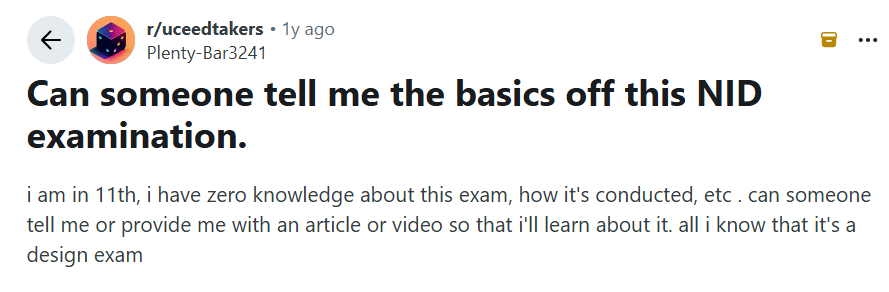
Replying to that, another Reddit user shared the whole description of the NID DAT exam.

Source: Reddit
NID DAT Exam Syllabus Topics 2027
The NID DAT exam 2027 syllabus topics are covered for the B.Des and M.Des Prelims and Mains examinations.
The program-based syllabus topics and expected weightage for both the Mains and Prelims papers are provided here.
NID DAT B.Des Prelims Syllabus 2027
The NID DAT exam 2027 Prelims high-weightage topics for B.Des include Design Principles & Elements, Design Awareness & Functional Design, Visual Reasoning, Spatial Reasoning & 3D Visualisation, and General Knowledge, with 5 - 7% weightage each.
| Topic/Chapter | Expected Weightage |
|---|---|
| Design Principles & Elements | 5 - 7% |
| Design Awareness & Functional Design | 5 - 7% |
| Visual Reasoning | 5 - 7% |
| Spatial Reasoning & 3D Visualisation | 5 - 7% |
| Pattern Recognition | 4 - 6% |
| Cubes, Nets & 3D Figures | 4 - 6% |
| Mirror/Water Images & Symmetry | 3 - 5% |
| Logical Reasoning | 4 - 6% |
| Analytical Ability | 4 - 6% |
| General Knowledge | 5 - 7% |
| Current Affairs | 3 - 5% |
| Environment & Sustainability | 3 - 5% |
| Indian Art, Culture & Heritage | 3 - 5% |
| Logos, Symbols & Brand Awareness | 3 - 5% |
| Colour Theory | 3 - 5% |
| Form, Shape, Pattern & Texture | 3 - 5% |
| Perspective Drawing | 4 - 6% |
| Proportion & Scale | 3 - 5% |
| Observation & Memory Drawing | 3 - 5% |
| Creative Problem Solving | 5 - 8% |
| User-Centric Design | 5 - 8% |
| Visual Storytelling/Poster Design | 4 - 6% |
| Reading Comprehension & Interpretation | 3 - 5% |
| Lateral Thinking | 4 - 6% |
NID DAT B.Des Mains Syllabus 2027
The NID DAT 2027 B.Des Mains syllabus topics are Creative Problem Solving with 15 - 20% weightage, In-Person Interaction, Model Making, Sketching & Drawing, and Material Manipulation with 10 - 15% weightage each.
| Topics | Expected Weightage |
|---|---|
| Creative Problem Solving | 15 - 20% |
| Model Making | 10 - 15% |
| Material Manipulation | 10 - 15% |
| Sketching & Drawing | 10 - 15% |
| Visual Storytelling | 8 - 12% |
| Observation Skills | 8 - 12% |
| Design Thinking | 10 - 15% |
| Communication & Presentation | 8 - 12% |
| In-Person Interaction | 10 - 15% |
NID DAT M.Des Prelims Syllabus 2027
The NID DAT 2027 exam M.Des Prelims high-weightage topics are Design Principles & Elements, Design Awareness, and Visual Reasoning, with 5 - 7% weightage.
| Topic | Expected Weightage |
|---|---|
| Design Principles & Elements | 5 - 7% |
| Design Theory | 4 - 6% |
| Design History & Movements | 4 - 6% |
| Form & Function | 4 - 6% |
| Design Awareness | 5 - 7% |
| Visual Reasoning | 5 - 7% |
| Spatial Visualisation | 4 - 6% |
| Symmetry & Pattern Recognition | 4 - 6% |
| Logical Reasoning | 4 - 6% |
| Analytical Ability | 4 - 6% |
| Colour Theory | 4 - 6% |
| Composition & Visual Balance | 3 - 5% |
| Light, Shade & Shadow | 3 - 5% |
| Perspective & Proportion | 3 - 5% |
| Materials & Manufacturing Awareness | 3 - 5% |
| Art, Architecture & Culture | 4 - 6% |
| General Knowledge | 4 - 6% |
| Current Affairs | 3 - 5% |
| Environment & Sustainability | 3 - 5% |
| Design Ethics | 3 - 5% |
| User-Centred Design | 4 - 6% |
| Creative Thinking | 4 - 6% |
| Lateral Thinking | 3 - 5% |
| Reading Comprehension | 3 - 5% |
NID DAT M.Des Mains Syllabus 2027
The NID DAT M.Des Mains highest-weightage topics are Model Making with 220 - 25% weightage, Material Manipulation and Creative Thinking with 15 - 20% weightage each.
| Topic | Expected Weightage |
|---|---|
| Model Making | 20 - 25% |
| Material Manipulation | 15 - 20% |
| Creative Thinking | 15 - 20% |
| Idea Development | 10 - 15% |
| Doodling & Visualisation | 8 - 12% |
| Audio-Visual Exercises | 8 - 12% |
| Design Sensitivity & Observation | 5 - 10% |
| Presentation & Visual Communication | 5 - 10% |
NID DAT Exam Pattern 2027 FAQs
Ques. Which topic contains the highest weightage in the NID DAT exam?
Ans. The high-weightage topics of the NID DAT examination 2027 are drawing and sketching, creativity, design aptitude, visualization, spatial reasoning, and observation. Further, students must also focus on visual storytelling, composition, logical reasoning, and design awareness.
Ques. Are NID DAT prelims scores counted for final merit list preparation?
Ans. As per the latest B.Des pattern, the prelims marks of the NID DAT exam are not carried for the calculation of the final merit list. The NID DAT prelims exam scores are required to ensure the student is qualified for the NID DAT Mains examination.
Ques. What is the weightage of the NID DAT B.Des Mains papers?
Ans. Based on the latest B.Des pattern, the B.Des Mains exam consists of two tests, namely, the Studio Sensitivity Test and an In-Person Sensitivity Test. The weightage of the Studio Sensitivity Test is 60%, and the weightage of the In-Person Sensitivity Test is 40%.
Ques. Is there negative marking for the NID DAT exam 2027?
Ans. No, there is no negative marking for the NID DAT examination 2027. Students are free to answer some questions that they are not aware of or are confused about between two options based on their guess. No marks will be deducted for those responses.
Ques. Can I crack NID without coaching?
Ans. Yes, a student can qualify the NID DAT exam with good scores without any coaching. If the students will have correct approach towards preparation and follow the most referred materials, they will be able to learn the concepts and topics in detail. Further, it is advised that students must practice previous years' papers and appear for mock tests.



Comments