



Education Content Expert
Permutations and Combinations are methods used to express a group of elements by arranging them in a set and forming subsets. Permutations and Combinations Formulas are used to arrange certain groups of data in a specific order.
- Permutation is a method of arranging all the elements of a set into a sequence or order.
- Combination is a method of selecting elements from a collection, such that the order of selection does not matter.
- Permutations can be considered as ‘Arrangements’ and combinations can be referred to as ‘Selections’.
Permutation Formula is used to arrange r things from a set of n things without replacement. Permutation Formula is given as:
| \({^nP_r} = \frac{n!}{(n-r)!} \) |
Combination Formula is used to choose r things from a set of n things without replacement. Combination Formula is given as:
| \({^nC_r} = \frac{n!}{r!(n-r)!} \) |
Key Terms: Permutations and Combinations Formula, Permutations, Combinations, Permutation Formula, Combination Formula
What is Permutation?
[Click Here for Sample Questions]
Permutation is defined as the way of arranging all the elements of a set into a finite order or sequence.
- In simpler words, Permutation is the sorting of elements of a set in ascending order or descending order.
- If the set of elements is already in sorted order, then rearranging elements of the set is known as Permuting.
- It is used to determine all possible arrangement sequences of a single data point.
- The sequence or order of arrangement matters in Permutation.
- Permutations are used in almost every field and sector of Mathematics.
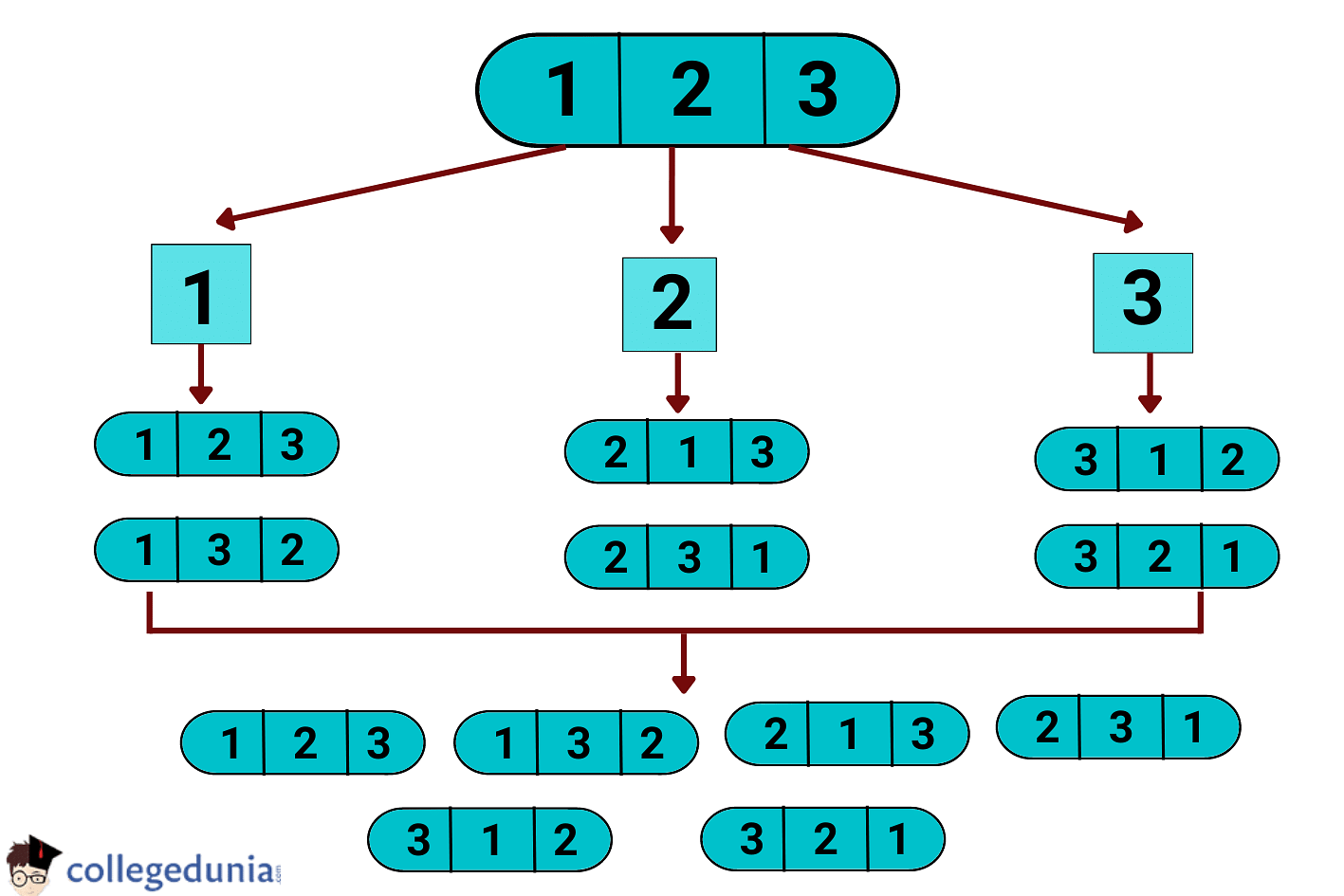
Permutations
Permutation Examples
Some examples of Permutation are as follows:
- Arranging people, digits, numbers, alphabets, letters, etc.
- Picking a team captain, pitcher, and goalkeeper from a group.
- Picking first, second, and third place winners.
Permutations and Combinations Detailed Video Explanation
Read More: NCERT Solutions for Class 11 Mathematics Permutations and Combinations
What is Combination?
[Click Here for Previous Years’ Questions]
Combination is defined as a way of selecting elements from a set, in which the order of selection doesn’t matter.
- It is the combination of n things taken k at a time without any repetition.
- The order or sequence of arrangement doesn’t matter in Combinations.
- In smaller cases, it is possible to count the number of combinations manually, however, it needs a formula for tedious calculations.
- Combination is also used in every field of mathematics just like Permutation.

Combinations
Combination Examples
Some examples of Combination are as follows:
- Picking up team members from a group
- Picking three winners.
- Picking three colors from a color brochure.
Read More:
Permutation and Combination Formulas
[Click Here for Sample Questions]
Permutation and Combination Formulas are the two key formulas used in basic methods of counting in Mathematics. They are used to find out the permutations and combinations of r items taken from n items.
- Permutation is a method used to find the different arrangements of elements of a set.
- Combination is used to find the different groups from a larger set.
- Permutation is always greater than the combination for any given values of n and r.
Permutation Formula
Permutation Formula is used is used to arrange elements of a set in sequence or order. When repetition is not allowed, Permutation Formula is given as follows:
| \({^nP_r} = \frac{n!}{(n-r)!} \) |
Where
- n refers to the Total number of objects in a given set.
- r refers to the Number of objects to be chosen from a given set.
Permutation with repetition of items can also be easily calculated using the exponent form. Thus, to find the number of permutations of n different things, taken r at a time, where repetition is allowed, the Permutation Formula is
| P (n, r) = nr |
Thus, Permutation Formula is used to arrange elements of a set with or without repetition.
Solved ExampleExample: What will be the number of 3-letter words that can be formed from the letters a, b, c, d, and e in which the letters are not allowed to be repeated? Solution: It is given that,
Using the Permutation Formula, \({^nP_r} = \frac{n!}{(n-r)!} \) Substituting the values, we get 5P3 = (5!) / (5 - 3)! = 5! / 2! = 120/2 = 60 So, there are 60 different permutations to form a 3-letter word from the letters a, b, c, d, and e in which the letters are not allowed to be repeated. |
Combination Formula
Combination is a method of choosing a subset from a larger set of things where the order or sequence doesn't matter. Combination Formula is given as follows:
| \({^nC_r} = \frac{{^nP_r}}{r!} = \frac{n!}{r!(n-r)!} \) |
Where
- n refers to the Total number of objects in a given set.
- r refers to the Number of objects to be chosen from the given set.
Solved ExampleExample: Find the number of ways can a committee be formed of 5 men and 3 women picked from a group of 9 men and 12 women. Solution: According to the question, the committee is to be made of a combination of 5 men and 3 women. Using the Combination Formula, \({^nC_r} = \frac{n!}{r!(n-r)!} \) Here, assume n being the total number of men to choose from and r be the number of men to be chosen. 9C5 = \( = \frac{9!}{5!(4)!} = 126\) Thus, 5 men can be chosen out of 9 men in 126 ways. Similarly, in nCr, with n being the total number of women and p being the number of women to be chosen. 12C3 = \( = \frac{12!}{3!(9)!} = 220\) Thus, 3 women can be chosen out of 12 women in 220 ways. Hence, the committee can be chosen in 126 × 220 = 27720 ways. |
Derivation of Permutation and Combination Formulas
[Click Here for Previous Years’ Questions]
Permutation and Combination Formulas are used to express a group of objects by arranging them in a certain order or forming their subsets.
- Permutation Formula is given as \({^nP_r} = \frac{n!}{(n-r)!} \).
- Combination Formula is given as \({^nC_r} = \frac{n!}{r!(n-r)!} \).
Given below is the detailed derivation of Permutation and Combination Formulas.
Derivation of Permutation Formula
Consider that there are r cartons and each of them can hold only one thing. Thus, there will be as many permutations as there are ways of filling in r vacant cartons by n objects.
- Number of Ways First Box can be Filled: n
- Number of Ways Second Box can be Filled: (n – 1)
- Number of Ways Third Box can be Filled: (n – 2)
- Number of Ways Fourth Box can be Filled: (n – 3)
- Number of Ways rth Box can be Filled: (n – (r – 1))
Thus, the number of ways of filling in r boxes in succession is given by:
n (n – 1) (n – 2) (n-3) . . . (n – (r – 1))
It can also be written as:
n (n – 1) (n – 2) … (n – r + 1)
The number of permutations of n different objects taken r at a time, where the objects do not repeat is:
n (n – 1) (n – 2) (n – 3) . . . (n – r + 1)
nPr = n ( n – 1) ( n – 2)( n – 3). . .( n – r + 1) …….. (1)
On multiplying and dividing (1) by (n-r) (n-r-1) (n-r-2)........... 3.2.1, we get
\(P (n, r) =\frac{n.(n-1).(n-2).…. (n-r+1)[(n-r) (n-r-1) (n-r-2)... 3. 2. 1]}{[(n-r) (n-r-1) (n-r-2)....3. 2. 1]}\)
\(p (n, r)= \frac{n!}{(n-r)!}\)
Hence Derived.
Read More: Important Questions For Class 11 Maths Permutations and Combinations
Derivation of Combination Formula
Combination is defined as the number of combinations of n distinct things taking r at a time where the order doesn't matter. Now,
- Number of Ways to Select First Object from n Distinct Objects: n Ways
- Number of Ways to Select Second Object from (n-1) Distinct Objects: (n-1) Ways
- Number of Ways to Select Third Object from (n-2) Distinct Objects:(n-2) Ways
- Number of Ways to Select Fourth Object from (n-3) Distinct Objects: (n-3) Ways
- Number of Ways to Select rth Object from (n-(r-1)) Distinct Objects: (n-(r-1)) Ways
An ordered subset of r elements is made by completing the selection of r things of the original set of n things. Thus, the number of ways to make a selection of r elements of the original set of n elements will be
n (n – 1) (n – 2) (n-3) . . . (n – (r – 1)) or n (n – 1) (n – 2) … (n – r + 1)
Now, consider the ordered subset of r elements and all its permutations. The total number of all permutations of the given subset will be equal to r! as r objects in every combination can be rearranged in r! ways. Thus,
C(n,r) = P (n, r)/ r!
\(C(n,r) =\dfrac{\frac{n!}{(n-r)!}}{r!}\)
Therefore, the Combination Formula is derived as:
\(C(n, r) = \dfrac{n!}{r!.(n - r)!}\)
Check More:
Things to Remember
- Permutations and Combinations are the counting methods used to determine the number of possible outcomes.
- Permutation is a way of arranging all the elements of a set into a finite sequence or order.
- Permutation Formula is expressed as \({^nP_r} = \frac{n!}{(n-r)!} \).
- Combination is a way of forming subsets by selecting data from a larger set.
- Combination Formula is expressed as \({^nC_r} = \frac{n!}{r!(n-r)!} \).
- The order or sequence of elements doesn’t matter in Combination, unlike Permutation.
For Latest Updates on Upcoming Board Exams, Click Here: https://t.me/class_10_12_board_updates
Previous Years’ Questions
- If all the words (with or without meaning) have five letters, formed using the letters…? [JEE 2016]
- How many four-digit numbers abcd exist such that a is odd, b is divisible by 3, c is even…? [KEAM]
- If the four-letter words (need not be meaningful ) are to be formed using the letters from the word…? [JEE 2016]
- If nCr−1 = 28, nCr = 56, and nCr+1 = 70, then the value of r is equal to…? [KEAM]
- Let A and B be two sets containing four and two elements respectively. Then the number of subsets…? [JEE 2015]
- Consider a class of 5 girls and 7 boys. The number of different teams consisting of 2 girls and…? [JEE 2019]
- All possible numbers are formed using the digit 1,1,2,2,2,2,3,4,4 taken all at a time…? [JEE 2019]
- An eight-digit number divisible by 9 is to be formed using digits from 0 to 9 without repeating…? [JEE 2014]
- How many 5-digit telephone numbers can be constructed using the digits 0 to 9, if each number…? [KCET 2014]
- If a, b and c are the greatest values of 19Cp, 20Cq, and 21Cr respectively, then…? [JEE 2020]
Sample Questions
Ques. (a) Find the number of words that can be formed using the letters of the word “TRIANGLES”.
(b) Determine how many of these words start with “T” and end with “S”. (3 Marks)
Ans. (a) There are 9 letters in the given word which are not repeated in the whole string. Thus, the number of permutations of the letters of the word is 9P9 is,
Using the Permutations Formula,
\({^nP_r} = \frac{n!}{(n-r)!} \)
9P9 = (9!) / (9 - 9)! = (9!) / (0!) { 0! factorial is 1}
9P9 = 9!
So, there are 9! ways in which letters of the word “TRIANGLES” can be formed.
(b) If we put “T” at the start and “S” at the end of the world, then we have to put 7 different letters in 7 places. This can be done in 7P7.
Using the Permutations Formula,
\({^nP_r} = \frac{n!}{(n-r)!} \)
7P7 = (7!) / (7 - 7)! = (7!) / (0!) {0! factorial is 1}
7P7 = 7!
Thus, there are 7! words that start with “T” and end with “S.
Ques. A permutation lock will open if the correct choice of 3 numbers from 1 to 50 is selected. Determine how many lock permutations can be made assuming no number is repeated. (3 Marks)
Ans. There are a total of 50 digits out of which 3 digits need to be arranged to get the right lock. Thus, there is a possibility of 50P3 ways.
Using the Permutations Formula,
\({^nP_r} = \frac{n!}{(n-r)!} \)
50P3 = (50!) / (50 - 3)! = (50!) / (47!)
If we open the factorial in the numerator till 47! then 47! in the numerator gets canceled with 47! in the denominator.
= (50 x 49 x 48 x 47!) / (47!)
= 50 x 49 x 48 = 117, 600 Ways
Thus, there are 117, 600 possible ways to open the permutation lock.
Ques. There are six friends that want to play enough games of chess to be sure everyone plays everyone else. How many games will they have to play? (3 Marks)
Ans. There are six players in total and two players are to be taken at a time for the game.
Using the Combination Formula,
\({^nC_r} = \frac{{^nP_r}}{r!} = \frac{n!}{r!(n-r)!} \)
C (6, 2) = 6C2 = 6! / 4! x 2! = 6 x 5 x 4! / 4! x 2!
4! in the numerator and 4! in the denominator will be canceled out.
= 30 / 2x1 = 30 / 2 = 15
Thus, the players need to play 15 games in total.
Ques. In a lottery, each ticket has 5 one-digit numbers 0 – 9 written on it.
(a) One win if the ticket has the digits in any order. What are the chances of winning the game?
(b) One would win only if the ticket has the digits in the required order. What are the chances of winning? (5 Marks)
Ans. There are 10 digits in total to be taken 5 at a time.
(a) Using the Combination Formula,
\({^nC_r} = \frac{{^nP_r}}{r!} = \frac{n!}{r!(n-r)!} \)
C (10, 5) = 10C5 = 10! / 5! * 5!
= 10 x 9 x 8 x 7 x 6 x 5! / 5! x 5!
5! in the numerator and 5! in the denominator will be canceled out.
= 10 x 9 x 8 x 7 x 6 / 5 x 4 x 3 x 2 x 1
= 252.
Thus, the chances of winning are 1 out of 252.
(b) In this case order of elements matters. So, we will be going to use permutations in this case.
Using the Permutations Formula,
\({^nP_r} = \frac{n!}{(n-r)!} \)
P (10, 5) = 10P5 = (10!) / (5!) = 10 * 9 * 8 * 7 * 6 * 5! / 5!
5! in the numerator and 5! in the denominator will be canceled out.
= 10 x 9 x 8 x 7 x 6 = 30240 Ways
So, the chance of winning, in this case, is 30240.
Ques. If the letters of the word RACHIT are arranged in all possible ways as listed in a dictionary, then, determine the rank of the word RACHIT. (3 Marks)
Ans. The alphabetical order of the letters of the word RACHIT is A, C, H, I, R, T.
- Number of Words beginning with A = 5!
- Number of Words beginning with C = 5!
- Number of Words beginning with H = 5!
- Number of Words beginning with I = 5!
Clearly, the first word beginning with R is RACHIT.
Thus, the Rank of the word RACHIT in the dictionary = 4×5! + 1= 4 x 120+1= 481
Ques. A candidate needs to answer 7 questions out of 12 questions, which are divided into two groups, each containing 6 questions. The candidate is not permitted to attempt more than 5 questions from either group. What will be the number of different ways of attempting the questions? (3 Marks)
Ans. The candidate cannot attempt more than 5 questions from either group, thus, he is able to attempt a minimum of two questions from either group.
The possible number of questions attempted by each group will be as given in the following table:
| Group I | 5 | 4 | 3 | 2 |
|---|---|---|---|---|
| Group II | 2 | 3 | 4 | 5 |
Therefore, the total number of possible ways = 2 [6C5 X 6C2 + 6C4 X 6C3]
= 2 [6 x 15 + 15 x 20]
= 2 x 390
= 780
Ques. A company wishes to select 6 persons from 8 but, if person A is chosen, then B must be chosen. In how many ways can selections be made? (3 Marks)
Ans. According to the question,
- Total Number of Persons = 8
- Number of People to be Selected = 6
It is given that, if A is chosen then, B must be chosen. Therefore, the following cases arise:
Case 1: When A is Chosen, B must be Chosen.
Number of Ways = Number of Ways of Selecting 4 persons from the Remaining 6 persons.
= 8-2C6-2
= 6C4
= 15 Ways
Case 2: When A is not Chosen
Number of Ways = Number of Ways of Selecting 6 persons from Remaining 7 persons.
= 7C6
Total Number of Ways to make Selection = 15 + 7 = 22 Ways
Ques. How many automobile license plates can be made if each plate contains two different letters followed by three different digits? (3 Marks)
Ans. There are 26 English alphabets and 10 digits (0 to 9).
It is given that each plate contains two different letters followed by three different digits.
- Arrangement of 26 letters, taken 2 at a time = 10C2 = 26 x 25 = 650
- Arrangement of 10 digits taken three at a time = 10P3 = 10 x 9 x 8 = 720
Total Number of License Plate = 650 x 720 = 468000
Ques. A bag contains 5 black and 6 red balls. Determine the number of ways in which 2 black and 3 red balls can be selected from the lot. (3 Marks)
Ans. The bag contains 5 black and 6 red balls.
- 2 black balls can be selected from 5 black balls in 5C2 ways.
- 3 red balls can be selected from 6 red balls in 6C3 ways.
Total number of ways in which 2 black and 3 red balls can be selected = 5C2 x 6C3
= 10 x 20 = 200
Thus, there are 200 ways in which 2 black and 3 red balls can be selected from the lot.
Ques. There are 10 lamps in a hall in which each one of them can be switched on independently. Find the number of ways in which the hall can be illuminated. (3 Marks)
Ans. There are 10 lamps in the hall. The hall can be illuminated if at least one lamp is switched.
Total number of Ways = 10C1 + 10C2 + 10C3… + 10C10
= 210 – 1
= 1024 - 1
= 1023
Thus, the hall can be illuminated in 1023 ways.
Check Out:



Comments