



Education Content Expert
Permutation and Combination are two different methods for representing a group of objects by arranging them in a set and forming subsets. They provide different ways to arrange a certain group of data.
- Permutation is a method of arranging members of a set in a defined sequence or series.
- Combination is a method of forming subsets from a larger set in which the selection order does not matter.
- Permutations are classified as ‘Arrangements’ while Combinations are referred to as ‘Selections’.
Difference Between Permutation and Combination is necessary to understand the right usage of permutation and combination. The major difference between Permutation and Combination is that the sequence of arrangement matters in Permutations while it doesn’t matter in Combinations. Combinations are used to group items or to quantify the number of subgroups that may be formed from a given collection of things. On the other hand, Permutations are used to find the number of possible arrangements of dissimilar things.
Read More: NCERT Solutions for Class 11 Mathematics Permutations and Combinations
| Table of Content |
Key Terms: Permutation, Combination, Factorial, Set, Combination Formula, Permutation Formula, Permutations and Combinations
What is Permutation?
[Click Here for Sample Questions]
Permutation is a way or method of arranging some or all of the elements of a set in a specified order or sequence.
- It involves arranging or rearranging the provided set into identifiable order in all possible ways.
- Subsets of sets are formed during the rearranging of the numbers to find all possible arrangement sequences of a single data point.
- Permutation is the act or process of altering the linear order of an ordered set.
- It is used for a list of data where the sequence or order of data matters.
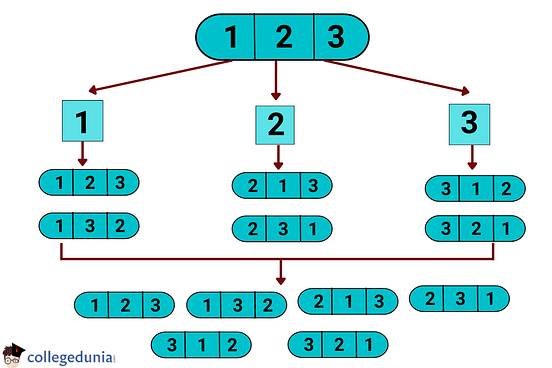
Permutations
Permutation Example
Example: Consider three letters p, q, and r. All possible permutations created with letters p, q, and r will be
- By Taking all Three at a Time: pqr, prq, qpr, qrp, rpq, rqp
- By Taking Two at a Time: pq, pr, qr, qp, rp, rq
Permutation and Combination Detailed Video Explanation
What is Combination?
[Click Here for Previous Year Questions]
Combination is a method of selecting objects or items from a set or collection of objects in such a way that the order of selection of elements does not matter.
- It refers to the method of choosing a group by taking some or all of the elements of a set, with no respect to subsequent order.
- It can be used to determine the number of possible groups that can be created from the available elements.
- It refers to the selection of N items from a group of K at a time with no repetition.
Combination Example
Example: Consider three letters p, q, and r. All possible combinations chosen with the letters p, q, and r are:
- When three out of three letters are to be selected, then the only combination is pqr.
- When two out of three letters are to be selected, then the possible combinations are pq, qr, rp.
Read More:
| Relevant Concepts | ||
|---|---|---|
| Combinatorics | Factorial Formula | Stirling Formula |
| Set Theory in Maths | Involute | Sets Formula |
Difference Between Permutation and Combination
[Click Here for Sample Questions]
Difference between Permutation and Combination can be understood by knowing the applications of Permutations and Combinations.
- Permutations are the different possibles arrangement of elements and are used when things are of a different kind.
- Combinations are the number of smaller groups or sets which can be formed from the elements of a larger set.
Listed below is the Difference between Permutation and Combination:
| Permutation | Combination |
|---|---|
| Permutation refers to the different methods of arranging a set of objects in sequential order. | Combination refers to the process of selecting items from a large set of objects, such that their order does not matter. |
| It is used for things of different kinds. | It is used for things of similar kinds. |
| The arrangement of permutation is relevant. | The arrangement of a combination is irrelevant. |
| It denotes the arrangement of objects. | It denotes the selection of elements instead of the arrangement of objects. |
| It’s possible to derive multiple permutations from a single combination. | From a single permutation, only a single combination can be derived. |
| Permutation is referred to as an Ordered Set. | Combination is referred to as Unordered Set. |
| Permutation Formula is given as \({^nP_r} = \frac{n!}{(n-r)!} \). | Combination Formula is given as \({^nC_r}= \frac{n!}{r!(n-r)!} \). |
| It indicates different ways to arrange things, people, digits, alphabets, colors, etc. | It indicates different ways of selecting menu items, food, clothes, subjects, etc. |
| Example: Permutation of two letters from given letters a, b, c is ab, ba, bc, cb, ac, ca. | Example: Combination of two letters from given letters a, b, c is ab, bc, ca. |
The value of Permutation is always greater than the value of Combination for the given values of n and r. In permutations, the different possible arrangements are counted, while in combinations, only the different subgroups are counted. Therefore, the answer for permutation is always greater than the combination.
Permutation and Combination Formulas
[Click Here for Previous Year Questions]
Permutation and Combination Formulas are utilized to find out the permutation and combination of r items taken from n items. Permutations find the different arrangements whereas combinations are used to find the different groups. It must be noted that Permutations are always greater than the combinations for any given values of n and r.
Permutation Formula
Permutation is a method that is used to arrange data in sequences or order without any repetition. Permutation Formula is given as
| \({^nP_r} = \frac{n!}{(n-r)!} \) |
Where
- n is the Total number of objects in a given set.
- r is the Number of objects to be chosen from the set.
Combination Formula
Combination is the method of choosing a subset from a larger set of things where the order doesn't matter. Combination Formula is given as
| \({^nC_r} = \frac{{^nP_r}}{r!} = \frac{n!}{r!(n-r)!} \) |
Where
- n is the Total number of objects in a given set.
- r is the Number of objects to be chosen from the set.
Read More: Important Questions For Class 11 Maths Permutations and Combinations
Solved ExampleExample: Find the number of permutations and combinations if n is 4 and r is 3. Solution: Given that
Using the Permutation and Combination Formulas, we get Permutation \({^nP_r} = \frac{n!}{(n-r)!} \)= \(\frac{4!}{(4-3)!} = \frac{4!}{1!} = \frac{4 \times3\times 2\times 1}{1} \)= 24 Combination \(\begin{array}{l}_{n}C_{r} = \frac{n!}{r!(n-r)!}\end{array} = \begin{array}{l}\frac{4!}{3!(4-3)!} = \frac{4!}{3!(1)!} = \frac{4 \times3\times 2\times 1}{3!(1)!} = 8\end{array}\) Thus, the permutations and combinations are 24 and 8 respectively. |
Relation Between Permutation and Combination
[Click Here for Sample Questions]
Permutation and Combination Formulas can be combined together in order to form one single formula. The formula for 'r' things taken from 'n' things is such that their permutation is equivalent to the product of 'r' factorial and combination.
\(^nP_r = \frac{n!}{(n - r)!}\)
\(^nP_r = \frac{r!.n!}{r!.(n - r)!}\)
\(^nP_r = r! \times ^nC_r\)
Permutation and Combination Examples
[Click Here for Previous Year Questions]
Permutations and Combinations have a wide range of applications in daily life. They are extremely useful in Probability. Given below are a few examples of Permutations and Combinations in day-to-day life:
- The different possible seating arrangements can be calculated using Permutation Formula.
- Permutations are also used to calculate the number of passwords that can be formed from the given numbers, symbols, etc.
- Combination can be used to find the number of possible teams which can be formed from a larger number of prospective players.
- Combination Formula is used to find the number of possibilities of forming a committee by picking a few people.
Check More:
Things to Remember
- Permutation is a method used to calculate the number of all possible arrangements of given elements.
- Combination is a method used to calculate the number of subgroups that may be generated from the given bigger set.
- Sequence of arrangement of elements matters in Permutations and not in Combinations.
- Number of Permutations (arrangements) is always greater than the Number of Combinations.
- Permutation is an ordered set, whereas Combination is an unordered collection or pairing of values.
- Permutation and Combination are used in almost every sector and branch of Mathematics.
Previous Year Questions
- If nCr−1 = 28, nCr = 56, and nCr+1 = 70, then the value of r is equal to…? [KEAM]
- The number of words that can be formed by using all the letters of the word PROBLEM only one is…? [KEAM]
- How many four-digit numbers abcd exist such that a is odd, b is divisible by 3, c is even…? [KEAM]
- Let Tn be the number of all possible triangles formed by joining vertices of an n-sided regular…? [JEE 2013]
- Let A and B be two sets containing four and two elements respectively. Then the number of subsets…? [JEE 2015]
- If all the words (with or without meaning) have five letters, formed using the letters…? [JEE 2016]
- All possible numbers are formed using the digit 1,1,2,2,2,2,3,4,4 taken all at a time…? [JEE 2019]
- An eight-digit number divisible by 9 is to be formed using digits from 0 to 9 without repeating…? [JEE 2014]
- If a, b and c are the greatest values of 19Cp, 20Cq, and 21Cr respectively, then…? [JEE 2020]
- Consider a class of 5 girls and 7 boys. The number of different teams consisting of 2 girls and…? [JEE 2019]
Sample Questions
Ques. What is the use of Permutations and Combinations in real life? (3 Marks)
Ans. Permutations and Combinations are often used in everyday life and are used in almost each and every sector of Mathematics. Given below are the application areas of Permutations and Combinations:
- Combination Application Areas: Network Security, Cryptography, Communication Networks, Menu Selection, Cuisine Selection, Clothing Selection, Subject Selection, and Team Selection.
- Permutation Application Areas: Communication Networks, Parallel and Distributed Systems, Arrangement of Individuals, Digits, Numbers, Alphabets, Letters, and Colors.
Ques. What is the Relation between Permutation and Combination? (3 Marks)
Ans. Permutation Formula and Combination Formula are combined together to form a single formula. The formula for 'r' things picked from 'n' things is such that their permutation equals the product of 'r' factorial and combination.
\(^nP_r = \frac{n!}{(n - r)!}\)
\(^nP_r = \frac{r!.n!}{r!.(n - r)!}\)
\(^nP_r = r! \times ^nC_r\)
Ques. Find the different three-digit codes which can be formed using the digits 1, 2, 4, 5, 8, and 9, using the concept of Difference between Permutation and Combination. (3 Marks)
Ans. Given digits are 1, 2, 4, 5, 8, and 9.
According to the question, we need to form a three-digit code from the given five digits. Using the concept of the difference between permutation and combination, it can be derived that here we need to find the arrangements and thus Permutation Formula will be used.
\(^{n}P_{r} = \frac{n!}{(n-r)!}\)
\(^5P_3 = \frac{5!}{(5 - 3)!} = \frac{5!}{2!} = 5 × 4 × 3 = 60\)
Thus, 60 three-digit codes can be formed from the given five digits.
Ques. What do n and r indicate in the Permutation Formula? (2 Marks)
Ans. Permutation Formula is given as
\({^nP_r} = \frac{n!}{(n-r)!} \)
Where n is the set size. It is the total number of items in the sample, and r is the subset size.
Ques. State the Difference between Permutation and Combination. (5 Marks)
Ans. The difference between Permutation and Combination is as follows:
| Permutation | Combination |
|---|---|
| Permutation is a method used to find how many times can data be arranged in different sequences. | Combination is a method used to find how many subsets can be possibly made from a larger set. |
| The arrangements are made in order or sequence in permutations. | The subsets are made irrespective of the order or sequence in combinations. |
| It is denoted by nPr. | It is denoted by nCr. |
| Examples include Arranging alphabets, numbers, or books. | Examples include Selecting a menu, or forming a team. |
Ques. What is the sum of all 4 digit numbers formed using the digits 2, 3, 4, and 5 without repetition? (3 Marks)
Ans. Given digits are 2, 3, 4, and 5.
- Number of Given Digits = n = 4
- Sum of Digits = 2 + 3 + 4 + 5 = 14
Sum of all Four Digits Formed will be
⇒ (n−1)!(Sum of Digits)(1111....n times)
⇒ (n−1)!(14)(1111)
⇒ 3!×14×1111
⇒ 6×14×1111
⇒ 84×1111
⇒ 93324
Thus, the sum of all 4 digit numbers formed using the digits 2, 3, 4, and 5 without repetition is 93324.
Ques. There are 4 white, 5 red, and 3 blue marbles in a bag. Each of them is drawn one by one and is arranged in a row. If 12 marbles are drawn, determine the number of different arrangements. (3 Marks)
Ans. Using the formula for arrangements of n objects of which there might be groups of indistinguishable objects.
In this problem, 12 marbles, consisting of indistinguishable groups of 4 white, 5 red, and 3 blue marbles are given.
Required Number of Arrangements = \(\frac{12!}{5!\times4!\times3!}\) = 27720
Thus, the total number of arrangements will be 27720.
Ques. A set of 5 players has to be formed out of a total of 10 players such that two particular players should be involved in each set. (3 Marks)
Ans. In order to find the number of ways of selecting r players from n players, we will use the combination formula:
\(^{n}C_{r} = \frac{n!}{(r!)(n-r)!}\)
Given that,
- n = 10
- r = 5
But, out of these five 2 particular players are already selected, so
Now, Total Players from which Selection is to be made, n = 10 - 2 = 8
Total Players to be Selected, r = 5 - 2 = 3
8C3 = 8!/(3! X (8! - 3!))
(8 x 7 x 6 x 5!)/ (5! X 3 x 2)
8 x 7 = 56
Thus, there is a total of 56 ways.
Ques. At a birthday party, every person shakes hands with every other person. If there was a total of 28 handshakes at the party, how many people were present at the party? (3 Marks)
Ans. Suppose that there are n persons present at a party and every person shakes hands with every other person. Then,
Number of Handshakes = nC2 = n(n − 1)/2
n(n−1)/2 = 28
n(n−1) = 28 × 2 = 56
Solving the Quadratic Equation, we get
n = 8
Thus, there are 8 people at the birthday party.
Ques. Determine the number of ways a coach forms a team of 2 players from among the six players in the academy. (3 Marks)
Ans. According to the question, the coach needs to select 2 players from the available 6 players. It is a case of forming groups, thus, the Combination Formula will be used here to find the possible number of teams that can be formed.
Here
- n = 6
- r = 2
Substituting the values,
\(^{n}C_{r} = \frac{n!}{(r!)(n-r)!}\)
\(^6C_2 = \frac{6!}{2!(6 - 2)!} = \frac{6!}{2!.4!} = 15\)
Thus, the coach can form 15 different teams of 2 players from the 6 players.
For Latest Updates on Upcoming Board Exams, Click Here: https://t.me/class_10_12_board_updates
Check-Out:



Comments