



Content Curator
Subsets are a subclass of the mathematical concept known as Sets. Georg Cantor, a German mathematician first developed the set theory in Maths.
- A set is a group of items or components that are enclosed in curly braces, such as "a, b, c, d".
- Set B is said to be a subset of A if set A is a collection of even numbers and set B contains the numbers 2, 4, and 6.
- B is designated as B ⊆ A and A is the superset of B.
Read Also: NCERT Solutions for Class 11 Maths Sets
Key Terms: Set, Superset, Power Set, Improper Set, Proper Set, Set Theory, Subset
What are Subsets?
[Click Here for Sample Questions]
A subset is a part of a given set (another or the same set). If all components of Set A is present in Set B, then Set A is a subset of Set B. Thus, Set B contains Set A.
As an illustration, if set A has the elements {X, Y} and set B contains the elements {X, Y, Z} then set A is the subset of set B.
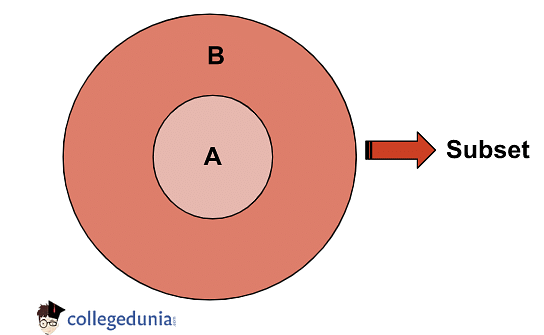
Subset Diagrammatic Representation
- The Symbol for the Subset is “⊆”.
- A subset is represented in set theory by the symbol, which means "is a subset of."
- We can represent subsets with this symbol in the following ways.
- Set A is a subset of Set B according to the formula A ⊆ B.
- Note that the set and a subset may be equal. Any element in the set may be found in a subset.
Thus, the same can be represented as,
| Number of elements | Example of such sets | Subset of sets in 2nd column | Number of subsets |
|---|---|---|---|
| 0 | {ϕ} | {ϕ} | 1 = 20 |
| 1 | {a} | {a}, {ϕ} | 2 = 21 |
| 2 | {a, b} | {a}, {b}, {a, b}, {ϕ} | 4 = 22 |
| 3 | {a, b, c} | {a}, {b}, {c}, {a, b}, {b, c}, {a, c}, {a, b, c}, {ϕ} | 8 = 23 |
| n | {a, b, c, …z, a1, b1 ……} | {a}, {b}, {c}, ……… {a, b, c, …z, a1, b1……}, {ϕ} | 2n |
Therefore, the maximum number of A subsets is n if A comprises n elements.
Hence, 2n
The largest number of non-empty sets, however, is equal to
➜ 2n - 1
The following are some other important Sets formulas for any three sets A, B, and C:
- A – A = Ø
- B – A = B ⋂ A’
- B – A = B – (A ⋂ B)
- (A – B) = A if A ⋂ B = Ø
- (A – B) ⋂ C = (A ⋂ C) – (B ⋂ C)
- A Δ B = (A - B) U (B - A)
- n (A ∪ B) = n (A) + n (B) – n (A ⋂ B)
- n (A ∪ B ∪ C) = n (A) + n (B) + n (C) – n (B ⋂ C) – n (A ⋂ B) - n (A ⋂ C) + n (A ⋂ B ⋂ C)
- n (A – B) = n (A ∪ B) – n(B)
- n (A – B) = n (A) – n (A ⋂ B)
- n (A’) = n (∪) – n (A)
- n (U) = n (A) + n (B) + – n (A ⋂ B) + n ((A ∪ B)’)
- n ((A ∪ B)’) = n (U) + n (A ⋂ B) – n (A) – n (B)
Subset Formulas
All the formulas related to subsets are mentioned below. If a set A has 'n' elements, then:
- The number of subsets of A = 2n.
- Thus, the number of elements of the power set A = (P(A)) is 2n.
- The number of proper subsets of A = 2n - 1.
- The number of improper subsets of A = 1.
Also Read:
Properties of Subsets
[Click Here for Previous Year Questions]
The following are some of the major properties of subsets:
- Each set is regarded as a subset of the overall set. It indicates that X ⊂ X, Y ⊂ Y, etc.
- We can state that a set that is empty is regarded as a subset of all sets.
- A subset of Y is X. It implies that X is a part of Y.
- We can state that a set Y is a superset of a set X if a set X is a subset of set Y.
Read More:
Types of Subsets
[Click Here for Sample Questions]
The different types of Subsets are:
Proper Subsets
If Set B has at least one member that is absent from Set A, Set B is said to be a proper subset of Set A.
- For instance, if set A has the elements {12, 24} and set B contains the elements {12, 24, 36} then set A is the correct subset of B since 36 is absent from set A.
- The symbol ⊂, which means "is a proper subset of," designates a proper subset.
- We can express a valid subset for sets A and B using this symbol as; A ⊂ B
- There are NCn different ways to choose N number of elements from a set that contains N number of elements.
- As a result, NCn is the total number of subsets that could exist that contain n members from a set of N elements.
Improper Subset
An improper subset is one that includes every component of the original set. It is indicated by ⊆.
- For instance: Set P = {2,4,6} The subsets of P are then; {}, {2}, {4}, {6}, {2,4}, {4,6}, {2,6} and {2,4,6}.
- Where the valid subsets are, 2, 4, 6, 2,4, 4,6, 2,6 and the unsuitable subsets are 2,4,6. Thus, we can write {2,4,6} ⊆ P.
- Because it is equal to itself, the empty set is not a valid subset of itself, but it is a proper subset of every other set.
Power Set
The collection of all subsets is referred to as the power set. P is its representative (A).
If A is a set with the elements {a, b}. Subsequently, A's power set will be;
P(A) = {∅, {a}, {b}, {a, b}}
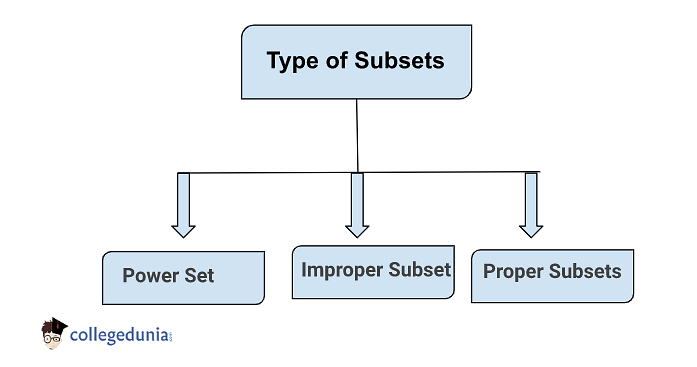
Types of Subsets
Differences Between Proper and Improper Subsets
[Click Here for Previous Year Questions]
The differences between proper and improper subsets are below. For the differences, assume a set A with 'n' elements in it.
| Proper Subset | Improper Subset |
|---|---|
| Proper Set comprises only a few (or no) elements of set A. | An improper subset comprises elements of set A. |
| It will never be equal to set A. | It will always be equal to set A. |
| The number of proper subsets of A is considered to be 2n - 1. | The number of improper subsets that are of A is only 1 (which is A itself). |
| "⊂" is the symbol used to denote only proper subsets. | "⊆"is the symbol used to denote both proper and improper subsets. |
What is Superset?
[Click Here for Sample Questions]
The symbol used to symbolise a superset is the mirror image of the sign used to denote a subset. Supersets have two characteristics.
- First, a null or empty set is a superset of every set because ϕ contains no elements at all, it implies that P ⊃ ϕ.
- The second fact is that each set is also a superset of itself now that you are aware that each set is a subset of itself.
As a result, Q can be represented as Q ⊃ P if it is a super of P. Both P and Q are sets of regular polygons.
P is the set of all polygons. In this instance, Q ⊂ P and Q ≠ A, so P is the superset of Q. A = {1, 2, 3, 4, 5, 6} and B = {m: m<4 and m ϵ N}. Here, Set B is a subset of set A, whereas set A is a superset of set B.
Check More:
Things to Remember
- Since A contains no items, every set is a superset of a null, void, or empty set.
- Subsets can be defined as a subclass of the mathematical concept known as Sets.
- Since the empty, null, or void set has no items, it is a member of every set.
- The term "inclusion" is frequently used to describe the relationship when one set is the other's subset.
- For a set A with n elements, the generic formula for the number of subsets is = 2n.
Read Also: Distributive Property
Previous Year Questions
- If A and B are non-empty sets such that… (KEAM)
- If A and B are not disjoint sets, then n(A∪B)...
- Two sets A and B are as under: A = {(a,b)... (JEE Main - 2018)
- Which of the following sets is a finite set…
- For any two sets A and B, A-(A−B) equals… (WBJEE - 2009)
- Let A and B be two sets then (A∪B)′… (BITSAT - 1990)
- Two finite sets have m and n elements. The total number…
- The number of proper subsets of a set having… (COMEDK UGET - 2014)
- If A and B are two sets, then A ∩ (A∪B)...
- Let S be a set containing n elements and we select two subsets… (BITSAT - 2005)
Sample Questions
Ques. Given any two of the subset's actual examples. (1 mark)
Ans. In daily life, we see many examples of subsets, including,
- Books about math are a subset of all books in a library, if we think of all books as one set.
- Cereals make up a subset if all the things in a grocery store are considered a set.
Ques. How is Set B A if Set A = {Father, Mother, You, Brother, Sister} and Set B = {You}? (1 mark)
Ans. According to the definition of a subset, each element of a subset is included in the other set, and since the element "You" is a member of your family, B A. Set A represents your family members, while set B represents a single element.
Ques. What formula is used to determine the number of subsets and the appropriate subset for any given set? (2 marks)
Ans. If a set has "n" members, then the formulas to determine the number of subsets and a proper subset are as follows:
Subset count is 2n.
2n - 1 is the number of appropriate subsets.
Ques. Consider N = {1, 2, 3, ..., 100}. show that
(i) the even number-containing subset of N.
(ii) the portion of N that is composed entirely of perfect square integers. (3 marks)
Ans. We know that,
If a set "A" is "contained" within a set "B," then "A" is a subset of "B." As a result, every element of "A" is likewise an element of "B."
(i) According to the question,
N = {1, 2, 3, …, 100}
Consequently, a subset of N with even numbers of elements
= {2, 4, 6, 8, ………,100}
(i) According to the question,
N = {1, 2, 3, …, 100}
In light of this, the subset of N whose members are perfect square numbers
= {1, 4, 9, 16, 25, 36, 49, 64, 81, 100}
Ques. For the given set A = {5, 6, 7, 8} determine the total number of subsets and the total number of valid subsets. (3 marks)
Ans. It is given that A = {5, 6, 7, 8}
There are four elements in the set.
We know that,
The formula to determine how many subsets there are in a given set is 2n.
= 24 = 16
There are 16 subsets.
The formula to determine how many appropriate subsets of a given set there are is 2n - 1.
= 24 – 1
= 16 – 1 = 15
There are fifteen appropriate subsets.
Ques. How many subgroups of the set may be created, each with three elements?
S = {1, 2, 3, 4, 5, 6, 7, 8, 9, 10} (3 marks)
Ans. There are 10 sets in total.
3 elements make up the subset.
Consequently, 10C3 is the total number of subsets that could include three elements.
= 10 ! / (10-3) ! × 3 !
= 10 × 9 × 8 × 7 ! / 7 ! × 3 × 2 × 1
= 720/6
= 120
As a result, there are 120 different subsets of the set S = {1, 2, 3, 4, 5, 6, 7, 8, 9, 10} that each include three elements.
Ques. The following sets, which are finite or infinite,
a. A year's worth of months
b. {1, 2, 3 …}
c. {1, 2, 3 … 99, 100}
d. The collection of positive integers greater than one hundred.
e. The collection of prime numbers below 99 (4 Marks)
Ans.
- Because it has 12 elements, the set of months in a year is a finite set.
- Because there are an endless number of natural numbers, the set "1, 2, 3... " is infinite.
- Because the numbers from 1 to 100 are finite, the set "1, 2, 3... 99, 100" is finite.
- Because the positive integers that are greater than 100 are infinite, the set of positive integers greater than 100 is an infinite set.
- Because the prime numbers that are less than 99 are finite, the set of prime numbers under 99 is a finite set.
Ques. Create a Venn diagram according to each of the following: (4 Marks)
a. (A U B)’
b. A’ ∩ B’
c. (A ∩ B)’
d. A’ U B’
Ans.
- (A U B)’

- A’ ∩ B’

- (A ∩ B)’

- A’ U B’

Ques. Indicate if each item in the list below is limitless or finite:
(i) The collection of lines parallel to the x-axis.
(ii) The alphabetic group of the English language
(iii) The collection of numbers that are multiples of five
(iv) The group of animals that exist on Earth.
(v) The collection of circles encircling the origin (0, 0) (4 marks)
Ans.
(i) Because the lines parallel to the x-axis are infinite, the set of lines that are among them is unlimited.
(ii) Because the English alphabet only has 26 letters, it is a finite set.
(iii) Because there are infinite multiples of 5, the set of numbers that are multiples of 5 is infinite.
(iv) Because there are only a finite number of species that can exist on Earth, the set of animals is a finite set.
(v) There are an endless number of circles that can pass through the origin (0, 0), making the set of circles that do so an infinite set.
Ques. Of the following, which are sets? Explain your response.
(i) A list of all the months of a year that start with the letter J.
(ii) A compilation of India's 10 best writers.
(iii) A group of the world's top eleven cricket batsmen.
(iv) The grouping of all the male students in your class.
(v) The totality of all natural numbers below one hundred.
(vi) A selection of books by author Munshi Prem Chand.
(vii)The grouping of all even integers is item.
(viii) A list of questions included in this Chapter.
(ix) A list of the world's most lethal animals. (5 marks)
Ans.
(i) The collection of all months in a year that starts with the letter J is a clearly defined group of objects since each month that is a part of this group can be distinguished.
This collection is a set as a result.
(ii) The list of India's top 10 writers is not clearly defined, as different people may have different standards by which to judge a writer's talent.
This collection is not a set because of this.
(iii) A group of the top eleven cricket batsmen in the world is not a clearly defined entity because different people have different standards for judging a batsman's talent.
This collection is not a set because of this.
(iv) You can tell which boy belongs to the collection of all the lads in your class because it is clearly defined.
This collection is a set as a result.
(v) Since it is possible to identify a number that is a member of the collection of all natural numbers less than 100, the collection is well-defined.
This collection is a set as a result.
(vi) A collection of Munshi Prem Chand's novels is a clearly defined collection because it contains every book in the series.
This collection is a set as a result.
(vii) Since an integer can be found that is a member of the collection of all even integers, it can be said that the collection is well-defined.
This collection is a set as a result.
(viii) The questions in this chapter are organised into a clearly defined set, making it easy to identify which questions are appropriate for this chapter.This collection is a set as a result.
(ix) The criteria used to determine an animal's level of risk might vary from one animal to another, making it difficult to identify a list of the most hazardous animals in the world.
This collection is not a set because of this.
Also Read:



Comments