



Education Content Expert
Photosynthesis is the process by which plants use sunlight, water, and carbon dioxide to produce glucose and oxygen. It is the process through which green plants, algae, and certain bacteria use sunlight to synthesize nutrients from carbon dioxide and water. Photosynthesis is a reaction that occurs to produce energy in plants, which is facilitated by the conversion of the substrates carbon dioxide and water. This conversion leads to the release of energy in the form of glucose and oxygen. Green plants are also called Autotrophs as they synthesize the food they need through photosynthesis on their own. Photosynthesis Formula is given as 6CO2 + 6H2O → C6H12O6 + 6O2 + 6H2O.
| Table of Content |
Key Terms: Photosynthesis, Photosynthesis Formula, Chemical Energy. Light, Carbon Dioxide, Plants, Oxygen, Glucose, Chlorophyll
Photosynthesis in Plants
[Click Here for Sample Questions]
Photosynthesis occurs when green plants use light energy to convert carbon dioxide and water into glucose and oxygen. The process of photosynthesis takes place mainly in the leaves of plants. The process of photosynthesis requires carbon dioxide, water, and sunlight, thus, all of these must be obtained or transported to the leaves.
- Carbon dioxide is obtained through tiny pores present in the leaves of the plant called stomata.
- Oxygen is also released through the stomata.
- Water is obtained by the plant through the roots and is then passed on to the leaves through the vascular plant tissue systems.
- Sunlight is absorbed by chlorophyll, a green pigment located in plant cell structures called chloroplasts.
- Chloroplasts are the sites of photosynthesis.
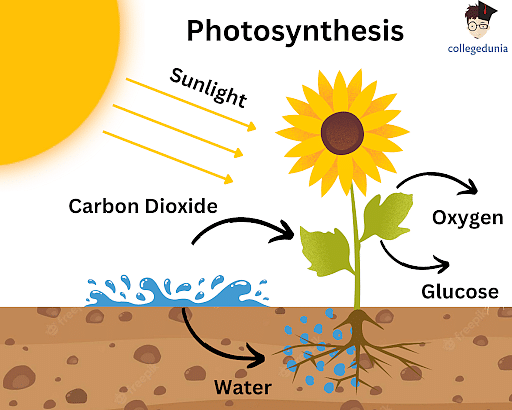
Photosynthesis
Read More:
Photosynthesis Formula
[Click Here for Previous Year Questions]
During photosynthesis, solar energy is converted into chemical energy which is stored in the form of glucose (sugar). Carbon dioxide, water, and sunlight are used to make glucose, oxygen, and water. The balanced reaction for
Photosynthesis Formula according to Kamen and Ruban (1941) is
6CO2 + 6H2O → C6H12O6 + 6O2 + 6H2O
In this process, six molecules of carbon dioxide (6CO2) and twelve molecules of water (12H2O) are consumed, while glucose (C6H12O6), six molecules of oxygen (6O2), and six molecules of water (6H2O) are produced.
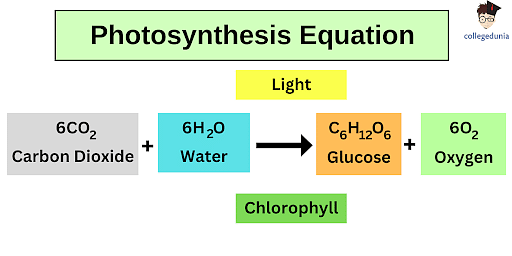
Photosynthesis Equation
Stages of Photosynthesis
[Click Here for Sample Questions]
Photosynthesis takes place in two stages. These phases are called the light reaction and the dark reaction. Light reactions happen or occur in the presence of light. Dark reactions do not require direct light, but dark reactions in most plants occur during the day.
Light Reaction of Photosynthesis
- Light reactions occurs mostly in thylakoid stacks of grana.
- Here, sunlight is converted into chemical energy in the form of ATP (free energy-containing molecules) and NADPH (a high-energy electron-carrying molecule).
- Chlorophyll absorbs light energy and initiates a chain of steps that lead to the production of ATP, NADPH, and oxygen (via water splitting).
- Oxygen is released through the stomata. Both ATP and NADPH are used in dark reactions to produce sugar.
The chemical equation in the light reaction of photosynthesis is:
2H2O + 2NADP+ + 3ADP + 3Pi → O2 + 2NADPH + 3ATP
Read More: Difference between Light Reaction and Dark Reaction
Dark Reaction of Photosynthesis
- Dark reactions occur in the stroma.
- Carbon dioxide is converted to sugar with the use of ATP and NADPH.
- This process is known as carbon fixation or the Calvin cycle.
- The Calvin cycle has three main phases namely carbon fixation, reduction, and regeneration.
- In carbon fixation, carbon dioxide is combined with a 5-carbon sugar [ribulose 1,5-bisphosphate (RuBP)] to form a 6-carbon sugar.
- In the reduction, the ATP and NADPH are used to convert the 6-carbon sugar into 2 molecules of the 3-carbon saccharide, glyceraldehyde-3-phosphate.
- glucose and fructose combine to form sucrose or sugar.
- In the regeneration phase, some glyceraldehyde-3-phosphate molecules combine with ATP and are converted back to the 5-carbon sugar RuBP.
- Once the cycle is complete, RuBP is available to combine with carbon dioxide to start the cycle again.
The chemical equation for the dark reaction is as follows:
3CO2 + 6 NADPH + 5H2O + 9ATP → G3P + 2H+ + 6 NADP+ + 9 ADP + 8 Pi
Read More:
Things to Remember
- Photosynthesis is defined as the process by which plants use sunlight, water, and carbon dioxide to create oxygen and glucose.
- It is the process by which light energy is converted into chemical energy and used to make organic compounds.
- In plants, photosynthesis typically occurs in chloroplasts located in plant leaves.
- Photosynthesis Formula is given as 6CO2 + 6H2O → C6H12O6 + 6O2 + 6H2O.
- Photosynthesis comprises two phases namely the light reaction, and the dark reaction.
- Light reactions convert light into energy (ATP and NADHP) and dark reactions use energy and carbon dioxide to make sugar.
Previous Years’ Questions (PYQs)
- During light reaction in photosynthesis, the following are formed…
- Energy transfer in photosynthesis occurs as… (JIPMER 2005)
- Anoxygenic photosynthesis is characteristic of… (NEET 2014)
- In photosynthesis, the light-independent reactions take place at… (NEET 2015)
- Law of limiting factor of photosynthesis was proposed by… (Delhi UMET/DPMT 2008)
- During photosynthesis, oxygen in glucose comes from…
- C4 plants are more efficient in photosynthesis than… (NEET 2010)
- In the C cycle, carbon dioxide is first fixed in…
- Stomatal opening or closing is due to… (AMUEEE 2010)
- Calvin cycle takes place in…
- Consider the following statements regarding photosynthesis… (KEAM)
- Synthesis of food in C4 pathway occurs in chloroplasts of… (KCET 2007)
Sample Questions
Ques. What is Photosynthesis? What are its by-products? (2 Marks)
Ans. Photosynthesis is the process by which green plants and certain other organisms transform light energy into chemical energy which is later used up for various cellular activities. It is a process where green plants use light energy, carbon dioxide, and water to produce glucose, oxygen, and water. Thus, the by-products of photosynthesis are Oxygen, Glucose, and Water.
Ques. Write the complete balanced reaction for photosynthesis in both symbolic and word equations. (3 Marks)
Ans. The balanced reaction for photosynthesis in word form is
Carbon Dioxide + Water → Glucose + Oxygen
The balanced reaction for photosynthesis in symbol form is
6CO2 + 6H2O + Light → C6H12O6 + 6O2 + 6H2O
Ques. What are chloroplasts? Explain their structure. (3 Marks)
Ans. Chloroplasts are chlorophyll-containing cell organelles in plant cells that play a vital role in life on earth since photosynthesis takes place in chloroplasts.
Chloroplasts contain several structures, each with specific functions:
- Outer and Inner Membranes: Protective coverings that keep chloroplast structures closed.
- Stroma: Thick liquid in the chloroplast that helps in converting carbon dioxide into sugar.
- Thylakoid: Flattened sac-like membrane structures.
- Grana: Densely layered stacks of thylakoid sacs. Places of conversion of light energy into chemical energy.
- Chlorophyll: The green pigment in the chloroplast which absorbs light energy.
Ques. State the relationship between photosynthesis and respiration. (3 Marks)
Ans. Photosynthesis and respiration are related. In both mechanisms, energy is released. Plants obtain energy in photosynthesis from sunlight, while respiration breaks down glucose molecules to obtain energy in the form of ATP molecules. Both processes are interdependent. Respiration uses the end product of photosynthesis (glucose in the form of food). It produces ATP for energy. This process releases carbon dioxide and water, which photosynthesis uses to produce more sugars.
Ques. How can short plants growing under dense canopies and receiving filtered light carry out photosynthesis in tropical rainforests? (2 Marks)
Ans. In the presence of light, plants carry out photosynthesis. The rate of photosynthesis is the only factor that is affected by the quality and intensity of light. Therefore, only the rate may vary between plants growing in different areas of the canopy.
Ques. Give a reason why the rate of photosynthesis decreases at higher temperatures. (2 Marks)
Ans. The process of photosynthesis is an enzyme-specific process. All enzymes work at an optimal temperature. If the temperature rises above 35 °C, the enzymes denature, which affects the rate of photosynthesis.
Ques. Name the pigment that causes the red color of tomatoes and chili peppers. Is the pigment a photosynthetic pigment? (2 Marks)
Ans. The pigment lycopene gives them their red color. It is due to the presence of chromoplasts in plants, different colors are created. It is a type of plastid that develops various color pigments that are not photosynthetic.
Ques. Explain why the color of a leaf changes in the dark? Which pigment do you think is more stable? (3 Marks)
Ans. The color of leaves stored in the dark changes from green to pale green or yellow. This is mainly due to the absence of sunlight and chlorophyll. In the dark or in the absence of light, photosynthesis does not take place, so there is no synthesis of starch and chlorophyll pigment. The most stable pigment is chlorophyll.
Ques. How are succulents able to meet their photosynthetic CO2 requirements since they are known to keep their stomata closed during the day to control transpiration? (3 Marks)
Ans. During the day, succulent plants must close their stomata because they grow in dry and xeric conditions to prevent water loss during transpiration, so there is no gas exchange. Thus, such plants have adapted to fix CO2 in the form of malic acid during the night. Malic acid is a four-carbon compound that stores CO2 released during the day in photosynthetic cells.
Ques. Does photosynthesis take place only in leaves? If not, what are the other parts that are able to carry out photosynthesis? (4 Marks)
Ans. The process of photosynthesis primarily occurs in the leaves of all green plants. Leaves are designed to capture sunlight and efficiently convert solar energy into chemical energy. However, in a few plants, modified parts other than leaves, carry out the process of photosynthesis. In some plants, chlorophyll develops in the roots and initiates photosynthesis, they are referred to as assimilative roots. Examples include Tinospora and Trapa.
The stem in some plants like Opuntia is modified and adapted to perform the functions of leaves, becoming thick, succulent and flattened, carrying out photosynthesis, these structures are referred to as phylloclade. In Australian Acacia, the petiole has the shape and function of photosynthesis when leaf stamina fails.
Ques. Define accessory pigments. State their importance in photosynthesis. (3 Marks)
Ans. Accessory Pigments are chlorophyll-b, xanthophyll, and carotenoids and are also referred to as photosynthetic pigments. They help accumulate sunlight and transfer it to chlorophyll-a. They are not directly involved in the emission of excited electrons. At the same time, this pigment itself absorbs maximum radiation in the blue and green areas. Therefore, chlorophyll-a is the main pigment and the other pigments are accessory pigments (chlorophyll-Ai, xanthophyll and carotenoid)
Ques. Do photosynthetic reactions, like dark reactions, require light? Explain. (2 Marks)
Ans. Dark reactions are reactions independent of light. Carbon dioxide is reduced to glucose through various processes, which do not require light. However, they rely on products formed during light reactions (NADPH2 and ATR).
Check-More:



Comments