



Education Journalist | Study Abroad Lead
Plant cells are eukaryotic cells that have a true nucleus with specialized structures, known as organelles, which carry out distinct functions. Simply, they have different cell organelles along with a true nucleus for carrying out various cell functions. The main difference between a plant cell and an animal cell is the presence of a cell wall in plant cells which provides it with a definite shape. Cell walls are composed of cellulose and provide various structural and mechanical processes. Plant cells contain a plastid called chloroplasts which helps in photosynthesis.
Check More: Cell Membrane and Plasma Membrane
| Table of Content |
Key Terms: Plant Cell, Chloroplast, Photosynthesis, Eukaryotic Cell, True Nucleus, Xylem, Phloem, Collenchyma, Eukaryotic Nucleus, Cell Wall, Cell Membrane,
What is a Plant Cell?
[Click Here for Sample Questions]
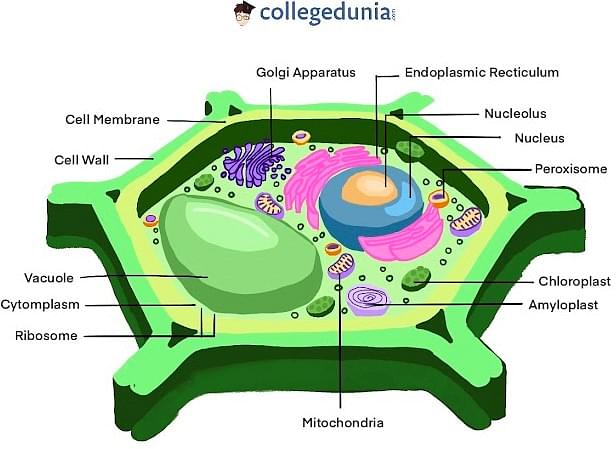
Plant cell is a basic unit of a plant that consists of various cell organelles. Plant cells are eukaryotic cells that have a true nucleus with specialized structures, known as organelles, which carry out distinct functions. The main difference between a plant cell and an animal cell is the presence of a cell wall, cell membrane and chloroplast.
Frequently Asked Questions Related to Plant CellQues. List the characteristics of prokaryotic cells. (3 marks) Ans. Some of the characteristics of a prokaryotic cell include:
Ques. List some functions of the Plant Cells. (3 marks) Ans. Some of the key functions of the plant cell are:
|
Plant Cell Diagram
[Click Here for Previous Year Questions]
Plant cells are rectangular in shape and bigger than animal cells. Despite the fact that plant and animal cells are both eukaryotic and share a few cell organelles, plant cells perform different activities when compared to animal cells. Plant cells can be easily seen when viewed under an electron microscope.
Also Read:
| Related Articles | ||
|---|---|---|
| Animal Cell Diagram | Endoplasmic Reticulum | Unicellular Organisms |
| Mitochondria and Plastids | Cyclic and Non-cyclic Photophosphorylation | Centriole |
Parts of a Plant Cell
[Click Here for Sample Questions]
Plant cells, like other organs in the body, include a variety of components called cell organelles that perform diverse activities in order to keep the plant alive. Among these organelles are:
Cell Wall
- Outside the cell membrane, the plant cell wall is a strong layer made up of cellulose, glycoproteins, lignin, pectin, and hemicellulose.
- Proteins, polysaccharides, and cellulose make the plant cell wall.
- The cell wall's principal role is to defend and provide structural support to the cell, as well as to shield the cell from mechanical stress and to give it form and structure.
- The cell wall also serves as a filter for chemicals entering and exiting the cell.
- Microtubules, which are made up of three layers: primary, secondary, and middle lamella, guide the development of the cell wall.
- Enzymes lay down cellulose to form the main cell wall.
Cell Membrane
- Cell Membrane is a semi-permeable membrane found inside the cell wall.
- Cell membrane is made up of a thin coating of fat and protein.
- The cell membrane is responsible for controlling the entry and exit of particular chemicals into and out of the cell.
- The cell membrane, for example, prevents poisons and foreign material from entering the cell while allowing nutrients and vital minerals to pass through.
Nucleus
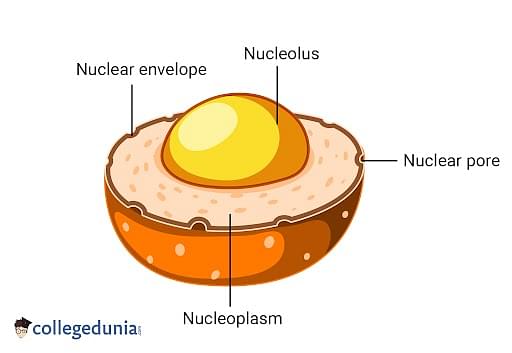
- Eukaryotic cells have a membrane-based organelle called the nucleus.
- Eukaryotes have a single nucleus in general, although certain cell types, such as human red blood cells, have no nuclei, while others, such as osteoclasts, contain many nuclei.
- Nucleolus: Nucleolus aids in the production of protein-making structures and ribosomes in cells.
- Nucleopore: Nucleopore are holes in the nuclear membrane that allow proteins and nucleic acids to flow through.
Cell Nuclues
Plastids
- Plant and algal cells include plastids, which are double-membrane organelles.
- These plastids are essential in the production and storage of food.
- Plastids frequently include pigments that are utilized in the photosynthesis process.
- These pigments can also alter the cell's color.
- Some important plastids are given below:
- Leucoplasts: They're present in non-photosynthetic plant tissues. Protein, fat, and starch are all stored in these cells.
- Chloroplasts: It is a Phospholipid membrane-enclosed elongated organelle. The stroma is the fluid within the chloroplast that contains circular DNA, and the chloroplast is structured like a disc. A green pigment called chlorophyll is found in each chloroplast and is necessary for photosynthesis. Chlorophyll takes light energy from the sun and converts it to glucose from carbon dioxide and water.
Chromoplasts
In photosynthetic eukaryotic organisms, they are diverse, coloured plastids that are responsible for pigment production and storage. Chromoplasts contain red, orange, and yellow pigments that give mature fruits and flowers their color.
Central Vacuole
- The central vacuole is a cellular organelle present in plant cells.
- It is frequently the cell's biggest organelle.
- It is encased in a membrane and serves as a storage facility for both supplies and trash.
- It also helps to maintain correct pressure by giving the developing plant proper structure. In a mature plant cell, it absorbs around 30% of the cell's volume.
Golgi Apparatus
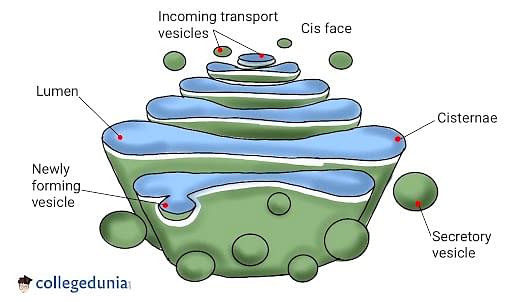
Golgi apparatus are present in all eukaryotic cells and are responsible for transporting produced macromolecules to different regions of the cell.
Golgi Apparatus
Ribosomes
- Ribosomes are macromolecular machines that are found in nearly all live cells and are responsible for the production of biological proteins.
- As a result, ribosomes are often known as the cell's protein manufacturers.
Mitochondria
- Mitochondria are double-membrane organelles present in the cytoplasm of all eukaryotic cells that produce energy by breaking down glucose and sugar molecules.
- Mitochondria is also called the "Powerhouse of the Cell."
Lysosome
- Lysosomes contain digestive enzymes in a confined membrane.
- They are known as suicide bags of a cell.
- By digesting worn-out organelles, food particles, and foreign substances in the cell, Lysosomes fulfil the job of cellular waste disposal.
Read More:
Types of Plant Cell
[Click Here for Previous Year Questions]
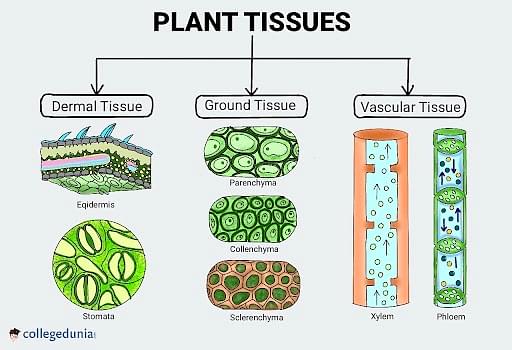
Plant cells are eukaryotic cells found in species belonging to the Plant Kingdom. As an organism develops, its cells mature to the point where they can perform specialized activities. Plant cells include parenchyma cells, sclerenchyma cells, collenchyma cells, xylem cells, and phloem cells, among others. Let's take a closer look at the activities of these cells:
- Xylem Cells: In vascular plants, xylem cells are transport cells. They aid in the transportation of water and nutrients from the roots to the leaves and other plant components.
- Parenchyma Cells: In all plants, parenchyma cells perform an important role. Plants' live cells that are involved in the formation of leaves are known as chloroplasts. They also play a role in gas exchange, food generation, organic product storage, and cell metabolism. Because they are thinner, these cells are usually more flexible than others.
- Phloem Cells: A sugar-carrying cell found throughout the plant, generated by the leaves. These cells survive for a long time after they have reached adulthood.
- Collenchyma Cells: These cells are rugged as well, but not quite as sclerenchyma cells. They also help the plants develop while they are young. Their development is synchronized with the expansion and stretching of the facility.
- Sclerenchyma Cells: This is due to the presence of a hardening chemical, which makes these cells stiffer than collenchyma cells. These cells are found in all plant roots and are primarily responsible for supporting the plants.
Types of Plant Tissue
Plant Cell Functions
[Click Here for Sample Questions]
There are several functions of plant cells, including:
- Plant cells are the main building blocks of plants and carry out various mechanical and physical processes.
- Chloroplasts in the plant cells help in the process of photosynthesis.
- Photosynthesis is the biochemical process where the plants synthesize their own food with the help of sunlight, water and carbon dioxide.
- Plant cells provide a rigid shape and help them to stand erect by providing necessary structural stability.
- The Cell wall and Cell Membrane of plants regulate the flow of components to the cytoplasm and block any unwanted foreign pathogens.
Check out: How are water and minerals transported in plants?
Previous Year Questions
- All types of plastids possess essentially the same structure because they … [NEET 1992]
- Flagella of prokaryotic and eukaryotic cells differ in … [NEET 2004]
- A cell organelle containing hydrolytic enzymes is … [NEET 2016]
- Water soluble pigments found in plant cell vacuoles are … [NEET 2016]
- Which of the following are not membrane-bound? … [NEET 2015]
- Besides giving out secretory vesicles … [NEET 1994]
Things to Remember
- Plant cells are the basic building unit of all plant life.
- Plant cells are eukaryotic cells which means they have a true nucleus.
- Plant cells consist of a cell wall and a cell membrane which is not seen in animal cells.
- Plant cells also consist of chloroplast which helps in the process of photosynthesis.
- The primary function of the plant cell is photosynthesis.
- A plant cell is made up of a variety of components
Read More:
Sample Questions
Ques: What is the difference between Prokaryotic and Eukaryotic Cells? (2 marks)
Ans: The basic difference between Prokaryotic and Eukaryotic cells are:
- Prokaryotic cells: A cell that lacks a well-defined nucleus, such as a bacterial cell.
- Eukaryotic cells: Plants, fungi, mammals, and protists all have eukaryotic cells, that have a well-defined nucleus.
Ques: What is the difference between plant cells and animal cells? (3 marks)
Ans: Plant cells are rectangular in shape and bigger than animal cells. Despite the fact that plant and animal cells are both eukaryotic and share a few cell organelles, plant cells perform different activities than animal cells.
Differences between Plant Cells and Animal Cells are tabulated below:
| Plant Cells | Animal Cells |
|---|---|
| Plant cells have a cell wall that surrounds the cell membrane. | Animal Cells do not have a cell wall to surround the cell membrane. |
| Plant Cells contain organelles called chloroplasts and central vacuoles. | Animal Cells don’t contain any organelles. |
Ques: When will a plant cell burst? (2 marks)
Ans: When a plant cell is submerged in a hypotonic solution, water enters the cell, a process known as endosmosis. This endosmosis causes the cells' turgor pressure to rise, putting strain on the cell wall. Plant cells rupture due to an excessive rise in turgor pressure.
Ques: When will the protoplasm of the plant cell shrink? (1 mark)
Ans: Exosmosis occurs when a plant cell is put in a hypertonic solution and water moves outside the plant cell. Exosmosis causes Protoplasm to shrink, resulting in the plasmolysis of a cell.
Ques: Why are the vacuoles of plant cells larger in size? (1 mark)
Ans: The role of the vacuole is to store chemicals, maintain osmolarity, and maintain turgor pressure. That’s why the vacuoles of the plant cells are larger in size.
Ques: What is the main function of chloroplasts? (1 mark)
Ans: Chloroplasts are a type of plastid that consists of the green color pigment called Chlorophyll. Chlorophyll helps in the process of photosynthesis.
Ques: What are the different types of Plant Cells? (3 marks)
Ans: The different types of plant cells include:
- Xylem Cells
- Phloem Cells
- Parenchyma Cells
- Collenchyma Cells
- Screlenchyma Cells
Ques: What are Xylem and Phloem Cells? (2 marks)
Ans: Xylema and Phloem cells can be defined as:
- Xylem Cells: Xylem cells are transport cells that aid in transporting water and nutrients from the roots to the leaves and other plant components.
- Phloem Cells: Phloem cells are sugar-carrying cells found throughout the plant. These cells survive for a long time after they have reached adulthood.
Ques: What is a plant cell? (2 marks)
Ans: A plant cell is a basic unit of a plant that consists of various cell organelles. Plant cells are eukaryotic cells that have a true nucleus with specialized structures, known as organelles, which carry out distinct functions. The main difference between a plant cell and an animal cell is the presence of a cell wall, cell membrane and chloroplast.
Ques: What are the colours absorbed by plants? The green light of the sunlight is blocked. How will the photosynthesis be affected? (2 marks)
Ans: Plants absorb all the colours in the spectrum. The plants reflect back the green light because of which they appear green in colour. Therefore, photosynthesis will not be affected if green light is blocked.
Ques: Write a note on Golgi apparatus and the functions it performs. (3 Marks)
Ans: Golgi apparatus or Golgi bodies or Golgi complex is composed of membrane-bound fluid-filled vesicles, vacuoles and cisternae. In animal cells they are larger and only one or two in number, while in plants they are smaller and more in number. Also, in plant cells, they are distributed throughout – the cytoplasm and are called dictyosomes.
Functions:
- It is involved in the transport and modification of the protein, lipids as well as carbohydrates.
- It helps in the formation of cell plates during cell division.
- It is also involved in the formation of cell walls, plasma membrane lysosomes, and peroxisomes.
- The material synthesised near endoplasmic reticulum is packaged and dispatched to various targets and outside the cell through the Golgi apparatus.
Ques: Write the name of different plant parts in which chromoplast, chloroplast, and leucoplast are present. (2 Marks)
Ans: Chromoplasts are present in flowers, fruits, or any other colored part of the plant (other than the green part). Chloroplasts are present in leaves and stem of plants (green part). Leucoplasts are present anywhere in plants as they are colourless and store food.
Ques: What do you mean by plasmodesmata? (2 Marks)
Ans: Due to the presence of cell wall the exchange of materials between the plap.t cells is not possible. Therefore, protoplasts of plant cells are connected by cytoplasmic channels through their walls which are called as plasmodesmata. These channels are used for the exchange of material between two cells.
Ques: What is cell sap? Give its composition. (2 Marks)
Ans: Liquid content in the vacuoles of plant cell is called cell sap. The cell sap contains sugars, amino acid, proteins, minerals and metabolic wastes.
Ques: Why is endocytosis found in animals only? (2 Marks)
Ans: For endocytosis to occur, the outermost membrane should be flexible like the plasma membrane of animals. But in plant cells, cell wall is the outermost membrane which is very rigid. Hence, endocytosis occurs only in animals and not in plants.
For Latest Updates on Upcoming Board Exams, Click Here: https://t.me/class_10_12_board_updates
Also Check:



Comments