



Content Writer
Physical science is a branch of natural science that deals with the study of non-living processes and systems in contrast to life science. It is used to explain concepts in the form of explanations and predictions about the universe.
- Physical science makes humans understand the history of the natural world.
- It is done through the observation of phenomena or experimentation wherein the natural processes are stimulated under controlled conditions.
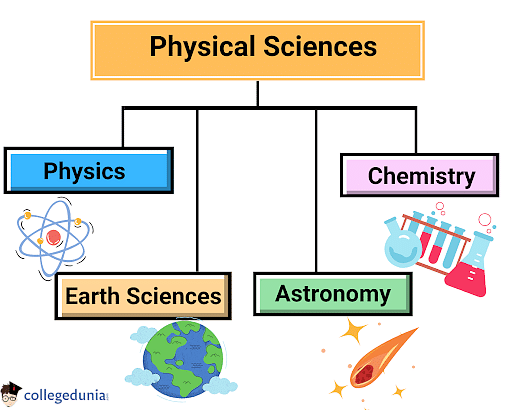
- Physical science has four general areas: physics, astronomy, chemistry, and earth sciences.
- Each of these areas is further split into fields and subfields which are called natural sciences.
- The criteria used for the study of quality control include validity, accuracy, and social mechanisms.
- Sir Isaac Newton, Albert Einstein, and Sir Stephen Hawking are some famous physical scientists.
Key Terms: Physical Science, Branches of Physical Sciences, Importance of Physical Science in Daily Life, Basic Principle of Physical Sciences, Physics, Chemistry, Astronomy, Earth Sciences, Natural Science, Life Science
What is Physical Science?
[Click Here for Sample Questions]
Physical science is the study of the inorganic world, in contrast to biological science, which distinguishes it from the organic world study. There are modern inventions and discoveries that were possible only because of physical science.
- It is derived from the rationalistic materialism that emerged in classical Greece during the 6th and 5th centuries.
- The philosophers explained the universe in terms of ordinarily observable natural processes.
- At the start of the 17th century, the German astronomer Johannes Kepler placed a hypothesis on astronomical concepts.
- He explained Kepler’s Law, which dominated much of astronomy and physics for over a century.
- The works of Newton changed the series of questions asked by succeeding generations.

Physical Science
Read More:
| Relevant Topics | ||
|---|---|---|
| Physics Scientists | Difference Between Discovery and Invention | The Living World |
| Four Spheres of Earth | Living Things | Living and Non-Living Things |
Branches of Physical Science
[Click Here for Sample Questions]
Physical science studies lifeless natural objects that are based on fundamental theories and concepts. It includes physics, chemistry, astronomy, and related subjects.
Physics
Physics is a branch of natural sciences that is used to explain concepts such as motion, gravity, space, energy, time, etc. It deals with discoveries and theories begun with the inventions by Einstein and Newton.
- It explains the physical properties and the phenomenon of different objects.
- Physics is divided into classical physics and modern physics.
- Topics included in classical physics include mechanics, heat, optics and thermodynamics.
- Modern physics topics include atomic physics, nuclear physics, and quantum physics.
Chemistry
Chemistry is one of the three disciplines of science that act as an intermediate between physics and biology. It helps explain the concept of matter, its properties, and the transformation of substances from one substance to another.
- Chemistry helps in explaining basic and applied principles at fundamental levels.
- It deals with the formation of atoms, molecules, and ions.
Astronomy
Astronomy is a branch of physical sciences that helps study the universe beyond Earth's atmosphere. It explains celestial objects and the phenomena that occur in the cosmos.
- Astrophysics, astrometry, astrometry and astrobiology are four branches of astronomy.
- It includes planets, moons, stars, nebulae, meteoroids, asteroids, and comets.
Earth Sciences
Earth sciences is a branch of science that deals with living organisms and their environment. It is based on the principles of physical and life sciences.
- Earth science studies about earth, air, water and atmosphere.
- It explains phenomena such as rainfall, hurricanes, storms, drought, floods, etc.
Basic Principle of Physical Sciences
[Click Here for Sample Questions]
The principles of Physical Science are this classified into four categories:
- Basic Principles of Physics
- Basic Principles of Chemistry
- Basic Principles of Astronomy
- Basic Principles of Earth Science
Basic Principles of Physics
Physics is the fundamental science that deals with the systems that obey the physics laws. It is the scientific principle that deals with physical properties and the phenomenon of different objects.
The study of Physics comprises the following:
- Newton’s Laws of Motion
- Gravity
- Work, Energy, and Power
- Force
- Mass, and Weight
- Conversion of Energy and Transfer
- Thermodynamics and Its Laws
- Heat Flow
Physical Science
Basic Principles of Chemistry
Chemistry is the study of matter, including its properties, composition, structure, and changes which it undergoes and laws governing those changes. It is the scientific principle that with elements and compounds, the formation of atoms, molecules, and ions.
The study of chemistry comprises the following:
- Water and its properties
- Nuclear Chemistry
- Organic Chemistry
- Atomic Theory
- Quantum Mechanics Principle
Basic Principles of Astronomy
Astronomy is the study of celestial bodies which includes asteroids, comets, moons, planets, stars, black holes, nebulae, and galaxies. It also investigates origination outside the atmosphere of Earth such as supernovae explosions, gamma-ray bursts, cosmic microwave background radiation, etc.
The study of astronomy comprises the concepts:
- Origin of the universe, i.e., The Big Bang Theory.
- Solar System, which comprises Earth.
- Measurement of Time
- Moon’s features and composition
- Moon and the Earth
- Characteristics of stars and galaxies
Basic Principles of Earth Science
The study of the only life-bearing planet in the solar system made by the integration of four systems or spheres namely air (Atmosphere), water (Hydrosphere), land (Lithosphere), and life (Biosphere) is known as Earth Science. It is the scientific principle that covers the hydrologic, geologic, and atmospheric sciences to understand the present features of the earth and its evolution.
The study of the basic areas of the Earth is:
- Soil Science
- Rocks and Minerals (Meteorology)
- Geology
- Earth’s Atmosphere
- Geophysics
- Earth’s Tectonic Structure
Importance of Physical Science in Daily Life
[Click Here for Sample Questions]
Physical science is involved in many things in our day-to-day activities which helps us appreciate art and nature around us. Technological advancement plays an important role in our lives.- Physical science generates fundamental knowledge for future technological advances.
- It contributes to the technological infrastructure that provides trained people to take advantage of scientific advances and discoveries.
- The concept helps improve the quality of life by developing new instrumentation and techniques for medical applications.
- It adds an important element to the field of education, chemists, engineers, computer scientists, and biomedical sciences.
- Physical sciences extends and enhances the disciplines of the earth, agricultural, chemical, biological, and environmental sciences.
Also Check:
| Related Topics | ||
|---|---|---|
| Layers of the Earth | Periodic Classification of Elements | Applications of Thermodynamics |
| Thermodynamic Processes | Difference between Asteroids and Comets | Resources on Earth |
Things to Remember
- Physical Science is a branch of science that deals with lifeless natural objects.
- The four main domains of Physical Science are Physics, Chemistry, Astronomy, and Earth Science.
- Physics focuses on nature and the different properties of matter as well as energy.
- Chemistry deals with elements and compounds, formation of atoms, molecules, and ions.
- Astronomy is the scientific study related to matter and universal phenomena, especially outer space.
- Earth Sciences deal with the geologic, hydrologic, and atmospheric sciences to understand the earth and its evolution.
Sample Questions
Ques. What is Physical Science? (2 marks)
Ans. Physical Science is the study of the inorganic world in contrast to biological science. The fundamental ideas and concepts that each describe and model a particular aspect of the behavior of nature form the basis of physical science. It comprises four general areas
- Physics
- Astronomy
- Chemistry
- Earth Sciences
Ques. What is Astronomy? (3 marks)
Ans. Astronomy is defined as the scientific study related to matter and universal phenomena, especially related to outer space. The branch deals with the positions, distribution, dimensions, composition, motion, evolution, and energy of the celestial bodies. It is a system of knowledge of the celestial phenomena apart from several astronomies of ancient civilizations.
Ques. What is the importance of Physical Science? (2 marks)
Ans. Physical Science plays an important role in developing one’s skills in exploration and experimentation. Even it is important for technological advancement. Even it develops the intellect and makes an individual understand various concepts.
Ques. What does the Earth's atmosphere consist of? (4 marks)
Ans. The earth's atmosphere is engulfed with a layer of gases which includes air held by Earth’s gravity. There are the following regions in earth’s atmosphere:
- Troposphere: The troposphere is the uppermost layer of the atmosphere, reaching a height of up to 18 km, and is the first layer at the equator and 8 km at the poles.
- Stratosphere: Since it contains ozone, the stratosphere is the most beneficial layer of the atmosphere because it absorbs UV rays from the sun.
- Mesosphere: With a temperature as low as -90 degrees Celsius, the mesosphere is one of the coldest parts of the atmosphere.
- Thermosphere: Due to the electrically charged gas particles in the thermosphere reflect back radio waves from Earth to space, it is the sole layer that aids in long-distance communication.
- Exosphere: At a height of 640 km, the exosphere is the final and outermost layer of the atmosphere.
Ques. Explain the history of basic Science? (3 marks)
Ans. The concept of Science started a few 100 years back wherein the great Greek philosopher Aristotle made a very important contribution to science. Even many other philosophers like Aristotle believed and found out the truth about the natural world through inward reflection. As per Aristotle, the truth about the natural world could come only from observations of nature and inductive reasoning.
Ques. What is Earth Sciences? (3 marks)
Ans. Earth Sciences is the study of the solid earth, the water, and the air that surrounds the earth. This branch deals with the geologic, hydrologic, and atmospheric sciences with the objective of understanding the present features of the earth and its evolution.
- Geophysics and Geodesy, Geology, Ecology, Geochemistry, Glaciology, Geoscience thermosphere, Physical geography, and Atmospheric sciences are the various branches of Earth Sciences.
- The subject deals with the earth’s magnetic field, the earth’s atmosphere, and the earth’s interior.
Ques. What is the relation between Science with Physical Science? (2 marks)
Ans. Physical science is a branch of natural science that studies non-living systems compare to science which is based on knowledge and understanding of the natural and social world following a systematic methodology based on evidence.
Ques. Answer following: (A) Who was behind the discovery of Physical Science?
(B)What is the old name of physics? (2 marks)
Ans. (A) The “Father of science” is a title given to Galileo Galilei. He is known for his scientific observations and his contributions to observational astronomy.
(B) Natural philosophy was the name given to physics until the late 1700s. Physics was acknowledged as a field apart from philosophy and the other sciences by the 19th century.
Ques. What are the different fields associated with modern physics? (2 marks)
Ans. Modern Physics involves the theories of nature that are from different classical descriptions that involve elements of quantum mechanics and Einstein’s relativity. There are different fields in modern physics which include the study of atoms and their components, cosmology, space exploration, relative and interaction of high-speed elements, and mesoscopic physics.
Ques. What is the importance of Earth Science? (3 marks)
Ans. Earth science studies the natural resources—soil, water, ground, rocks, and metals—that are a part of our surroundings. In particular, it investigates the surfaces of the oceans, the atmosphere, the land, and the water moving on Earth.
- It addresses how energy resources are distributed naturally.
- Earth science assists in establishing different techniques and protocols that forecast the consequences of numerous natural disasters, including earthquakes, floods, landslides, and volcanic eruptions.
- In order to live a good life, it aids in our understanding of our planet and its workings.
Ques. What are the two branches of physics? (2 marks)
Ans. The two branches of physics are as follows:
- Classical Physics: Classical physics include concept such as mechanics, thermodynamics, and electromagnetism.It is the Physics of the pre-1900 era that does not apply to very small objects such as atoms or neutrons.
- Modern Physics: The definition of modern physics is 20th-century physics. Quantum physics and relativity theory make up the majority of current physics. Albert Einstein was the one who proposed most of these hypotheses.
For Latest Updates on Upcoming Board Exams, Click Here: https://t.me/class_10_12_board_updates
Check-More:



Comments