



Content Curator
Mass and weight are two most important components of Matter. Mass can be defined as the measure of the amount of matter in a body, and the SI unit of mass is Kilogram (kg). Weight is the measure of the force of gravity that is acting on a body. The formula for weight is given by: w = mg. The force of gravity exerted on a body is measured by its weight. Because weight is a force, it has the same SI unit as a force. The SI unit of weight is Newton.
| Table of Contents |
Key Terms: Scaler Quantity, Vector Quantity, Gravitational Field, Acceleration, Inertial Mass, Relativistic Mass, Weightlessness
What is Mass?
[Click Here for Sample Questions]
Mass can be expressed as the measurement of the amount of matter in a body. Kilogram (kg) is the SI unit of mass. Every item contains matter, and the mass is the measurement of that matter.
| Note: A body’s mass does not change at any time. During extreme cases, when a massive amount of energy is given or taken from a body, only then can there be a change in the mass of the body. Example: A tiny amount of matter, in a nuclear reaction, can be converted into a huge amount of energy, which in turn reduces the mass of the substance. |
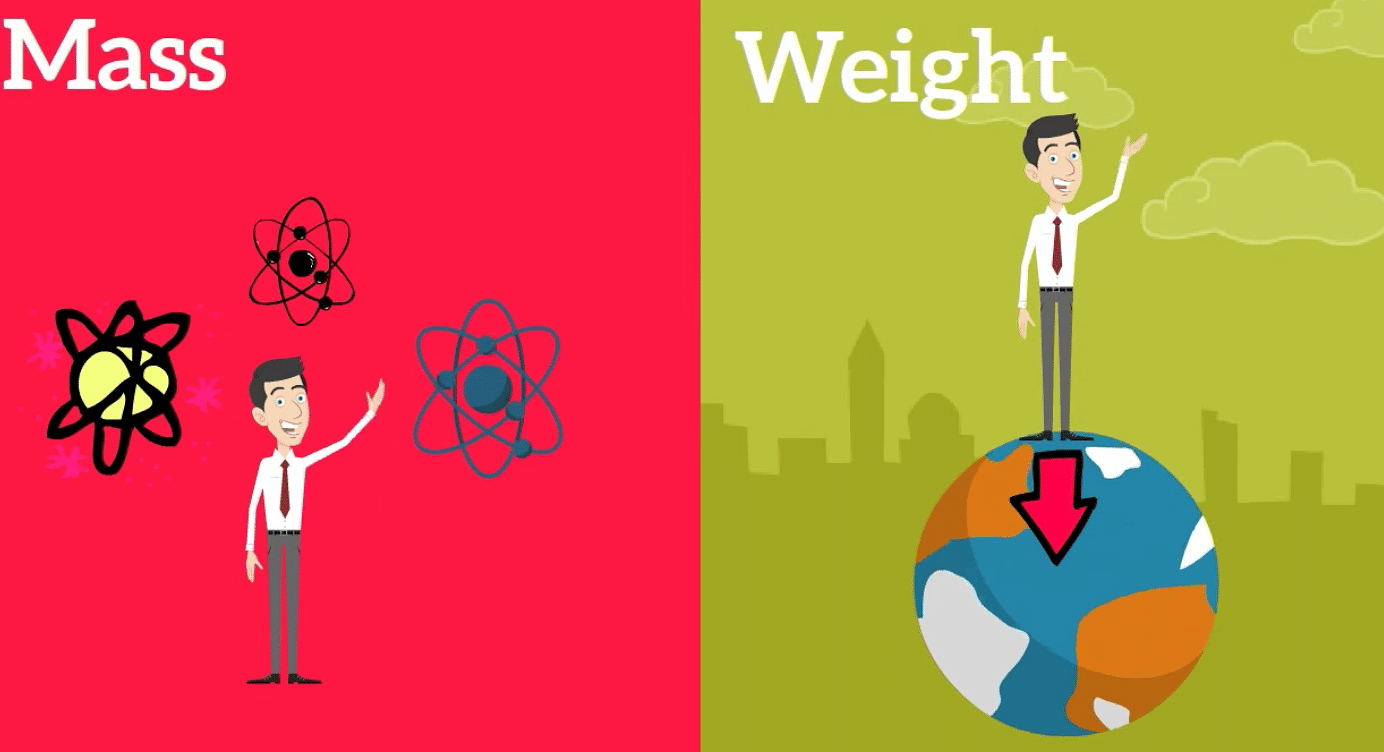
Mass and Weight
The system's overall mass is believed to be constant. This implies that the mass of an object or person is generally not affected by the gravitational field strength, regardless of its location. The magnitude of mass is expressed in kilograms and grams. Due to all these characteristics, mass is regarded as a scalar quantity.
What is Weight?
[Click Here for Sample Questions]
Weight is the primary feature of matter and one of the fundamental quantities in physics. Mass is a unit of measurement for the amount of matter in a body. The force of gravity exerted on a body is measured by its weight. Because weight is a force, it has the same SI unit as a force. Newton is the SI unit of weight.
Explain the relationship between mass and weight.The relationship between mass and weight can be expressed as: “Weight is basically the mass of a body which is further multiplied by the acceleration due to gravity.” Define weightlessness.Weightlessness can be defined as a condition of free-fall wherein the gravity is cancelled by the inertial force occurring from orbital flight or other gravity-negating situations. Weightlessness is often experienced because of the absence of feeling of weight. This condition usually occurs during the lack of contact forces acting on human bodies. |
Unit of Mass and Weight
[Click Here for Sample Questions]
Each object in physics has a unit that determines the body's standard measurement. The unit of mass and weight can be depicted as:
- A physical quantity like mass has a unit. The mass is measured in Kilograms, indicated by the symbol kg, in the International System of Units (SI).
- Weight is a vector quantity indicated by N that is measured in Newton.
Frequently Asked Questions Related to Mass and WeightQues. How can weight be calculated? (1 mark) Ans. c) Weight = Mass \(\times\) Gravitational Field Strength Ques. What is the formula for weight? (1 mark)
Ans. b) w = mg Explanation: The weight of a body or object is directly proportional to its mass. Thus, w = mg. |
Relationship between Mass and Weight
[Click Here for Sample Questions]
Consider a body with a lot of mass and weight. A huge object that is difficult to toss because of its weight is an example of this predicament. As a result, Newton's second law, which states that a free-falling object has an acceleration "g" as the magnitude, may be used to deduce the relationship between weight and mass.

Relationship Between Mass and Weight
If an item with a mass of 1 kg falls with an acceleration of 9.8 m s-2, the magnitude of the force is given as:
F = ma
= (1kg) (9.8m s-2)
= (9.8 kg m s-2)
= 9.8 N
As a result, the relationship between the weight and mass of an object having a mass of 1kg yields a weight of 9.8N.
Read More:
Difference between Mass and Weight
[Click Here for Sample Questions]
There are several differences between Mass and Weight. Some of them include:
| Parameters | Mass | Weight |
|---|---|---|
| Definition | The quantity of matter in a body, regardless of its volume or the forces operating on it, is defined as mass. | The gravitational force acting on an object is measured by its weight. |
| Units | The units of mass are kilograms (kg), grams (g), and milligrams (mg) (mg). | Newton is unit for Weight. |
| Effect of Gravity | At all times and in all places, mass remains constant. | The weight of an object is determined by local gravity. |
| Measurement | A pan balance, a triple-beam balance, a lever balance, or an electronic balance are used to determine mass. | We can measure weight with the help of Spring Balance. |
| Quantity | Scalar | Vector |
Things to Remember
- Weight is the gravitational force that acts on an object, while mass is a measure of how much stuff is in an item.
- There can never be zero mass. Weight is zero when no force of gravity acts on it.
- A scalar quantity is a mass. Weight is a vector quantity.
- The most common units of mass measurement are grams and kilograms. Weight is frequently expressed in newtons, which is a unit of force.
- An object's mass is an abstract characteristic. It is unaffected by the acceleration it will experience when applied to a force.
- The force that a given body exerts on the weighing scale is measured by the weighing scale. It does not take into account the body's mass.
- The object's mass is its inertial mass. It's never the same as a person's weight. The gravitational field affects weight.
Sample Questions
Ques: What are the physics of mass and weight? (2 marks)
Ans: The mass of anything is a measurement of how much force it will take to change its course. Weight can be described as the downward force exerted on an object by gravity. The gravitational force increases with the mass of the object: the more inertia it has, the stronger gravity pulls.
Ques: What role do mass and weight play in your life? (2 marks)
Ans: Weight is not a consistent measure of the amount of matter, whereas mass is. Mass is also responsible for the gravitational force that defines weight, which is why it is included in the weight equation. This is a clear indication that mass is the fundamental attribute of matter, and weight is a result of it.
Ques: What is the most significant aspect of the mass-weight connection to remember? (2 marks)
Ans: In a nutshell, mass refers to the amount of matter in an item, whereas weight refers to the gravitational force acting on that matter. So, weight is essentially the product of gravity. The conversion factor, g (10N/kg on Earth), is made up of units that divide kilograms by N.
Ques: Is mass proportional to weight? (2 marks)
Ans: Because mass is not affected by gravity, it differs from weight. The weight of an object is determined by its mass (the quantity of matter it contains) and gravitational attraction.
Ques: Is mass proportional to volume? (2 marks)
Ans: The mass is determined by the volume, and the volume is determined by the mass. If we keep the gas at the same pressure and temperature and fill an object with a variable volume, such as a balloon or a cylinder with a sliding end, the final volume is precisely proportional to the amount of gas we inject.
Ques: What does relativistic mass imply? (2 marks)
Ans: The mass ascribed to a moving body in the special theory of relativity is known as relativistic mass. As the body's velocity approaches the speed of light, the relativistic mass m becomes infinite, therefore even if a body is arbitrarily provided with massive amounts of momentum and energy, its velocity will always be less than c.
Ques: Name the SI unit of weight. (1 mark)
Ans: The SI unit of weight is Newton.
Ques: Does mass and weight vary as per location? (1 mark)
Ans: Mass generally does not change as per location, while weight varies according to location.
Ques: What is Mass? (1 mark)
Ans: Mass can be defined as the measurement of the amount of matter in a body. Kilogram (kg) is the SI unit of mass.
Read Also:



Comments