



Content Curator
Poisson distribution formula is used to calculate the likelihood of an independent event occurring at a fixed interval of time and with a constant mean rate. It is a type of probability distribution formula. The probability mass function of the Poisson distribution can also be applied to other fixed intervals such as volume, area, distance, and so on. If there are few successes over a large number of trials, a Poisson random variable will fairly describe the phenomenon. When the trials are indefinitely large, the Poisson distribution is used as a limiting case of the binomial distribution.
| Table of Content |
Key Takeaways: Poisson distribution, Poisson distribution formula, Binomial distribution, Probability, Probability distribution
Also read: Isosceles Triangle Theorems
Poisson Distribution
[Click Here for Sample Questions]
Siméon-Denis Poisson, a French mathematician, invented poisson distribution in the year 1830. Poisson distribution refers to the number of times an event may take place in a large number of attempts. Poisson distribution is a process that limits the binomial distribution. The Poisson random variable can be defined as following:
- The number of successes in two disjoint time intervals is independent of one another.
- The likelihood of success during a given small time interval is proportional to the length of the entire time interval.
There are certain conditions under which the poisson distribution formula is applicable which are as follows:
- n is the number of trials which tends to be infinite.
- P is the success probability which tends to be 0.
- np = 1 which is finite.
Also Read: Probability and statistics symbols
Poisson Distribution Formula
[Click Here for Sample Questions]
Assume X is the probability distribution of a Poisson random variable. The formula represents the number of successes that occur in a given time interval:
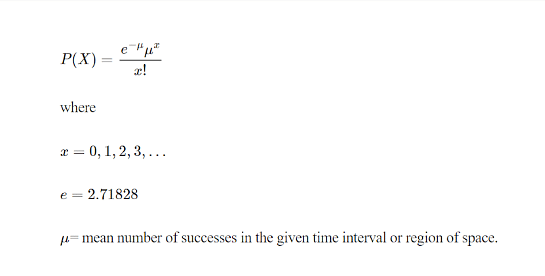
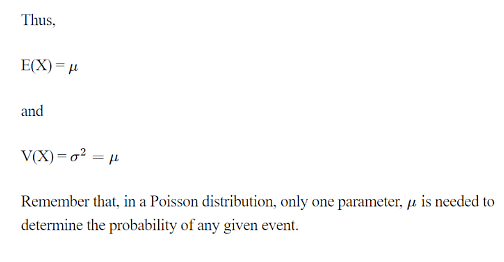
The mean and variance of the Poisson distribution are equal to μ when the μ is the average number of successes taking place at a given time interval or region in the Poisson distribution.
Poisson Distribution Table
[Click Here for Sample Questions]
As with the binomial distribution, there is a table that we can use under certain conditions to determine probability values with the Poisson Distribution. The values of f(x) = P(X x) are shown in the table, where X has a Poisson distribution with parameters.

Poisson Distribution Expected Value
[Click Here for Sample Questions]
The Poisson distribution's expected value is as follows:
E(x) = μ = d(eλ(t – 1))/dt, at t = 1.
E(x) = λ
Therefore, the expected mean value and variance of the Poisson distribution is equal to λ.
Points to Remember
- Poisson distribution is a probability distribution used in statistics to show how many times an event is likely to occur over a given time period.
- Poisson distributions are used when the variable of interest is a separate count variable.
- An event can occur any number of times at any point in time.
- The event can take into account any number of parameters such as volume, area, distance, and time.
- Each event is not dependent on all other events, which means that the probability of one event occurring does not affect the probability of another event occurring at the same time.
Also read: First Order Differential Equation
Sample Questions
Ques: Some vehicles pass through a busy road junction at a rate of 300 miles per hour on average. Determine the likelihood that none will pass in a given minute. How many people are expected to pass in two minutes? Determine the likelihood that this expected number will pass through in a given two-minute period. (3 marks)
Ans: The average number of cars per minute is
\(\Box\) = 300/60= 5
Applying the formula,

Expected number each 2 minutes= E(X) = 5*2=10
Now, with m = 10 , we have,
P(x10) = (e-101010)/ 10! = 0.12511
Ques: Given that only three students showed up for class today, calculate the likelihood that exactly four students will show up tomorrow. (3 marks)
Ans. Given,
Average rate of value(λ) = 3
Poisson random variable(x) = 4
Poisson distribution: P(X = x) = 
P(X = 4) = (e-3 . 34)
P(X = 4) = 0.16803135574154
Ques: The Acme Realty company sells two homes per day on average. What is the likelihood that exactly three homes will be sold tomorrow? (3 marks)
Ans: This is a Poisson experiment where the following are given:
- μ = 2; since on average 2 homes are sold per day, on average.
- x = 3; since we want to find the probability of 3 homes getting sold the next day.
- e = 2.71828; since e is a constant equal to approximately 2.71828.
We plug these values into the Poisson formula as follows:
P(x; μ) = (e – μ) (μx) / x!
P(3; 2) = (2.71828 – 2) (23) / 3!
P(3; 2) = (0.13534) (8) / 6
P(3; 2) = 0.180
Thus, the probability of selling 3 homes tomorrow is 0.180 .
Ques: In a cafe, customers arrive at a rate of 2 per minute on average. Using the Poisson distribution formula, calculate the probability of 5 customers arriving in 1 minute. (2 marks)
Ans: Given: λ = 2, and x = 5.
Using the Poisson distribution formula:
P(X = x) = (e-λ λx )/x!
P(X = 5) = (e-2 25 )/5!
P(X = 6) = 0.036
3.6% per minute is the probability of arrival of 5 customers.
Ques: Find the mass probability of function at x = 6, if the value of the mean is 3.4. (2 marks)
Ans: Given: λ = 3.4, and x = 6.
Using the Poisson distribution formula:
P(X = x) = (e-λ λx )/x!
P(X = 6) = (e-3.4 3.46 )/6!
P(X = 6) = 0.072
The probability of function is 7.2%.
Ques: If 3% of electronic units manufactured by a company are defective. Find the probability that in a sample of 200 units, less than 2 bulbs are defective. (3 marks)
Ans: The probability of defective units p = 3/100 = 0.03
Give n = 200.
We can consider p to be small and n to be large here. Thus it is a Poisson distribution.
Mean λ= np = 200 × 0.03 = 6
P(X= x) is given by the Poisson Distribution Formula as (e-λ λx )/x!
P(X < 2) = P(X = 0) + P(X= 1)
=(e-6 60 )/0! + (e--661 )/1!
= e-6 + e--6 × 6
= 0.00247 + 0.0148
P(X < 2) = 0.01727
The probability that less than 2 bulbs are defective is 0.01727
Ques: My computer crashes once every four months on average.
a) What is the likelihood that it will not crash within four months?
b) What is the likelihood that it will crash once every four months?
c) What is the likelihood of it crashing twice in four months?
d) What is the likelihood that it will crash three times in four months? (3 marks)
Ans.

Ques: On average, a person receives three emails per hour.
a) What is the likelihood that he will receive 5 emails in the next two hours?
b) What is the probability that he will receive more than 2 emails over a period of two hours? (3 marks)
Ans.

Also Read:



Comments