



Education Content Expert
Potassium Oxide is an ionic compound formed through the combination of Potassium and Oxygen. Potassium Oxide is represented by the chemical formula K2O.
- Potassium cannot be found in its natural state because it is highly reactive.
- It possesses valency +1 and rapidly reacts with oxygen atoms to generate K2O.
- When potassium is oxidized, Potassium Oxide, K2O, is formed as a grey crystalline substance.
- Potassium is burned in excess oxygen to generate potassium oxide.
- When dissolved in water, Potassium Oxide is a very corrosive alkali.
- Other names of Potassium Oxide are Potassium Monoxide, Di-potassium Hydroxide, and Kalium Oxide.
- Potassium Oxide is widely used as a fertilizer in agriculture.
Key Terms: Potassium Oxide, Potassium, Oxygen, Ionic Compound, Electron, Alkali, Potassium Nitrate, Fertilizers
What is Potassium Oxide?
[Click Here for Sample Questions]
Potassium Oxide is an ionic compound with the chemical formula K2O. It is made up of two elements namely Potassium and Oxygen.
- Potassium and Oxyegn are joined together by ionic bonds to form Potassium Oxide.
- Potassium has an oxidation state of +1, thus, it can easily lose one electron.
- It belongs to the group of alkali metals and has a high tendency to combine with any other counter ion to complete its valency.
- Potassium readily reacts with oxygen to form Potassium Oxide due to its reactivity.
- It has a pale-yellowish appearance and is commonly used as a fertilizer.
- Potassium Oxide is a strongly corrosive alkali when dissolved in water.

Potassium Oxide
Structure of Potassium Oxide
[Click Here for Sample Questions]
Potassium Oxide Formula is K2O. It has two potassium atoms and one oxygen atom. These atoms are connected by Ionic Bonds. Potassium is at an oxidation state of +1. The oxidation state of oxygen is -2. Two atoms of potassium unite with one atom of oxygen to balance the valency. Thus, Potassium Oxide has the chemical formula K2O.
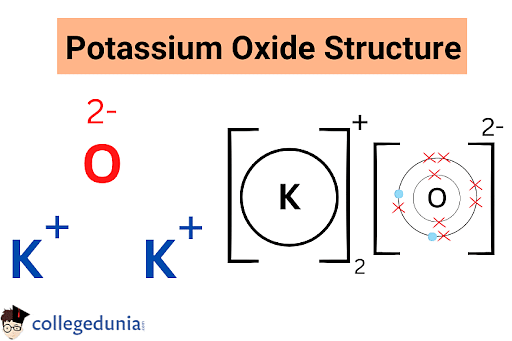
Potassium Oxide Structure
Read More:
Preparation of Potassium Oxide
[Click Here for Sample Questions]
Potassium Oxide can be prepared through the following ways:
(I) When potassium reacts with oxygen, Potassium Oxide is generated. The chemical equation for the reaction is as follows:
| 4K + O2 \(\rightarrow\) 2K2O |
(II) Potassium Peroxide is also generated during the above process, which, when treated with potassium, creates Potassium Oxide.
| K2O2 + 2K \(\rightarrow\) 2K2O |
(III) Potassium Oxide can be easily generated by heating potassium nitrate with potassium metal. The chemical equation for the reaction is as follows:
| 2KNO3 + 10K \(\rightarrow\) 6K2O + N2\(\uparrow\) |
(IV) When potassium peroxide is heated to 500 Degrees Celsius, potassium oxide is also formed. In other words, potassium peroxide decomposes to form potassium oxide and oxygen. The chemical equation for the reaction is as follows:
| 2K2O2 \(\rightarrow\) 2K2O + O2\(\uparrow\) |
Physical Properties of Potassium Oxide
[Click Here for Sample Questions]
The important physical properties of Potassium Oxide are as follows:
- Potassium Oxide has a solid pale yellow color.
- The molecular weight of Potassium Oxide is 94.2 g/mol.
- K2O has a density of 2.35 gm/cm3.
- Potassium Oxide has a melting point of 740 °C.
- It can be dissolved in ether and ethanol.
| Physical Properties of Potassium Oxide | |
|---|---|
| Chemical Name | Potassium Oxide |
| Chemical Formula | K2O |
| Density | 2.35 g/cm³ |
| Molecular Weight/ Molar Mass | 94.2 g/mol |
| Charge | 0 |
| Melting Point | 740 °C |
| Odour | Odourless |
| Appearance | Pale Yellow Solid |
| Heat Capacity | 83.62 J/mol·K |
| Complexity | 2.8 |
| Solubility | Soluble in EtOH and Ether |
Chemical Properties of Potassium Oxide
[Click Here for Sample Questions]
The chemical properties of Potassium Oxide are:
(I) Potassium Hydroxide is formed when potassium oxide reacts with water. The chemical formula is shown below.
| K2O + H2O \(\rightarrow\) 2KOH |
(II) Potassium chloride and water are formed when potassium oxide interacts with hydrogen chloride. The chemical formula is shown below.
| K2O + 2HCl \(\rightarrow\) 2KCl + H2O |
Uses of Potassium Oxide
[Click Here for Sample Questions]
Important uses of Potassium Oxide are listed below:
- Potassium Oxide or “pure potash” is expressed as K2O, and has been designated the commercial standard or unit.
- It is used as a fertilizer in agriculture.
- It may also be used to make glass and soap, and in tiny amounts.
- Potassium Oxide can be also be utilized for medical purposes.
- It is used in treatment for fungal granulomatous disease and infections caused by zygomycetes.
- For over a century, it has been used to treat actinomycosis and actinobacillosis in cattle.
- It is also used to treat sporotrichosis and botryomycosis.
- It is utilized in the aircraft sector to make structural composites and lightweight bowls.
- It is also used in several medicines at trace levels.
Check More:
Things to Remember
- Potassium Oxide is an ionic compound formed when Potassium and Oxygen combines with each other.
- It contains both Potassium and Oxygen ions in a 2:1 ratio.
- The chemical formula of Potassium Oxide is K2O.
- Potassium Oxide is a pale yellow colour crystalline solid.
- It is prepared by heating potassium nitrate with potassium metal.
- It reacts with hydrogen chloride to form Potassium chloride and water.
- Potassium Oxide is majorly used in fertilizers, cement formulas, and in glassmaking formulas.
Sample Questions
Ques. What are the Uses of Potassium Oxide? (3 Marks)
Ans. The uses of Potassium Oxide are as follows:
- Potassium Oxide is frequently used as a fertilizer in the agriculture industry.
- It is also utilized in the production of soaps as well as the production of glass.
- Potassium Oxide is also used in several medical procedures such as treatment for fungal granulomatous disease and infections caused by zygomycetes.
Ques. State the Physical Properties of Potassium Oxide. (3 Marks)
Ans. The physical Properties of Potassium Oxide are as follows:
- Density: 2.35 g/cm³
- Molecular Weight: 94.2 g/mol
- Melting Point: 740 °C
- Odour: Odourless
- Appearance: Pale Yellow Solid
- Heat Capacity: 83.62 J/mol·K
- Solubility: Soluble in EtOH and Ether
Ques. Is Potassium Oxide acidic or basic? (2 Marks)
Ans. Potassium Oxide is a basic oxide in nature. It ia a pale yellow solid that is the simplest oxide of teh element potassium. FeO (Iron Oxide) and CaO (Calcium Oxide) are two other notable examples of basic oxides.
Ques. How is Potassium Oxide produced? (3 Marks)
Ans. Potassium Oxide can be obtained by reacting potassium with oxygen.
4K+O2 \(\rightarrow\) 2K2O
When Potassium is combined with oxygen, Potassium Peroxide is also generated, which, when treated with potassium, creates Potassium Oxide.
K2O2 +2K \(\rightarrow\) 2K2O
Ques. What happens when Potassium Oxide reacts with water? (2 Marks)
Ans. Potassium Hydroxide is formed when potassium oxide reacts with water. The chemical equation for the reaction is as follows:
K2O+H2O \(\rightarrow\) 2KOH
The reaction between Potassium Oxide and water is a fast, vigorous one.
Ques. Is K2O Ionic or Covalent? (2 Marks)
Ans. K2O stands for Potassium Oxide. Potassium Oxide is an ionic compound. During the creation of potassium oxide, two potassium atoms send two electrons (one electron from each potassium atom) to an oxygen atom to establish an ionic bond.
Ques. Does potassium oxide cause any health hazards? (3 Marks)
Ans. Potassium Oxide has the chemical formula K2O and is an inorganic substance. It is highly corrosive and aggressive in both moisture and air. As a result, it must be handled with caution and safety during chemical reactions or while working with it. Some of the health risks associated with potassium oxide are as follows:
- It might cause skin irritation if it comes into touch with the skin.
- If it gets into your eyes, it can cause significant harm.
- It can cause coughing and shortness of breath when inhaled.
- It can irritate the nose, throat, and lungs when inhaled.
As a result, while working in the laboratory with Potassium Oxide, it is vital to wear gloves, lab coats, and safety eyewear.
Ques. What is Potassium Superoxide? (2 Marks)
Ans. Potassium Superoxide has the chemical formula KO2 and is an inorganic substance. The oxygen oxidation state in KO2, potassium superoxide, is -1. It is a paramagnetic yellow solid that decomposes in damp air. Its chemical and physical properties differ from those of potassium oxide and potassium peroxide.
Ques. When Potassium Oxide is dissolved in water, what is the pH of the solution formed? (3 Marks)
Ans. Potassium Oxide is an ionic chemical with a basic structure. When it is dissolved in water, it totally decomposes into K+ and OH ions. The pH of a solution is calculated using the concentration of [OH] ions.
- pH = 14 - pOH
- pH = 14 – 1.48 = 12.52
As a result, the pH of the resulting solution will be 12.52.
Ques. What is Potassium Hydroxide? (3 Marks)
Ans. Potassium Hydroxide is an inorganic compound which is odorless, white, or slightly yellow. It has the chemical formula KOH.
- It is also known as Caustic Potash, lye, and Potash lye.
- It is available in various forms such as a powder, flakes, or pellets.
- It is an alkali metal hydroxide and is considered to be a very powerful base.
For Latest Updates on Upcoming Board Exams, Click Here: https://t.me/class_10_12_board_updates
Check-Out:



Comments