



Education Journalist | Study Abroad Lead
Potassium Iodide is a metal-halide salt that features an ionic bond between the cation, potassium (K+), and the anion, iodide (I-). It is an inorganic ionic compound that has the chemical formula as KI. The compound has a saline taste and is bitter in nature. Potassium Iodide is used as an effective and safe medicine that is also recognized by World Health Organization and is also used for many commercial and industrial applications. Potassium Iodide is produced by treating KOH with iodine, its structure, properties, it benefits, and side effects. KI which is a white solid turns yellow when exposed to air due to oxidation.
Read About: Different Types of Bonds
| Table of Content |
Key Terms: Potassium Iodide, Anion, Metal-Halide, Thyroid Gland, Iodine, Radioiodine, Potassium, Ionic Bond, Redox Reaction
What is Potassium Iodide?
[Click Here for Sample Questions]
Potassium Iodide is a chemical compound consisting of Potassium (K) and Iodine (I). It has the chemical formula KI. Potassium Iodide is a colorless or white color salt of stable iodine, not radioactive in nature which is usually used for medication and dietary supplement purposes. Stable iodine is important for the body to make thyroid hormones and to mitigate the potential effects of radioactive iodine. It has been used medically since 1820.
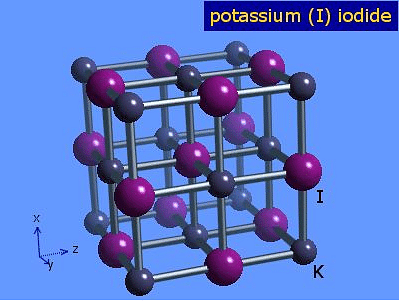
Potassium Iodide Structure
Potassium Iodide is a metal halide that contains an ionic bond between potassium cation (K+) and iodide anion (I-). This compound is prepared by reacting Iodine with a hot solution of potassium hydroxide. It is a chemical necessary for the smooth functioning of the thyroid gland and it is also listed on the World Health Organization’s list of essential medicines.
Read More:
| Important Topics Related to Potassium Iodide | ||
|---|---|---|
| Decomposition Reaction | Displacement Reaction | Galvanic Corrosion |
| Oxidizing Agent | Reducing Agent | Fentons Reaction Agent |
| Potassium Ferrocyanide | Potassium Chlorate | Transition Element Oxidation State |
Structure of Potassium Iodide
[Click Here for Sample Questions]
Potassium with an oxidation number of +1 and iodide with an oxidation number of -1 are held together by an ionic bond, having the formula KI. The molecular structure of KI is given below:
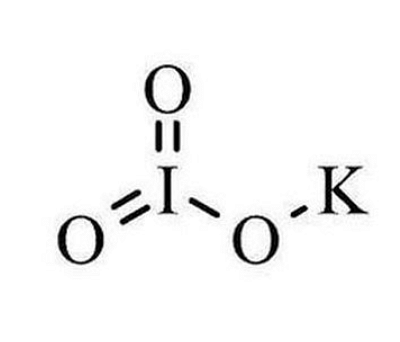
Potassium Iodide Structure
Physical Properties of Potassium Iodide
[Click Here for Sample Questions]
Some of the important physical properties of Potassium Iodide are tabulated below:
| Important Physical Properties of Potassium Iodide | |
|---|---|
| Molecular Formula | KI |
| Molecular Weight | 166.0028 g/mol |
| Density | 3.12 g/cm³ |
| Solubility | Soluble in water |
| Color/Form | Colorless or white, Crystals or Powder |
| Taste | Strongly bitter/Saline |
| Boiling point | 1323°C |
| Melting point | 681°C |
| pH | Alkaline usually pH between 7-9 |
| Refractive Index | 1.677 |
Chemical Properties of Potassium Iodide
[Click Here for Sample Questions]
- Since iodide is a mild reducing agent, I- gets easily oxidized to I2 by oxidizing agents like Cl- (chlorine). The reaction is given by:
2KI + Cl2 → 2KCl +I2
- When Potassium Iodide is rinsed in dichloromethane, it is observed that even air can oxidize iodide and it is evident by the formation of a purple extract during the process.
- Potassium Iodide is even more easily oxidized under acidic conditions, because of the formation of a powerful reducing agent, hydroiodic acid (HI).
- KI forms I3- when combined with iodine
KI + I2 →KI3
Here I3- formed is highly soluble in water and it is used in redox titrations.

Potassium Iodide Crystals
Read More: Acid, Bases and Salts
Preparation of Potassium Iodide
[Click Here for Sample Questions]
Potassium Iodide can be prepared in laboratories as well as in industries. Some methods are given below:
- In the laboratory, it is prepared by treating iodine with a hot solution of potassium hydroxide. The pale yellow solution obtained is evaporated to dry it and the residue is then heated with charcoal to reduce iodate to iodide.
6KOH + 3I2 → KIO3 + 5KI + 3H2O
KIO3 + 3C → KI + 3CO
- In Industries, it is prepared by using potassium carbonate and iron fillings. In iodine solution, iron filings are agitated to form ferric iodide. Then it is boiled with a concentrated solution of potassium carbonate to form potassium iodide.
4Fe + 5I2 → 2FeI2FeI3
FeI2FeI3 + 4K2CO3 → 8KI + FeO.FeO3 + 4CO2
Read More: List of Strong Acids
Benefits of Potassium Iodide
[Click Here for Sample Questions]
Radioactive accidents lead to the production of a large number of active isotopes of iodine such as the I-125 and I-131. If it enters the body, it would go into the thyroid gland rendering it cancerous or non-functional.
- When the KI compound is taken, it will lead to a saturation of the thyroid gland which will stop it from intaking more iodine (which is radioactive in nature).
- Therefore, the thyroid gland will be saved from the harmful effects.
- However, potassium iodide does nothing for people that are exposed to Strontium-90, radio-cesium, etc.

Benefits of Potassium Iodide in a Radiological Accident
Read More: Isotopes
Uses of Potassium Iodide
[Click Here for Sample Questions]
Some of the most important uses of potassium iodide are listed below.
Medical Use
- Potassium Iodide is used in case of a medical emergency to block radioactive Iodine (radioiodine) from entering the thyroid gland that can cause radiation injury.
- Potassium Iodide prevents or reduces the amount of radioiodine in the gland and thus reduces the risk of thyroid cancer or some other type of thyroid disease.
- Potassium Iodide is also useful for long-term lung problems.
- A person suffering from asthma or chronic bronchitis or emphysema can use potassium iodide as its breaks up mucus in the airways or loosen congestion in the chest and throat and thus making it easy for the person to breathe.
- Potassium iodide is also used for dermatological diseases.
- It is effective in circumstances where neutrophils predominate in the early stage of the disease.

Potassium Iodide as a Dietary Supplement
Industrial Use
- Potassium iodide is used to prepare silver iodide (AgI). It is used for high-speed photographic films.
KI + AgNO3 → AgI + KNO3
- Potassium iodide is used in the preparation of aryl iodides in the Sandmeyer reaction, starting from aryl amines in organic synthesis.
- Potassium iodide is a component along with iodine in the electrolyte of dye-sensitized solar cells.
Side Effects of Potassium Iodide
[Click Here for Sample Questions]
Potassium iodide contains many side effects if overdosed, so it is always advised to take potassium iodide after consulting a doctor.
- Potassium iodide may cause stomach or gastrointestinal issues, allergic reactions, rashes, and inflammation of the salivary glands.
- A condition known as hypothyroidism may develop in newborn infants especially babies less than 1 month old.
- Thyroid hormone levels turn out to be very low on receiving more than one dose of KI. If it is not treated immediately, it can lead to brain damage.
- Potassium Iodide is not advisable for people having conditions like hypocomplementemia vasculitis and dermatitis herpetiformis that are linked to iodine sensitivity risk.
Things to Remember
[Click Here for Sample Questions]
- Potassium iodide is a non-prescribed drug.
- Iodine is an important part of our health but iodine in KI is much stronger than in table salt.
- Table salt or food rich in iodine does not have much iodine required to block radioactive iodine from entering the thyroid gland. Therefore, table salt cannot replace KI.
- Physical properties: Colorless, Odorless, Granular powder, Soluble in water and alcohol.
- Chemical properties: Reaction with chlorine and Reaction with hydrogen peroxide.
- Some common side effects of KI can be vomiting, diarrhea, abdominal pain, headache, goiter, rash, allergic reaction, and swelling of salivary glands.
- Foods that contain potassium iodide are seaweed, cod (white fish), dairy products, shrimp, tuna, etc.
- The thyroid gland is an endocrine gland in the base of our neck. It is an organ shaped like a butterfly and it releases hormones that control metabolism in our body.
Previous Year Questions
- Which metal displaces hydrogen from acids. [JIPMER 2000]
- Choose the correct option. [JEE MAIN 2021]
- Which depicts the oxidizing nature of peroxide? [JEE MAIN 2021]
- Which statement is not true for oxidation? [KCET 2021]
- The oxidation number of phosphorous in phosphoric acid. [NEET 1999]
- When chlorine gas reacts with concentrated NaOH, the oxidation number of chlorine changes from? [NEET 2012]
- Phosphorous has an oxidation of +3 in? [NEET 1994]
- There is no change in valency in which of the reactions? [NEET 1994]
- The oxide which doesnt acts as a reducing agent is? [NEET 1995]
- Which of the following is a redox reaction? [NEET 1995]
- What is the role of hydrogen peroxide in the given reaction? [NEET 2014]
- Which element undergoes maximum oxidation number change? [NEET 2012]
- Which species undergoes disproportionation reaction? [NEET 2018]
- Which does not show oxidizing behaviour? [NEET 2016]
- Oxidation state of Cr in CrO5 is? [NEET 2014]
- What is the change in oxidation number of carbon? [NEET 2020]
- Which is not true for oxidation? [KCET 2021]
- The given reaction is an example of which type of reaction? [KCET 2017]
- Alkali metals have negative reduction potential and hence they behave as? [KCET 2013]
- The oxidation number of Br changes to? [KCET 2006]
- What is the value of X in the given ionic equation? [KCET 2007]
Sample Questions
Ques. What is Potassium Iodide? (2 marks)
Ans. Potassium iodide is a chemical compound containing potassium and iodine, its chemical symbol is KI. It is basically a drug used for the treatment and for the protection of the thyroid gland from the injury that may be caused by the release of radioactive iodine during the accident at a nuclear power plant.
Ques. How does potassium iodide work on the thyroid gland? (5 marks)
Ans. Potassium iodide fulfills the requirement of iodine in the thyroid gland and thus protects it from radioactive iodine. Suppose a person is taking the dose of potassium iodide and due to some unfavorable situation the person is exposed to radioactive iodine, but it will have no effect on the thyroid gland because the radioactive iodine will not be absorbed by the gland due to the existent KI in the body. Potassium iodide does not provide protection to other parts of the body.
Ques. How potassium iodide is prepared? (3 marks)
Ans. Potassium iodide can be prepared by reacting elemental iodine (I) with a hot solution of potassium hydroxide (KOH)
3I2 + 6KOH → 5KI + KIO3 + 3H2O
It is mostly used in the form of a saturated solution. The KI solution is always advisable to take with water, juice, or milk. It is more preferable if pills are taken rather than the solution.
Ques. How do nuclear accidents affect the thyroid? (3 marks)
Ans. During a nuclear accident, nuclear fission products are formed and release excessively nuclear energy making the gland very unstable. This undergoes beta decay very quickly due to the instability and makes them radioactive. The fission product releases iodine during exposure which is the most dangerous one. Radioactive iodine, also called radioiodine is absorbed by the gland whenever breathed in or ingested and it may cause thyroid cancer. The Chernobyl disaster is one such example of a nuclear accident.
Ques. When should KI be actually taken and for how long it is effective? (3 marks)
Ans. Potassium iodide should be immediately taken after exposure to nuclear radiation or it should be taken beforehand. The effectiveness of KI reduces if it is taken three to four hours later after exposure to radioactive.
KI is effective only for 24 hours from the time it is administered. If the person is removed from the affected area, there is no need to continue it.
Ques. Who can take potassium iodide? (3 marks)
Ans. People having low amounts of iodine in their thyroid are recommended to take potassium iodide. Infants, children, pregnant women are only recommended to take KI if they are exposed to nuclear radiation on the advice of a doctor. Persons who are iodine sensitive should avoid taking potassium iodide. People above 40 years should not take KI until it is a medical emergency.
Ques. Does potassium iodide have side effects? (3 marks)
Ans. Yes, it has. When potassium iodide is taken more than recommended or in a stronger dose, it can cause severe health issues including death. A single dose that lasts for 24 hours is all that is required to protect the thyroid gland. In a severe situation, if a person is exposed to radioiodine for more than 24 hours, the emergency officials may prescribe the doses for a few days.
Ques. What is a saturated potassium iodide solution? (2 marks)
Ans. Saturated potassium iodide solution means an equal amount of potassium iodide in an equal amount of water. The solution must be in an equilibrium state. For instance, 100 g of potassium iodide in 100ml of water equates to approximately 50 mg/drop.
Also Check:



Comments