



Education Content Expert
Projectile Motion is a two-dimensional motion of an object thrown or projected into space at some angle. The object thrown into space is referred to as a Projectile upon which the only acting force is Gravity. Trajectory is the path followed by a projectile. Projectile Motion can be studied by breaking the combined motion into two one-dimensional motions i.e. along horizontal and vertical directions.
In projectile motion, there are two independent rectilinear motions simultaneously:
- Along the x-axis: Uniform velocity, accounting for the horizontal (forward) motion of the particle.
- Along the y-axis: Uniform acceleration, accounting for the vertical (downward) motion of the particle.
Read More: NCERT Solutions for Class 11 Physics Motion in a Plane
Key Terms: Projectile Motion, Projectile Momentum, Velocity, Angle of Projection, Trajectory, Projectile, Acceleration, Motion
What is Projectile?
[Click Here for Sample Questions]
Projectile is a thing or object thrown into space upon which gravity is the only acting force. Gravity is the only primary acting force for a projectile. This does not mean that other forces do not act on it, only that their effect is minimal compared to gravity. The path followed by a projectile is referred to as a trajectory. A tennis ball batted or thrown is an instance of the projectile.
Projectiles can be roughly categorized into three types:
- Projectile that is free to fall from a considerable height.
- Projectile that is projected straight up.
- Projectile upwards at an angle to the horizontal.
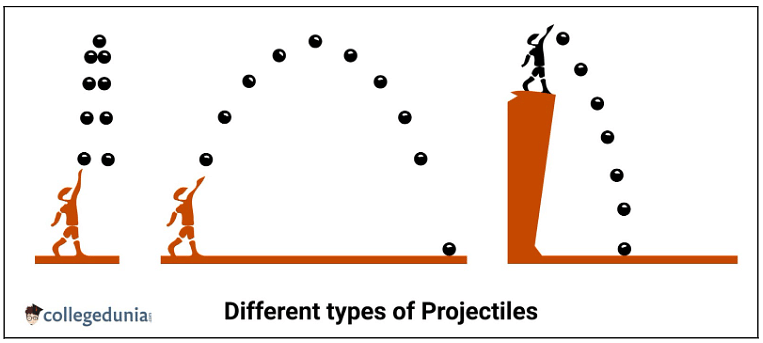
Types of Projectile
Read More: Projectile Motion Formula
What is Projectile Motion?
[Click Here for Previous Year Questions]
When a particle is thrown obliquely near the surface of the earth, it moves along a curved path under constant acceleration directed towards the centre of the earth. The path of such a particle is called a projectile, and this motion is known as projectile motion.
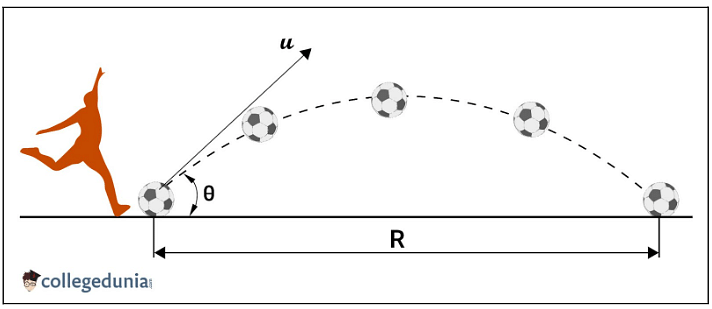
Projectile Motion
There are two simultaneous independent rectilinear motions in Projectile Motion:
- Along the x-axis: Uniform Velocity which is repsonsible for the horizontal (forward) motion of the particle.
- Along the y-axis: Uniform Acceleration which is repsonsible for the vertical (downward) motion of the particle.
Acceleration of a particle in horizontal and vertical projectile motion is:
- The acceleration due to gravity (g) acts vertically downside.
- The velocity in the horizontal direction remains constant, which indicates that there is no acceleration in the horizontal direction of the projectile.
Read More:
| Relevant Concepts | ||
|---|---|---|
| Motion in a Straight Line | Oscillatory Motion | Motion in a Plane |
| Horizontal Motion | Simple Harmonic Motion | Uniform and Non-Uniform Motion |
Real-Life Examples of Projectile Motion
[Click Here for Sample Questions]
In real life, one can observe numerous instances of projectile motion around us. For example, basketing a basketball, javelin throw, water coming out of a pipe. Some examples are discussed in detail below.
Throwing a Ball or Anything
When a ball is thrown up into the air, we notice that it travels for a certain distance and then falls. This path that the object follows seems to be like a parabola or U-shaped curve. This part of the path is neither linear nor circular; it is known as projectile motion, and the path followed by the ball or the object is known as its trajectory.
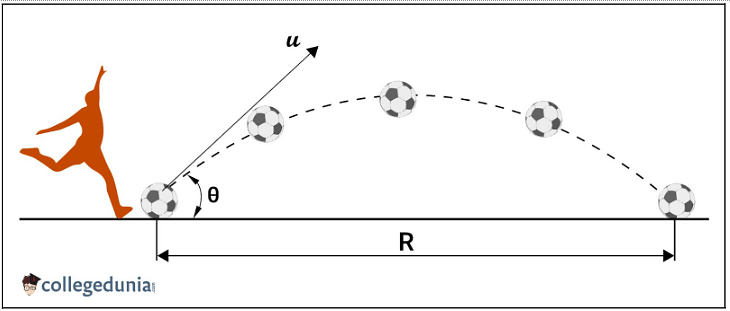
Projectile Motion of Ball
- When we throw the ball horizontally in the air, it forms a loop that goes up and up in a parabola-like pattern and then comes down. This is due to projectile motion.
- In physics, especially mechanics (the study of physical change), the speed of an object is calculated by dividing its distance from an observer by the time it has travelled.
- For example, If an object covers 30 meters in two seconds, it is travelling at a speed of 15 meters per second (15 m/s). This principle applies to any type of force exerted on an object because all forces change in motion or state of motion.
Bullet Fired from a Gun
When an object is moved through the air, multiple forces act on it simultaneously. The force from the ignition of the gunpowder and the force of gravity combine to affect how long and in what direction the bullet moves. However, as soon as the bullet exits the gun, gravity starts exerting more force and starts guiding it toward the earth whether it falls or not depends entirely on how much opposing force it finds in its path.
Read More: Motion in a Plane Important Questions
Total Time of Flight
[Click Here for Previous Year Questions]
In projectile motion, the Time of Flight is defined as the total time taken by an object to fall after being projected. It is the total time up to which an object remains in space before falling onto the ground.
In the vertical direction, the resultant displacement (s) = 0. Therefore, the time-of-flight formula using the equation of motion is given:
gt2 = 2(uyt – sy) (Where, uy = usinθ and sy = 0)
gt2 = 2t × (usinθ)
Hence, Time of Flight Formula (t) will be:
Total Time of Flight (t) = \(\frac{2usin \theta}{g}\)
Horizontal Range
[Click Here for Sample Questions]
Horizontal Range is defined as a distance covered by a projectile horizontally. It depends on the initial velocity, acceleration due to gravity and angle of projection of a projectile. Hence it is given by
Horizontal Range (OA) = Total Flight Time (t) × Horizontal component of velocity (ux)
R = (ucosθ) × (2ug×sinθ)
∴ The formula of Horizontal Range in a projectile motion will be (R):
Horizontal Range (R) = \(\frac{u^2sin2 \theta}{g}\)
Read More: Path Length
Maximum Height of Projectile
[Click Here for Previous Year Questions]
An object’s maximum height is the highest vertical position along its path. The projectile's horizontal displacement is known as its range. The projectile range depends on the object’s initial velocity.
If v is the initial velocity, g is the acceleration due to gravity and H is the maximum height in meters, θ is the angle of the initial velocity from the horizontal plane (radians or degrees).
The formula for the maximum height of the projectile will be
H = \(\frac{v_0^2sin^2 \theta}{g}\)
Equation of Trajectory
[Click Here for Sample Questions]
Projectile follows a parabolic trajectory in projection. Equation of trajectory gives the relation between the motion in the x and y directions. Using the equation of trajectory we can determine the x and y coordinates of a projectile at any point in time during the projectile motion.
Equation of Trajectory = xtan θ – \(\frac{gx^2}{2u^2cos^2 \theta}\)
This is the equation of projection in projectile motion, and it proves that projectile motion is always parabolic.
Important Points Related to Projectile Motion
[Click Here for Previous Year Questions]
- At the highest point, the linear velocity is m (u cos θ) and the kinetic energy is 1/2m (u cosθ)2.
- A projectile has a parabolic path.
- At the lowest point, Kinetic energy is 1/2mu2.
- At the lowest point, Linear momentum = mu.
- A projectile acting vertically downward has an acceleration g equal to and constant throughout the motion.
- The angular speed of the projectile = muhcosθ, where h = height.
- For angular projection, the angle between acceleration and velocity differs from 0° < θ < 180°.
- The maximum height happens when the projectile covers a horizontal distance that is equivalent to half of the horizontal range, i.e., R/2.
- When the maximum range of the projectile is R, then its maximum height will be R/4.
Check More:
| Related Topics | ||
|---|---|---|
| Uniform Circular Motion | Rotational Kinetic Energy | Angular Momentum |
| Rolling Motion | Moment of Force | Angular Displacement |
Projectile Motion Formulas
[Click Here for Sample Questions]
Here are some important formulas related to Projectile Motion:
| Projectile Motion Formulas | |
|---|---|
| Time of Flight | T = 2(u sinθ /g) |
| Time to Reach Maximum Height | Tmax = (usinθ)/g |
| Horizontal Range of projectile (R) | R = u2 sinθ/ 2g |
| Maximum Horizontal Range (at θ= 45°) | Rmax = u2/2g |
| Maximum height of Projectile (H) | H = (u sinθ)2 / 2g |
| Equation of Trajectory | y = x tanθ – g2u2 /2u2cos2θ |
| Vertical Displacement after t Seconds | y = (u sinθ) t – 1/2gt2 |
| Horizontal Displacement (x) after t Seconds | x = (u cosθ) t |
Projectile Motion Solved Example
[Click Here for Previous Year Questions]
Here is a solved example on Projectile Motion to understand the concept better:
Example: A projectile is projected from point Q at an angle of 30° with an initial velocity of 30 m/s. If the projectile hits the ground at M, then find the following (Note that g = 10m/s2):
- Total Time of Flight
- Horizontal Range of Projectile (QM)
- Maximum height of Projectile
Solution: Given that,
- Initial Velocity (u) = 30m/s.
- Angle of Projection, θ = 30°
(a) Total Time of Flight
T = 2u sinθ / g
Putting the provided values,
T = (2 × 30 sin 30°)/10
= 3 s
(b) Horizontal Range of Projectile
R = (u2sinθ) / 2g
Putting the provided values, we get,
R = [(30)2 sin 60°] / 10 [sin60° =√3/2 ]
= 45 √3 m.
(c) Maximum Height of Projectile
H = (usinθ)2/2g
Putting the provided values,
H = [(30)2sin2(30°)] / (2 × 10) [sin30° = 1/2]
= 11.25 m
Things to Remember
- Projectile Motion is a motion experienced by an object in the air under the influence of gravity.
- Projectile is a thing or object thrown into space upon which gravity is the only acting force.
- The path followed by a projectile is referred to as a Trajectory.
- Time of Flight Formula (t) is (2usinθ)/g.
- Horizontal Range (R) in a projectile motion is given by R = (u2sin2θ)/g.
- Maximum Height (H) of the Projectile is given by, H = (usinθ)2/2g.
- Equation of Trajectory is y = xtanθ - gx2/2u2cos2θ.
- At the highest point, the linear velocity is m (u cos θ) and the kinetic energy is 1/2m (u cosθ)2.
- At the lowest point, Kinetic energy = 1/2mu2 and Linear Momentum= mu.
Previous Years’ Questions
- Parabolic path of a projectile as seen by another similar projectile…
- The trajectory of a projectile projected from origin is given by the… (KCET - 2019)
- A projectile has…
- The equations of motion of a projectile are given by…
- From the ground, a projectile is fired at an angle of… (KEAM)
- During projectile motion, the horizontal velocity…
- The speed of a projectile at its maximum height is half of its… (AIPMT 2 - 2010)
- Assertion (A) : The velocity of a projectile at a point on its trajectory… (AP EAPCET)
- Generally the path of a projectile from the earth is parabolic… (AFMC - 2010)
- The velocity with which a projectile must be fired so… (AIIMS - 2003)
Sample Questions
Ques. What assumptions are applicable in Projectile Motion? (3 Marks)
Ans. The assumptions applicable in Projectile Motion are:
- Since there is no frictional resistance in air, the external resistance is assumed to be zero unless otherwise specified in the figure.
- Earth's rotation and curvature have little influence; so, it doesn't count.
- At all points of projectile motion, the acceleration because of gravity is constant in magnitude and direction.
Ques. What are the factors that affect projectile motion and how do they affect it? (3 Marks)
Ans. The factors that affect Projectile Motion are:
- Initially, the faster the body moves, the further it travels.
- The greatest range is achieved by advancing to 45 degrees.
- A problem is wind velocity, which complicates ballistics significantly. You can qualitatively infer whether the wind blows in the opposite direction of motion, in the same direction of motion, or sideways to motion.
- The moment of inertia can also influence whether the projectile spins or rotates about the flight axis, but this is beyond the scope of most courses.
Ques. Give two examples where one can visualize projectile motion in actual life. (3 Marks)
Ans. In real life, one can visualize various projectile motions. Some examples are
Shooting a Canon: A fired cannonball does not travel in a straight line; instead, it travels on a curved path. This is because the ball is fired at an angle which causes it to move vertically and horizontally. Consequently, projectile motion is said to exist.
Sneezing: Sneezing is our body's natural reaction to expel foreign material from our mouth and nose. Particles and droplets from your mouth travel as projectiles when you sneeze and land on nearby objects and surfaces.
Ques. Is projectile motion exhibited by a car turning on a curved road? (3 Marks)
Ans. No, since there is no vertical component to the turning of the vehicle, it cannot be classified as a projectile action. However, if the car is launched into the air while turning, it can be called projectile motion. When a stunt is performed, this is the position.
When an object moves in projectile motion, it uses both horizontal and vertical momentum. Vertical velocity is one of the most important conditions for a stuntman to jump a car on a ramp and land safely on the other side of the setup.
Ques. What is the maximum horizontal range covered by a body of mass m, acceleration g due to gravity, launched at an angle θ from the ground with an initial velocity of v? (3 Marks)
(a) R = v2 (sin 2θ)/g
(b) R = v2 (sin θ)/2g
(c) R = v2 (sin 2θ)/2g
(d) R = v2 (sin θ)/g
Ans. (a) R = v2 (sin 2θ)/g
Explanation: The computation for range utilizes the horizontal component of the initial velocity and time. Range = Time taken for the motion x distance. The time can be found using the fact that the vertical velocity goes to zero at maximum height (i.e. halfway through the period) and using the first equation of motion for this. So, on calculation, the range will be obtained as R = v2 (sin 2θ)/g.
Ques. What is the basis behind the theory of Projectile Motion? (1 Mark)
Ans. Projectile is defined as an object thrown with a certain initial velocity and then allowed to move by gravity alone without the aid of an engine or fuel. In this way, projectile motion is understood.
Ques. A ball of mass 100 g, launched at an angle of 30° from the ground with an initial velocity of 11 m/s, acceleration because of gravity is g = 10 m/s2, what is the maximum height? (3 Marks)
(a) 1.5 m
(b) 3.0 m
(c) 1.0 m
(d) 2.0 m
Ans. (a) 1.5 m
Explanation: The maximum height formula is h = (v sinθ)2/2g. Here, g = 10 m/s2, v = 11 m/s, θ = 30°. So, putting the values in the formula we get,
h = (11 sin30°)2/ (2*10) [sin30° = 1/2]
h = 1.5125
∴ The maximum height achieved will be 1.5125 m. This value can be rounded up to 1.5.
Ques. When can we attain maximum range in simple projectile motion? (3 Marks)
(a) When θ = 45°
(b) When θ = 60°
(c) When θ = 90°
(d) When θ = 0°
Ans. (a) When θ = 45°
Explanation: The horizontal range formula is R = v2(sin 2θ)/g.
The maximum range will be when sin 2θ = 1, which indicates that 2θ = 90°, which in turn indicates that θ = 45°. So, the correct answer is when θ = 45°.
Ques. When can we attain a maximum height in simple projectile motion? (3 Marks)
(a) When θ = 45°
(b) When θ = 60°
(c) When θ = 90°
(d) When θ = 0°
Ans. (c) When θ = 90°
Explanation: The horizontal range formula is h = (v sinθ)2/2g.
It will be maximum when sin θ = 1, which indicates that θ = 90°. So, the correct answer is when θ = 90°.
Ques. A bag of mass 1000 g, launched at an angle of 90° from the ground with an initial velocity of 5 m/s, acceleration because of gravity is g = 10 m/s2, what will be the maximum height? (3 Marks)
(a) 1.25 m
(b) 3.0 m
(c) 1.5 m
(d) 2.0 m
Ans. (a) 1.25 m
Explanation: The maximum height is given by h = (v sinθ)2/2g.
Here, v = 5m/s, g = 10m/s2, and
For maximum height, we know θ = 90°.
Putting the values in the formula we get,
h = (5 x sin90°)/ (2x10) [sin 90° = 1]
h = 1.25 m
∴ The maximum height will be 1.25 m.
Alternate Method: The maximum height can alternatively be found with the help of the equations of motion as the bag is thrown vertically upwards.
We know,
v2 = u2 - 2gh
At maximum height, the final velocity is zero (i.e. v = 0). Hence,
2gh = u2
h = u2/2g
h = (5)2/(2*10)
h = 1.25 m
Ques. A body of mass 5 kg covers a horizontal distance of 45 m projected at an angle of 45° from the ground, acceleration due to gravity is g = 10 m/s2, what is the velocity with which it was covered? (3 Marks)
(a) 21.21 m/s
(b) 20 m/s
(c) 22 m/s
(d) 21.1 m/s
Ans. (a) 21.21 m/s
Explanation: The horizontal range formula is R = v2(sin 2θ)/g.
Given, θ = 45°, g = 10, R = 45.
Putting the values in the formula we get,
45 = v2(sin90°)/10 [sin 90° = 1]
v2 = 450
v = 21.21
∴ The velocity will be 21.21 m/s. The result can be verified by putting this value of velocity and finding the range.
Hence, option (a) is correct.
Ques. A large stone of mass 1000 g, launched at an angle of 30° from the ground, with an initial velocity of 12 m/s, acceleration due to gravity is g = 10 m/s2, calculate the time of flight. (3 Marks)
Ans. The time of flight is given by t = 2(usinθ)/g.
Given, g = 10, u = 12 m/s, θ = 30°.
Putting the values in the formula we get,
t = 2 (5sin30°)/ (10) [sin 30° = 1/2]
t = 0.5
∴ The time of flight is 0.5 s.
Ques. When the projectile is at the highest point of its trajectory, its direction of velocity and acceleration are (3 Marks)
(a) parallel to each other
(b) anti-parallel to each other
(c) Inclined to each other at 45
(d) Perpendicular to each other
Ans. (d) Perpendicular to each other
Explanation: At the highest point of the projectile, the vertical component of the velocity becomes zero. Therefore, there are only horizontal components. Hence, the net velocity is horizontal at this point. Now the acceleration is vertically downward throughout the motion. Therefore, acceleration and velocity vectors are perpendicular to each other at the highest point.
Ques. The horizontal and vertical displacement of the projectile at time t are given below: (3 Marks)
(a) x = 36t
(b) y = 48t − 4.9t2
Here t is in seconds, while x and y are in meters. Find the initial velocity of the projectile.
Ans. Given:
- x = 36t
- y = 48t−4.9t2
For a body projected with velocity ‘u’ at an angle θ with the horizontal, the x and y displacement is given by
- x= (ucosθ) t
- y = (usinθ) t−gt2/2
Comparing this to the provided equation, we have
- ucosθ = 36
- usinθ = 48
By squaring and adding we will get
u2(cos2θ+sin2θ) = 3600 (cos2θ+sin2θ = 1)
so, u = 60 m/s
Ques. What do you mean by the Angle of Projection? (1 Mark)
Ans. The angle at which a body is projected about its horizontal position is known as the angle of projection.
For Latest Updates on Upcoming Board Exams, Click Here: https://t.me/class_10_12_board_updates
Check-Out:



Comments