



Education Journalist | Study Abroad Lead
One of the various functional groups found in organic compounds is alcohol. It contains at least one hydroxyl group bound to a saturated carbon atom. The term originally referred to ethanol which is a drug and also the main alcohol present in alcoholic drinks. Organic compounds form a homologous series in which successive compounds contain the same functional group and differ from one another by a – CH2 group. Organic chemistry is the study of organic compounds, i.e., the compounds which contain carbon-carbon covalent bonds.
| Table of Content |
Keywords: Alcohol, Functional groups, Hydroxyl group, Organic chemistry, Ethanol, Ethyl alcohol, Homologous series, Hydrocarbon, Carbon, Alkyl group
What are Alcohols?
[Click Here for Sample Questions]
Alcohols are any class of organic compounds that contain one or more hydroxy (- OH) groups attached to a carbon atom of an alkyl group or a hydrocarbon chain. They can be considered as organic derivatives of water, the hydrogen atoms replaced by an alkyl group. This is typically represented by R in organic structures. Some of the most common organic compounds, alcohols are often used as sweeteners and in making perfumes. They are also among the most abundantly produced organic chemicals in the industry.
Perhaps the most common alcohols are ethanol and methanol. Ethanol is typically used to sterilize hospital instruments and is also used in toiletries, pharmaceuticals, and fuels. The greatest use of ethyl alcohol is however as the alcohol in alcoholic beverages. Ethanol is also used to manufacture the aesthetic ether. Methanol, on the other hand, finds many uses as a solvent and as a raw material for the manufacture of formaldehyde and special resins, in special fuels, in antifreeze, and for cleaning metals.
If a primary carbon atom is bonded to the hydroxyl group, the alcohol is called primary alcohol. If a secondary carbon atom is bonded to the hydroxyl group, the alcohol is called secondary alcohol. Likewise, tertiary alcohol has the hydroxyl group bonded to a tertiary carbon atom.
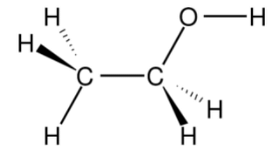
Ethanol
Also Read:
Properties of Alcohols
[Click Here for Sample Questions]
- Alcohols are colourless liquids.
- Most of them give off a sweet smell.
- They are flammable and produce a blue flame. Burning them does not produce smoke.
- Compared to other hydrocarbons, they have a high boiling point.
- Alcohols are generally suitable solvents for many organic compounds.
- They are more soluble in water compared to other hydrocarbons.
- Upon oxidation, alcohols produce aldehydes and ketones.
- Ethanol produces carbon dioxide and water on heating.
- Alcohols produce alkenes on dehydration.
- Alcohols react with metals and form alkoxides.
- When alcohols react with HCl, they form alkyl halides by the removal of hydroxyl groups.
- The reaction of alcohols with carboxyl acids in the presence of a catalyst to produce esters is called esterification.
Structure of Alcohols
[Click Here for Sample Questions]
In general, alcohols are organic compounds in which a hydroxyl functional group is attached to an aliphatic carbon atom. Since -OH is a functional group present in all alcohols, we usually represent alcohols as ROH, where R is the alkyl group. The carbon atom is bonded to the oxygen atom of the hydroxyl group by a sigma (σ) bond. The sigma bond is a result of the overlap of an sp3 hybridized orbital of carbon with an sp3 hybridized orbital of oxygen.

General Structure of Alcohol
Structure of Phenol
[Click Here for Sample Questions]
In organic chemistry, phenols are molecules that have a hydroxyl group attached to the carbon atom of an aromatic ring. The –OH group is attached to the sp2 hybridized carbon atom of an aromatic ring. The C-O bond length of phenol is less than that of methanol. This is because of two factors.
- The conjugation of unshared electron pair of oxygen with π electrons of the aromatic ring causes a partial double bond character.
- Oxygen is bonded to carbon which is an sp2 hybridized state.

Phenol
Structure of Ethers
[Click Here for Sample Questions]
An ether group is defined as an oxygen atom connected to two alkyl or aryl groups. Their general structural formula is R-O-R’. The bond angles of the C-O-C linkages of ethers are 104.5 degrees and the C-O distances are about 140 pm. An ether molecule is tetrahedral in structure. The bond angle R-O-R’ is slightly greater than the tetrahedral angle. This is due to the repulsive interaction between the two bulky R and R’ groups.

Structure: Esters
Things to Remember
[Click Here for Sample Questions]
- Alcohols are organic compounds that contain one or more hydroxy (- OH) groups attached to a carbon atom of an alkyl group or a hydrocarbon chain.
- If a primary carbon atom is bonded to the hydroxyl group, the alcohol is called primary alcohol.
- If a secondary carbon atom is bonded to the hydroxyl group, the alcohol is called secondary alcohol.
- Tertiary alcohol has the hydroxyl group bonded to a tertiary carbon atom.
- Alcohols are organic compounds in which a hydroxy functional group is attached to an aliphatic carbon atom. Since -OH is a functional group present in all alcohols, we usually represent alcohols as ROH, where R is the alkyl group.
- Phenols are molecules that have a hydroxyl group attached to the carbon atom of an aromatic ring. The –OH group is attached to the sp2 hybridized carbon atom of an aromatic ring.
- For An ether group, an oxygen atom is connected to two alkyl or aryl groups. Their general structural formula is R-O-R’.
Also Read:
Sample Questions
Ques. Are alcohols acidic or basic? (3 Marks)
Ans. Alcohols do not produce H+ nor OH- in solution when dissolved in water. Hence, by the Arrhenius definition of an acid and base, alcohols are neither acidic nor basic. It can be said that they are very weak Brønsted acids(acids that are proton donors) with pKa values generally in the range of 15 – 20.
Ques. Is ethanol flammable? (3 Marks)
Ans. Ethanol is a flammable, colorless, slightly toxic chemical compound. It is a renewable fuel made from corn and other plant materials, also known as the alcohol in alcoholic beverages. It is easily burned in presence of air by the supply of an ignition source and is considered a Class 3 Hazardous Material.
Ques. Why is alcohol toxic? (2 Marks)
Ans. The cell membranes easily diffuse alcohols and it is metabolized by most tissues. Hence, most organs are affected by their toxicity. The liver is the major site of alcohol metabolism where most alcohol is broken down by an enzyme called alcohol dehydrogenase (ADH). Thus, the liver is a major target of alcohol-induced organ damage.
Ques. What is the oldest way of preparing alcohol? (3 marks)
Ans. One of the oldest ways of preparing alcohol is by sugar fermentation which produces the alcohol ethyl alcohol. This alcohol is produced in absence of air. This process of fermentation produces carbon dioxide. When the ferment comes in contact with air it oxidises which changes ethanol (the fermented mixture) into ethanoic acid.
Ques. Explain the process of preparing Methanol. Also mentions its important uses. (3 marks)
Ans. Methanol is prepared by the process of catalytic reduction of carbon monoxide. This is an industrial method of producing methanol under which carbon monoxide reacts with hydrogen which leads to the formation of Methanol. Some of the important uses of methanol are as follows:
- Methanol is widely used as an industry insolvent, it is often used to make dyes, resins.
- Methanol is also used for producing acetic acid and formaldehyde.
- Water and methanol are also often mixed and used in high-performance engines.
- Methanol is also considered a substitute for gasoline.
- It is also used as an antifreeze.
Ques. Which are the most commercially used alcohols, give reasons for why they are widely used? (3 marks)
Ans. The most commercially used alcohols are methanol and ethanol. These two are most commonly used because of their important features such as volatility, flammability. These features help in making ethanol and methanol useful as a solvent, fuel. They also help in making dye, resins. Other than this, methanol is also considered a better alternative fuel that does not contribute to pollution.
Ques. How is the presence of alcohol tested? (3 Marks)
Ans. The presence of alcohol is usually determined by test reagents that react to the -OH group. The initial test conducted is is to take the neutral liquid, free of water, and add solid phosphorus(V) chloride. If there is a burst of acidic steamy hydrogen chloride fumes, the presence of alcohol is indicated.
Ques. Why are alcohols neutral? (2 Marks)
Ans. Alcohols are neutral because the hydrogen in the -OH groups bond with water. Higher alcohols have less solubility because the hydrocarbon chain starts to break an appreciable number of hydrogen bonds in water. The pH of alcohols shows as neutral.
Ques. Which alcohols are the most acidic? (3 Marks)
Ans. In a gaseous phase, t-butanol is the most acidic alcohol, more acidic than isopropanol, followed by ethanol and methanol. Water is much less acidic than methanol, in a gaseous phase. The fact is consistent with the difference in polarizability between a proton and a methyl group.
Ques. Does alcohol float in water? (2 Marks)
Ans. It is the result of the density of both substances. Alcohol is less dense than water. Hence, spirits can float on top of water and juices. They don’t mix because the natural mixing of fluids is a very slow process unless they are stirred.
Ques. Give some important uses of alcohol in industrial work. (3 marks)
Ans. Important uses of alcohol in industrial work are as follows:
- Alcohol is also used as it is most widely known in the form of alcoholic beverages, alcohols like ethyl (also called ethanol alcohol) are used in alcohol.
- Alcohols like ethanol are often considered a substitute for gasoline. It also contributes less to pollution.
- Ethanol is used as a solvent for perfume and cosmetics making.
- Methanal is used in producing plastics, paints, textiles, and cosmetics.
- Alcohol is also used as antifreeze.
- Alcohol is also used as an antiseptic and anti-disinfectant.
Ques. Why are phenols more acidic than alcohol? (2 marks)
Ans. Alcohols and Phenols are both organic compounds. However, both have some differences in characteristics. One of these characteristics is that Phenols are more acidic than alcohol. Phenols in a reaction with sodium hydroxide (aqueous) produce phenoxide ions. These ions are an indicator of the acidity of phenols, which is rather higher than alcohol acidity level. The presence of an electron-withdrawing group leads to an increase in the acidity of phenol.
For Latest Updates on Upcoming Board Exams, Click Here: https://t.me/class_10_12_board_updates
Check-Out:



Comments