



Content Curator
Inflorescence is defined as an arrangement of clusters of flowers on the floral or main axis. The major division of inflorescence is into two parts i.e., racemose and cymose depending on whether the apex gets converted into a flower or continues to grow.
Also Check: Inflorescence
| Table of Contents |
Key Terms: Flower, Inflorescence, Elongated Main- Axis, Shortened Main- Axis, Flattened Main- Axis, Cluster, Apex
What Is Racemose Inflorescence?
[Click Here for Sample Questions]
A racemose is a type of inflorescence in which the main axis grows indefinitely and does not end in a flower. As a result, it is also referred to as an indefinite or indeterminate inflorescence.
Some of the salient features of the racemose inflorescence are given below:
- The main axis is known as a peduncle, and the growth of the main axis is indefinite and continues to produce flower buds.
- Peduncles are monopodial.
- It is less common to see flowers arranged in groups.
- Flowers are born in acropetal succession, with older flowers on the periphery and younger ones on top.
- Flowers provide no protection to newly formed fruits.
- A flower is not always at the end of the peduncle.
Also Check: Morphology of Flowering Plants
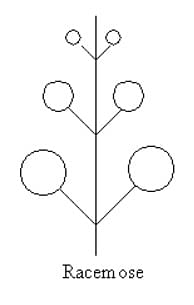
Racemose
Types Of Racemose Inflorescence
[Click Here for Previous Year Questions]
The various types of racemose inflorescence are listed below. The racemose inflorescence is divided into various types based on the branching, length of the peduncle, and the presence or absence of pedicel:
Elongated Main-Axis
Elongated main axis is specified below:
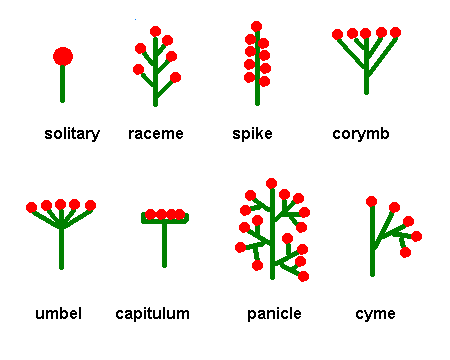
- Raceme - A simple inflorescence in which the flowers are borne on short stalks of approximately equal length at equal distances along an elongated axis and open in succession toward the apex.
Example: mustard (Brassica campestris) and radish (Raphanus sativus).
Compound raceme or panicle refers to when the main axis of the inflorescence is branched and lateral branches bear flowers in a simple raceme manner.
Examples: Mango(Mangifera indica ), Azadirachta indica (neem), etc.
- Spike - The main axis remains elongated in this type of racemose inflorescence, and the lower flowers are older, i.e., open earlier than the upper ones, as in raceme, but the flowers are sessile. Amaranth (Amaranthus spp.), latjira (Achyranthes Aspera), etc. are example.
The spike of spikelets is another name for a compound spike. On the branched main axis, sessile flowers (spikelets) are present. Wheat, barley, sorghum, oats, etc. are examples.
Also Check: Crop Production
- Spikelets - Each spikelet can have one or two several flowers (florets) attached to a central stalk called a rachilla. Spikelets are arranged in a spike inflorescence, which is made up of several to many spikelets that are combined in various ways along a central axis known as the rachis. Inflorescence of spikelets can be raceme, panicle, spike, or compound spike.
Raceme spikelet: Spikelets that grow on pedicels and are attached to the rachis (central axis). Festuca, Paspalum (crown grass), Echinochloa (barnyard grass), and other species are examples.
Panicle spikelet: Spikelets are attached to panicle branches rather than directly to the rachis. Avena, switchgrass, reed canary grass, Alopecurus (foxtails), and other species are examples.
Sessile Spikelet: A sessile spikelet that is attached directly to the rachis or panicle branches (compound spike) and lacks a pedicel. Hordeum, ryegrass, Triticum aestivum (Wheat), and others are examples.
- Catkin - is a drooping spike with a modified central axis. It has unisexual sessile flowers that are arranged close together on the peduncle. Flowers have scaly bracts and inconspicuous petals. Morus alba (mulberry), Betula (birches), Salix (willows), etc. are examples.
Also Check: Monocot Dicot Plants Anatomy
- Spadix - When a spathe covers a spike with a sheath-like covering, a spadix forms. Members of the Araceae, Musaceae, and Palmaceae, for example. This inflorescence is found primarily in monocotyledonous plants.
They are joined in a spike inflorescence, which is composed of various spikelets that are combined in various ways along the main axis known as the rachis. Festuca, for example.
The main axis of the compound spadix is branched, and each branch bears sessile flowers. The entire inflorescence is surrounded by a thick boat-shaped spathe. For example, coconut.

Raceme & Panicle
Shortened Main Axis
The main axis grows slowly and is shortened in this case. Corymb & Umbel falls into this category:
- Corymb - In this type of inflorescence, the length of the lower flower's pedicels is greater than the length of the upper flower's pedicels, resulting in all flowers appearing at the same level. When viewed from above, they have the general appearance of an umbrella. A compound corymb is one that has the main axis branched in a corymbose pattern and flowers arranged in corymbs on each branch. Hawthorn is an example.
Also Check: Plant and Tree
- Umbel - The main axis is shortened. The involucre of bracts (whorl) is present. Flowers emerge from the axil of bracts. Each flower has a pedicel that is the same length and spreads from a common point.
It can be a simple umbel or a compound umbel, which is an umbel with branches, also known as an "umbel of umbels." The Apiaceae (Umbelliferae) family is known for its umbel inflorescence.
Simple Umbel plants include Centella Asiatica (Brahmi), Allium cepa (onion), Fatsia japonica (paper plant), Primula veris (cowslip), etc.
Compound umbels include Foeniculum vulgare (fennel), Daucus carota (carrot), Conioselinum pacificum (parsley), etc.

Umbel & Compound Umbel
Flattened Main Axis
The main axis is Flattened in this case. Capitulum falls into this category:
- Capitulum - In this type of inflorescence, the main axis becomes suppressed and flat, and the flower becomes sessile, or without talk, allowing them to form crowded patterns on the flat surface of the receptacle.
These florets are arranged in a centripetal pattern on the receptacle, which means that the outer flowers are older and open earlier than the inner ones.
Also Check: Difference Between Monocot and Dicot Stem
Inflorescence
Difference Between Cymose And Racemose Inflorescence
[Click Here for Sample Questions]
The main difference between racemose and cymose inflorescence is described below:
| Cymose | Racemose |
|---|---|
| The main axis has definite growth and ends in a flower. | The main axis will continue to expand indefinitely |
| The peduncle grows in a sympodial or multimodal pattern. | The peduncle grows in a monopodial manner |
| The flower appears apically in basipetal succession. | The flowers appear laterally in acropetal succession. |
| The flower arrangement is centrifugal. | The flower arrangement is centripetal. |
| Flower clustering is more common. | The arrangement of flowers is less common. |
| The quantity of flowers is fixed. | Flowers can form indefinitely or unrestrictedly. |
| The first flower appears at the peduncle's tip. | The first flower appears at the base of the peduncle. |
| Flowers bloom at regular intervals. | Flowers bloom at regular intervals. |
| Flowers protect newly formed fruits. | Flowers do not protect newly formed fruits. |
Also Check: Asexual Reproduction In Plants
Things To Remember
- A Racemose is a type of inflorescence in which the main axis continues to grow indefinitely and does not terminate in a flower.
- The simple inflorescence is classified into two types: Racemose Inflorescence & Cymose Inflorescence
- Aside from these two, inflorescence can be classified into three types: Hypanthodium, Cyathium, & Verticillaster.
- The different types of racemose inflorescences are based on an elongated main axis: Raceme, Spike, Spikelets, Catkin, & Spadix; Based on a shorter main axis: Corymb & Umbel; Based on a flattened main axis: Capitulum.
Important PYQs Based on Racemose Inflorescence
- Radial symmetry is found in the flowers of... [NEET 2016]
- The inflorescence in Ocimum is... [JIPMER 2004]
- Cymose inflorescence is present in... [NEET 2012]
- Inflorescence is racemose in... [NEET 2013]
Sample Questions
Ques. What exactly is racemose inflorescence? (1 Mark)
Ans. The inflorescence is a flower arrangement that revolves around the floral axis. Racemose inflorescence occurs when the main axis does not terminate in a flower and continues to grow.
Ques. Give five examples of racemose inflorescence? (1 Mark)
Ans. Mustard, snapdragon, Gulmohar, wheat, barley, parsley, etc. with racemose inflorescences are examples.
Ques. Is umbel Racemose inflorescence? (2 Marks)
Ans. Yes, an umbel is a racemose inflorescence with a shortened main axis. Each flower has a pedicel that is the same length and spreads from a common point. For example, parsley, dill, coriander, fennel, onion, etc.
Ques. What are the various kinds of racemose inflorescence? (2 Marks)
Ans. The different types of racemose inflorescences are based on an elongated main axis: Raceme, Spike, Spikelets, Catkin, & Spadix; Based on a shorter main axis: Corymb & Umbel; Based on a flattened main axis: Capitulum.
Ques. What is the difference between Cymose and Racemose? (2 Marks)
Ans. Racemose and cymose are two types of inflorescences, which are flower clusters that are arranged around a central axis. Racemose flowers have an indefinite primary axis and blooms that are borne laterally. flowers are borne terminally on the floral axis in cymose inflorescences, and the main axis grows continuously.
Ques. Define Shortened main axis racemose inflorescence. (4 Marks)
Ans. Shortened main axis: The main axis grows slowly and is shortened in this case. Corymb & Umbel falls into this category:
Corymb: In this type of inflorescence, the length of the lower flower's pedicels is greater than the length of the upper flower's pedicels, resulting in all flowers appearing at the same level. When viewed from above, they have the general appearance of an umbrella. Hawthorn is an example.
Umbel: An umbel is an inflorescence composed of several short flower stalks that radiate from a central point, similar to umbrella ribs. Waxflower is one such example.
Ques. Define Flattened main axis racemose inflorescence. (4 Marks)
Ans. Flattened main axis: The main axis is Flattened in this case. Capitulum falls into this category:
Capitulum: In this type of inflorescence, the main axis becomes suppressed and flat, and the flower becomes sessile, or without talk, allowing them to form crowded patterns on the flat surface of the receptacle.
These florets are arranged in a centripetal pattern on the receptacle, which means that the outer flowers are older and open earlier than the inner ones.
Ques. What are salient features of Racemose Inflorescence? (5 Marks)
Ans. The Salient features of Racemose Inflorescence: The main axis is known as a peduncle, and the growth of the main axis is indefinite and continues to produce flower buds.
- Peduncles are monopodial.
- It is less common to see flowers arranged in groups.
- Flowers are born in acropetal succession, with older flowers on the periphery and younger ones on top.
- Flowers provide no protection to newly formed fruits.
- A flower is not always at the end of the peduncle.
Ques. What type of inflorescence is Jasmine? (2 Marks)
Ans. A dichasial cyme can be found in the inflorescence of a flower from the order Lamiales. Jasmine inflorescences have at least three flowers in cymose clusters, but they can also be solitary on the branchlets.
Ques. Is Racemose an acropetal flower? (3 Marks)
Ans. Yes, the arrangement of flowers in a racemose inflorescence is acropetal, with younger flowers or buds at the top and older flowers at the bottom.
The arrangement of flowers in a group is centripetal, which means that the younger flowers are in the center and the older flowers are on the outside.
Check-Out:



Comments