



Content Curator
Reflection and Symmetry are connected in many ways. We can observe many examples of reflection and symmetry in our surroundings. For example the reflection of images of trees and mountains in the nearby water bodies.
- The word symmetry is the actual meaning of proportion and balance.
- we saw a lot of things around us that are related to reflection and symmetry as most of all things have symmetric shapes.
- Reflection symmetry states that if at least one line divides a figure into two halves, one half is the mirror image of the other.
- It is also known as mirror symmetry or line symmetry.
- An object can have more than one line of symmetry and it can be in any direction.
- The line of symmetry divides the object or the shapes into two halves of equal size.
- These halves are just like the Xerox of each other.
- Reflection symmetry can be seen in the reflection of mountains in the water.
| Table of Content |
Key Terms: Reflection, Symmetry, Reflection symmetry, Applications of reflections symmetry, Lines of symmetry, Light, Mirror, Shiny surface, Symmetric alphabets
What is Reflection?
[Click Here for Sample Questions]
Reflection is bouncing off of light from an object. If the light falls on a shiny surface such as glass, water, or a polished metal then it bounces back and reflects the same angle. Due to reflection, we can see images in mirrors and water.

Types of Reflection
The different types of reflection are
- Regular or Specular Reflection
- Diffused Reflection
Regular or Specular Reflection
Regular Reflection can be defined as the light that is reflected from a smooth surface.
- It reflects only in one direction.
- It is also called Specular Reflection.
Diffused Reflection
When the light is reflected from a rough surface then it is called a diffused reflection. It reflects in all directions.
Also Read:
| Related Articles | ||
|---|---|---|
| Knowing our numbers | Whole Numbers | Integers |
| Decimals | Data handling | Mensuration |
What is Symmetry?
[Click Here for Sample Questions]
Symmetry is the exact match in the shape & size of an object when it is divided into two halves.
- Symmetry makes things beautiful with its presence.
- The objects & figures that are evenly balanced in proportions are symmetrical.
- For example: If we fold a picture in half & all the halves match exactly then we can say that the picture is symmetrical.

What is Reflection Symmetry?
[Click Here for Sample Questions]
Reflection Symmetry is a type of symmetry that deals with reflections. Reflection symmetry states that if there is a line that divides a figure into two halves, then one half is the mirror image of the other half.
- Reflection Symmetry is also called line symmetry or mirror symmetry.
- Any figure can have one or more lines of reflection symmetry, it can be in any direction.
- If we place a mirror along the line in the middle, half part of, the object reflects through the mirror by creating an identical half with the remaining side.
- Moreover, it can also be said that the line where the mirror has been placed divides the figure into two identical parts of the same size.
- Both the specific parts that are on the one side of the line have their reflection exactly at the same distance on the other side.
- It is called Mirror symmetry.
-
For example; the left & right sides of human faces, the wings of the butterflies on both sides, etc.

Applications of Reflection and Symmetry
[Click Here for Sample Questions]
The applications of Reflection and Symmetry are discussed below
- In the line of symmetry, the shape of the reflections is reflected.
- The original shape & the reflected shape are the same accordingly.
- Both the shapes are the same in size & distance consequently.
- Symmetry is used in every field of work whether it is art or architecture.
- If we place a mirror at the center of any alphabet, we will get the reflection of the other half.
- This is because some alphabets pose reflection symmetry like A, H, W & M, etc.
- Symmetry is one of the most significant mathematical concepts as it plays an important role in the problem-solving technique.
- A device, Kaleidoscope which is cylindrical or triangular, consists of three or more mirrors.
- We can put colorful objects like beads & pieces of glass in it.
- When the light enters from one end & when we look from the other hand, we can see that the mirrors are acting as reflectors by providing multiple lines of symmetry.
- This is due to the repeated reflections in the mirrors.
- If an image has one or more lines then the first half is the mirror image of the second half.
- Another name for reflection symmetry is Mirror Symmetry.
Lines of Symmetry
[Click Here for Sample Questions]
The line of symmetry is the line that divides the figure identically between two parts of the same size.
- Each of the images is the mirror image of the other half.
- It is also called the axis of symmetry.
Lines of Reflection Symmetry
When a figure is folded along the line, one-half of it will coincide exactly with the remaining half. The line that splits the object between two similar parts of the same size is called the line of symmetry.
- Some objects that have no line of symmetry objects are called asymmetrical.
- A scalene triangle has an irregular shape so it is not symmetrical.
- Some figures & objects have more than one line of symmetry.
Symmetry For Shapes
[Click Here for Sample Questions]
There are so many geometrical shapes. Different shapes have different lines of symmetry, some have one line of symmetry, and some have more than one line of symmetry.
Here are some different shapes with the lines of symmetry they have, concerning the reflection.
Square
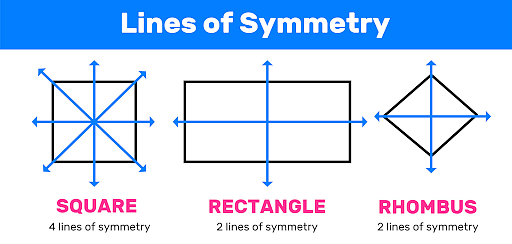
A square can be easily halved into two equal parts along with its diagonal & sides both vertically & horizontally. It has four lines of symmetry.

Rectangle
A rectangle can be divided into two identical along with the width & the length they have. It has two lines of symmetry.

Circle
A circle can be halved into two parts of equal size along with the diameter it has. As we already know a circle can have a vast number of diameters. Undoubtedly we can say that a circle can have infinite lines of symmetry.

Triangle
A triangle can have 1,2 or can also have more than that lines of symmetry.
- But some triangles don’t have any lines of symmetry.
- Conversely, an equilateral triangle has three lines of symmetry.
Uses of Symmetry
[Click Here for Sample Questions]
Symmetry is an essential part of our daily life because if you look around yourself you will find so many things in a symmetrical form.
- The human body is symmetrical too.
- If we lose one hand or leg or eyes we can’t do symmetric properly with a single hand, leg, or eye.
- Symmetry helps make things understandable by creating a sense of order & control.
- It is not possible to customize everything as per our choice but symmetry does the work.
- We don’t need to measure both the left & right sides of everything.
- We know that each side is a mirror image of the other one.
- While designing a building symmetry is also used.
- When things are in symmetrical shape it is easy to calculate & understand them.
- Art, design creations, architecture., textile technology, Kolams, Rangoli, Geometrical reasoning, etc are examples of symmetrical shapes.
Things to Remember
- The word symmetry is the actual meaning of proportion and balance.
- Reflection is bouncing off of light from an object.
- The two types of reflection are Regular and Diffused Reflection.
- Symmetry is the exact match in the shape & size of an object when it is divided into two halves.
- Reflection Symmetry is also called line symmetry or mirror symmetry.
- The line of symmetry is the line that divides the figure identically between two parts of the same size.
- Mirror symmetry is another name for reflection symmetry, it is called mirror-image symmetry.
Also Read:
Sample Questions
Ques. What is reflection? (1 Mark)
Ans. Reflection is the phenomenon of bouncing off the light after striking a shiny surface.
Ques. What are the different types of reflection? (2 Marks)
Ans. The different types of reflection are
- Regular reflection
- Diffused reflection
Ques. Is a parallelogram symmetrical? (1 Mark)
Ans.
At first view, a parallelogram may appear symmetrical. However, it is not symmetric along any of the axes of reflection.Ques. What is a real-life example of symmetry?
Ans.
From snowflakes to sunflowers, starfish to sharks, symmetry can be found everywhere in nature.Ques. Write the name of any 8 symmetrical objects from your home & school. (3 Marks)
Ans. Here we are listing 8 symmetrical objects:
- The Dining Table
- A blackboard
- The wall Clock
- A pair of the Scissors
- A notebook
- The bucket
- The Inkpot
- A glass
Ques. Describe Rotational symmetry. (3 Marks)
Ans. Rotational symmetry is when an object is turned around from its center point & remains the same from all its sides. When we rotate a square or the circle they become an example of rotational symmetry. The middle point of the rotation is a fixed point. The rotation occurs around this point & from this point, the object appears the same from all of its sides. The order of symmetry of an object is the number of positions an object can be rotated & it will still look the same.
Ques. Write the following. (3 Marks)
(1) Four English letters that have no line of symmetry.
(2) Five English letters have a horizontal line of symmetry.
(3) Five English letters have vertical lines of symmetry.
Ans.
- The four letters not having a line of symmetry are: P, F, G & Z
- The five alphabets having a horizontal line of symmetry are: E, B, C, D & K
- The letters that have vertical lines of symmetry are: A, H, I & M
Ques. list the English alphabet from A to Z among the letters that have: (3 Marks)
(1) Horizontal lines of symmetry
(2) Vertical lines of symmetry
(3) Vertical & horizontal loves of symmetry
(4) No Lindsey
Ans.
- The letters B, C, D, E, H, I, K, I & X have horizontal lines of symmetry. It can be seen in the following diagram.
Horizontal lines of Symmetry
- The letters A, understand, T, U, V, W, X & Y have vertical lines of symmetry. The following diagram will be helpful to understand it.
Vertical lines of Symmetry
- The letters H, I, O, and X have vertical and horizontal lines. The following diagram will be helpful to understand it.
Vertical & Horizontal Lines of Symmetry
- The letters F, G, J, L, N, P, Q, R, S& Z do not have any lines of symmetry.
Ques. What are the types of Symmetry? (3 Marks)
Ans. There are four types of symmetry in geometry.
- Rotational symmetry
It is a symmetry that explains the fact that when an object is rotated on its axis shape looks the same.
- Reflection symmetry
Reflection symmetry is related to the reflections. If there is one line in an object that divides it into two halves of the same size then it is reflection symmetry.
- Translation symmetry
In translation symmetry, the particular translation does not change the object it’s just delicate to a different position.
- Glide reflection symmetry
In Glide reflection symmetry, A figure is fit exactly onto the original one & translated a given distance at a given direction & then it is reflected within the line.
Ques. Describe reflection symmetry with a picture. (3 Marks)
Ans. Reflection Symmetry

For Latest Updates on Upcoming Board Exams, Click Here: https://t.me/class_10_12_board_updates
Check-Out:



Comments