



Education Journalist | Study Abroad Lead
Reflection of light is a phenomenon that occurs when rays of light traveling through a medium after the incident on a surface bounce back to the same medium.
- The principles governing the phenomenon of reflection are known as the Laws of reflection.
- The study of reflection and its laws have many applications in various scientific fields.
- The laws of reflection determine the angles at which the light is incident and reflected.
- When a ray of light incident on a surface, some part of it is absorbed by the surface, a part is transmitted by the medium of the surface, and a part of it bounces off the surface.
- The phenomenon of the bounce back of light rays in the same medium from where it is coming is called reflection.
| Table of Content |
Key Terms: Laws of reflection, Light, Electromagnetic spectrum, Wavelength, Reflection of light, Energy, Specular and diffuse reflection.
Light
[Click Here for Sample Questions]
Light is a form of energy that induces the sensation of sight in our eyes and makes us able to see various things present in our surroundings. The visible part of the electromagnetic spectrum consists of various colors of wavelengths ranging from 400 nm to 760 nm and is called light.
- Light travels in a straight line in air or vacuum at a speed of 3 x 10⁸ m/s.
- Since the size of the object we generally see in our daily life is very large as compared to the wavelength of light, so light appears to be traveling in a straight line.
- Light traveling along a straight line path is called a ray of light.
- The bundle of parallel rays of light is called a beam of light.
Reflection of Light
[Click Here for Sample Questions]
The phenomenon in which light rays are sent back to the same medium from which it is coming, on interaction with a boundary, is called reflection of light.
- The boundary to which rays of light incident or reflected can be a rigid surface or an interface between two media.
- When light rays incident on a surface, they may be absorbed, transmitted, or reflected.
- The part of the visible light that bounces back from the surface to the same medium from where it is coming is known as reflected rays of light, and the phenomenon is called reflection of light.
- In terms of the wavefront, the phenomenon of reflection is the change in direction of a wavefront at the boundary of two different media so that the wavefront returns to the medium from which it originated.
Also Read:
| Related Articles | ||
|---|---|---|
| Reflection of Light by Spherical Mirrors | Reflection on a Plane Mirror | The Refractive Index |
| Refraction at Spherical Surfaces and By Lenses | Snell’s Law | Concave Lens |
Types of Reflection of Light
[Click Here for Sample Questions]
Depending on the nature of the interface, the reflection of light is divided into two types
1. Specular Reflection
When a parallel beam of incident light after reflection from a surface bounces back maintaining its parallel alignment, then the reflection is called Specular reflection.
- This can happen only when the reflecting surface will be very smooth or well-polished.
- It is also known as Regular reflection.
- Mirrors are the best example of specular reflection.
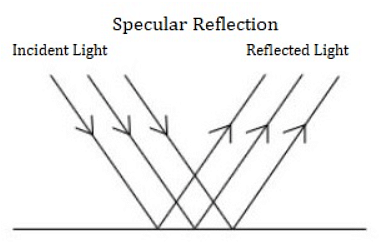
Specular reflection of light
2. Diffuse Reflection
When a parallel beam of incident light after reflection from a surface is scattered in many directions rather than one direction, then the reflection is called diffuse reflection.
- Diffuse reflection occurs when the reflecting surface is rough or irregular.
- It is also known as irregular reflection.
- Reflection from surfaces like paper, clothes, walls, etc. are examples of diffuse reflection.
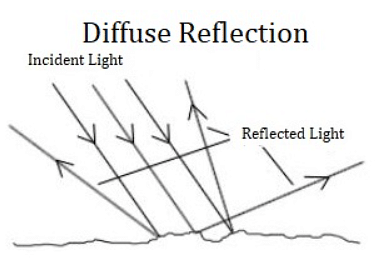
Diffuse reflection of light
Read More: Difference between Reflection and Refraction
Laws of Reflection
[Click Here for Sample Questions]
The phenomenon of reflection of light obeys certain laws, known as the Laws of reflection. Consider a ray of light AB incident on a reflecting surface (e.g. a mirror) at point B and bounces back to the same medium along BC after reflection.
- The ray of light AB is known as the incident ray.
- The ray BC is known as a reflected ray.
- BN is normal to the reflecting surface.
- The angle between the incident ray and the normal to the surface is known as the angle of incidence or incident angle, denoted by ∠i.
- The angle between the reflected ray and the normal to the surface is known as the angle of reflection or reflecting angle, denoted by ∠r.
- The angle between the plane of the reflecting surface and the incident ray is known as the glancing angle.
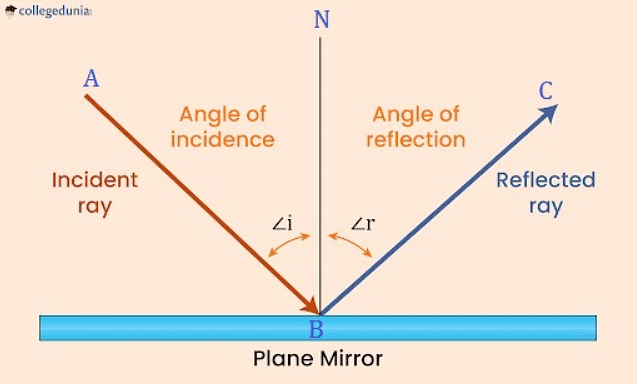
Reflection of Light and Laws of Reflection
According to the Law of Reflection:
- The incident ray, the reflected ray, and the normal to the reflecting surface all lie in the same plane, called planar of incidence.
- The angle of incidence is equal to the angle of reflection.
∠i = ∠r
Read More: Image Formation by Lenses
Applications of Laws of Reflection in Daily Life
[Click Here for Sample Questions]
Some applications of laws of reflection in daily life are
- The reflection of light from a plane or spherical mirror obeys the laws of reflection.
- To avoid parallax errors in ammeter or voltmeter, mirrors are used.
- The law of reflection of light helps to design and analyze optical instruments.
- The rear views mirrors of a car obey the law of reflection that enable the to driver see things behind the car.
- Reflecting materials or surfaces used on the road follow laws of reflection for safety purposes.
Read More:
Things to Remember
- Light is a form of energy, and is a part of the electromagnetic spectrum.
- Reflection is the process of bouncing back light to the same medium.
- Specular and Diffusion are the two types of reflection of light.
- According to the laws of reflection, for a smooth surface, the angle of incidence is equal to the angle of reflection.
- The glancing angle is the angle between the reflecting surface and the incident ray of light.
Sample Questions
Ques. If a ray of light incident on a smooth horizontal surface at an angle of 60o with the normal. Find the angle of reflection. (3 Marks)
Ans. Given, the angle of incidence, ∠i = 60o
According to the law of reflection, we have
∠i = ∠r
Where ∠r is the angle of reflection.
Therefore, the angle of reflection is 60o
Ques. Write three characteristics of the image formed by a plane mirror. (3 Marks)
Ans. The characteristics of the plane mirror are
- The image formed by the plane mirror is of the same size as that of an object.
- The image formed by a plane mirror is at the same distance behind the mirror as the object in front of it.
- The image formed by a plane mirror is virtual, erect, and laterally inverted.
Ques. Define the phenomenon of reflection of light. (2 Marks)
Ans. Reflection of light is the process of bouncing back of a ray of light traveling through a medium to the same medium after the incident on a surface.
Ques. If a ray of light incident on a smooth horizontal surface at an angle of 30o with the normal. Find the angle of reflection. (2 Marks)
Ans. Given, the angle of incidence, ∠i = 30o
According to the law of reflection, we have
∠i = ∠r
Where ∠r is the angle of reflection.
Therefore, the angle of reflection is 30o
Ques. Define Focal length. (1 Mark)
Ans. Focal length is defined as the distance between the pole and the principal focus of a spherical mirror.
Ques. The glancing angle of a ray of light incident on a smooth surface is 350. What is the value reflecting angle? (3 Marks)
Ans. We know, the glancing angle is the angle between the reflecting surface and the incident ray.
Give, glancing angle = 300
Then, the angle of incidence = 90 - 30 = 600
According to the law of reflection, we have
∠i = ∠r
Where ∠r is the angle of reflection.
Therefore, the angle of reflection is 60o
Ques. What is the focal length of a plane mirror? (1 Mark)
Ans. The focal length of a plane mirror is infinity.
Ques. What are the laws of reflection? (2 Marks)
Ans. According to the laws of reflection, the angle made by the incident ray with the normal to the surface is equal to the angle made by the reflected ray to the normal to the surface. Also, the incident ray, the reflected ray, and the normal all lie in the same plane.
For Latest Updates on Upcoming Board Exams, Click Here: https://t.me/class_10_12_board_updates
Check-Out:



Comments