



Content Curator
Transparent, translucent and opaque are the materials that can be classified based on the amount of light they transmit. If we cannot see through an object at all, it is an opaque object. If we can somewhat see through an object, it is translucent and if we can easily see through an object, the object is transparent.
Read More: NCERT Solutions of Light
| Table of Contents |
Key Terms: Light, Opaque objects, Transparent Objects, Translucent Objects, Reflection, Magnification, Wave
What are Opaque Objects?
[Click Here for Sample Questions]
Opaque objects are those objects through which light cannot pass. One cannot see at all through opaque objects. Materials that are opaque include concrete, wood, and metal.
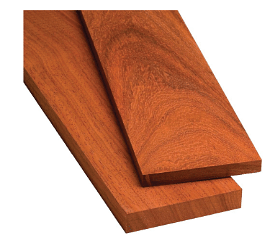
Piece of Wood
Experiment Related to Opaque ObjectsAim: By taking any object, such as a notebook, an example of opaque objects can be illustrated. 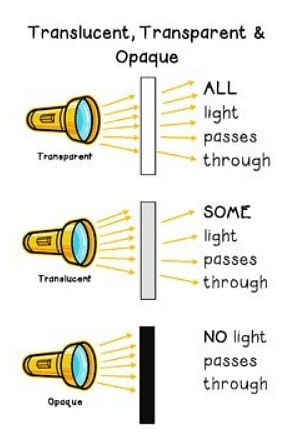 Translucent, Transparent & Opaque Example Investigation: Without any screens drawn, you place this notepad behind one of your house's glass windows. By doing so, we can see the notebook clearly. What if we keep the notebook in the wooden cabinet? Then, the notepad will be hidden from view. Conclusion: You placed the notebook behind a transparent object (the glass window) in the first scenario, and behind an opaque object in the second case (cupboard). The amount of light passing through the objects in question, the glass window, and the cupboard, differed in these circumstances. |
Read More:
What are Transparent Objects?
[Click Here for Sample Questions]
Transparent substances have a virtually equal refractive index. These materials allow light rays to flow through them completely. When light is seen to meet transparent materials, most of it passes directly through them. Some of the major examples of Transparent materials are Glass, Water and Clean Air.
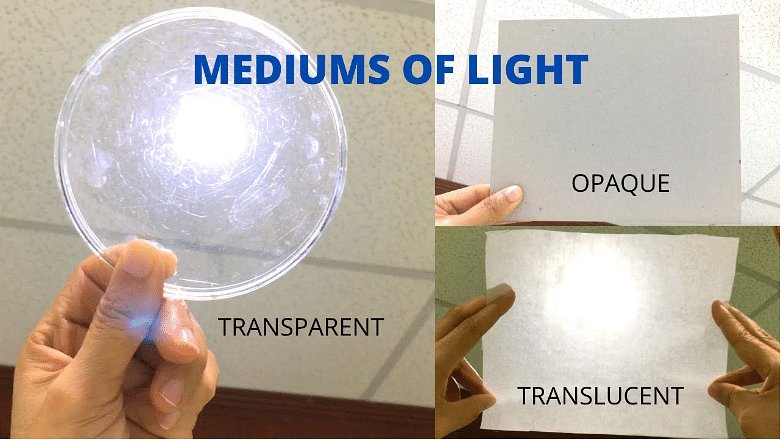
Mediums of Light
The majority of the light that strikes a transparent object passes through it. This happens because the amount of dispersion when going through a transparent object is quite low. In consequence, an image that is clear is visible on the other side of the object. Lenses, spherical mirrors, spectacles, and many other items are made of transparent materials (such as glass).
Read Also: Some Natural Phenomena due to Sunlight
What are Translucent Objects?
[Click Here for Sample Questions]
Translucent Objects let a lesser amount of light pass through them, such that the materials on the opposite side are not clearly visible. If a substance allows for partial transmission of light through it, it is considered transparent.
In such objects, light rays are scattered. As a result, the light rays emerge in a random pattern. When you look through a translucent object, the image looks blurred and hazy. Frosted glass, butter paper, tissue, and various polymers are examples of translucent materials.
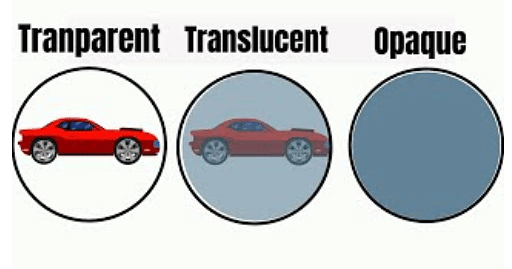
Translucent objects
| Properties that cause Translucency The following properties can cause translucency:
|
Difference between Transparent, Opaque and Translucent
[Click Here for Sample Questions]
As we already know, Objects are broadly classified into Transparent, Translucent and Opaque. The key differences between them are tabulated below.
| Transparent objects | Translucent objects | Opaque objects |
|---|---|---|
| Light passes through transparent objects easily. | Light passes through translucent objects partially. | No light passes through opaque objects. |
| We can see clearly through transparent objects. | We cannot see through translucent objects clearly. | We cannot see through opaque objects. |
| Examples: Glass, air, water, etc. | Examples: Wax paper, greased paper, etc. | Examples: Wood, metal, chair, etc. |
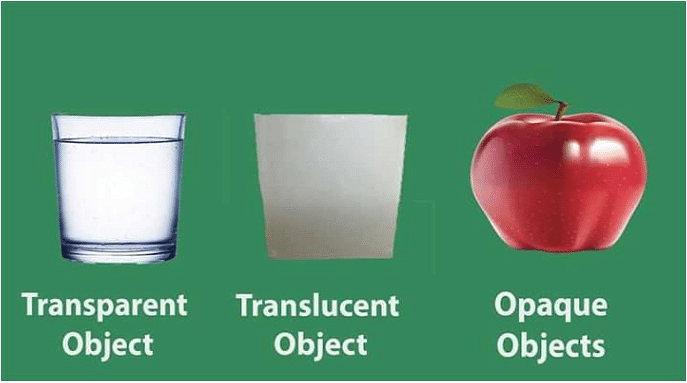
Difference between Opaque, Transparent and Translucent Objects
Read More:
Things to Remember
- Materials have been classified according to the amount of light that can pass through them.
- Transparent objects are objects that let light pass through them easily. One can see through transparent objects. Examples of transparent objects are glass, clear plastic etc.
- Translucent objects are objects which allow partial transmission of light through them. Examples of such objects are butter paper, curtains etc.
- Opaque objects are objects that do not let light pass through them. Examples of such objects are wood, steel, gold etc.
Sample Questions
Ques. List five things that can be made out of wood. [2 marks]
Ans. The five things that can be made out of wood are:
(i) Chair
(ii) Desk
(iii) Doors
(iv) Cupboard
(v) Bed
Ques. Give two examples of substances that do not allow light to pass through. [2 marks]
Ans. Steel and stones are the substances through which light does not pass.
Ques. Write down four man-made sources of light. [2 marks]
Ans. The four man-made sources of light are:
- Candle
- Oil lamp
- Electric bulb
- Torch.
Ques. Close your eyes and gaze at the bright sunlight. Cover your eyes with your palm while keeping your eyes closed. Do you think there's a difference? Determine if your eyelids are transparent, translucent, or opaque based on this experience. [2 marks]
Ans. Upon performing the experience, it is seen that eyelids are translucent as light can be sensed upon closing the eyes.
Ques. Write down three similarities between iron, copper and aluminium? [2 marks]
Ans:
(a) They all have lustre,
(b) They are all metals,
(c) They are opaque
Ques. What is meant by: [3 marks]
(i)an opaque medium
(ii) by a transparent medium
Ans. i) Opaque medium is a medium that does not allow light to pass through it. Examples of opaque mediums are iron, stone, wood and many more.
ii) A transparent medium is a medium that allows light to pass through it completely.
Ques. Classify the following into transparent, opaque and translucent objects:
Laptop, window, butter paper, eyelids, sugar, water, clouds, matchstick, books, goggles, milk, balloon, wood, stone. [3 marks]
Ans. Transparent objects are windows, water, goggles
Opaque objects: laptop, matchstick, books, wood, stone.
Translucent objects are butter paper, eyelids, sugar, clouds, milk, and balloons.
Ques. How will you convert a transparent glass sheet into a translucent sheet? Suggest any two ways to do it. [3 marks]
Ans. 1. We can turn a clear glass sheet into a translucent sheet by smearing a thin layer of oil on it.
- Using butter paper to cover one side of the glass sheet
Ques. What is the purpose of categorising materials and what is the basis of such categorization? [3 marks]
Ans: Materials are classified according to how similar or distinct their qualities are.
Materials are categorised for our convenience so that we can examine their qualities and look for trends.
Ques. Even after shaking, kerosene, coconut oil, and mustard oil do not dissolve in water. After a while, they divide, establishing two distinct layers. Please explain why. [3 marks]
Ans: Water molecules do not combine with those of oil molecules. Oil does not occupy the space between the molecules of water, hence they are immiscible in water and float on the water.
Ques. What are luminous and non-luminous objects? [3 marks]
Ans. Luminous things are those that give out or emit light on their own, such as the sun, a torch, a light, a bulb, and so on.
Non-luminous objects are those that do not emit their own light, such as the moon, a chair, a shoe, a pen, and so on.
Ques. Why is a tumbler not made with a piece of cloth? [3 marks]
Ans: To store a liquid, we require tumblers made of glass, plastic, and metal. These materials have the ability to hold liquid.
A tumbler made of cloth cannot contain a liquid because:
- Cloth cannot store a liquid as it is too soft and cannot hold a shape.
- Cloth isn’t seeped through so the liquid will spill out of the tumbler.
Also Check:



Comments