



Education Journalist | Study Abroad Lead
Reflection of Light forms images from two types of spherical mirrors- concave and convex mirrors. Spherical mirrors have the shape of a piece cut out from any spherical surface. It is a form of a mirror whose reflecting surface is part of a hollow sphere of glass. When light falls on these curved surfaces, it forms an image and bounces back from the smooth polished surface. This occurs due to reflection of the light wherein the incident ray reflects back after hitting the glass surface. Laws of reflection and its types, spherical mirrors and their types and some imortant parameters related to reflection of light are discussed below.
Key Terms: Reflection, Light, Spherical Mirrors, Images, Concave lens, Convex Lens, Focal Length, Focal Point
Reflection of Light
[Click Here for Previous Year Questions]
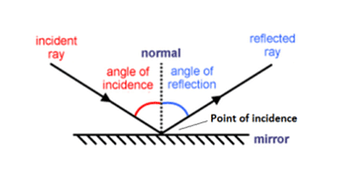
Any polished or shiny surface like water can act as a mirror. When a beam of light falls on such a smooth or shiny object, the light from the object will reflect these rays back to our eyes. This phenomenon is the reflection of light. The light ray that is incident on the surface gets reflected back and is known as the reflected ray.
Check more:
Laws of Reflection
[Click Here for Sample Questions]
The light rays approaching the mirror are the "incident light rays". The light coming out of the mirror is the "reflected light". At the point where the incident light enters the mirror, draw a vertical line as the "normal". This normal is what divides the incident ray and the reflected ray equally and gives us the “Angle of Incidence” θI and “Angle of Reflection” θr
- The inclination of occurrence is always similar to the inclination of reflection.
- The incident light, normal and reflected light are all on the same plane.
- The reflected rays and incident rays are on opposite sides of the normal.
What is a Spherical Mirror?
[Click Here for Previous Year Questions]
A spherical mirror can be defined as a mirror that has a reflecting surface part of a hollow sphere of glass. In general, spherical mirrors can be divided into two types, Concave mirrors and Convex mirrors.
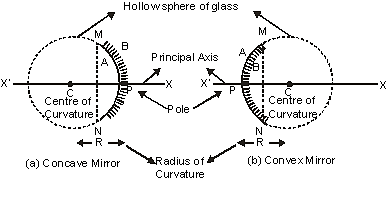
- Radius of curvature (c): It is the distance between the pole and the center of curvature.
- Center of Curvature (r): The center of curvature of a spherical mirror is the point at the center of the mirror that passes through the curve of the mirror and has the same tangent and curvature at this point.
- Aperture: This is the point where light reflection actually occurs.
- Pole (p): The pole is the midpoint of the mirror. It is twice the focus.
- Focal point: Any point where light rays parallel to the main axis converge after reflecting off the mirror.
- Principal axis: It is an imaginary line which passes through the optical center and the center of curvature of the spherical mirror.
- Focal length: On the axis of the mirror, rays parallel to the axis converge after being reflected or refracted.
Types of Spherical Mirrors
[Click Here for Sample Questions]
There are two types of spherical mirrors:
- Convex Mirror
- Concave Mirror
Concave Mirror
Concave mirrors are also called converging mirrors, because in these types of mirrors, light rays converge at a point after impact and reflect back from the reflective surface of the mirror.
Convex Mirror
The convex mirror has a reflective surface that is curved outward. Regardless of the distance between the subject and the mirrors, these mirrors are "always" virtual, upright and reduced.
When parallel rays hit the mirror, they are reflected in a diffuse or divergent manner. Therefore, the convex mirror is also a divergent mirror. If these reflected rays extend behind the mirror through the dotted line, they will meet at one point. This is the focal point of the convex lens. Concave mirrors are used in vehicles so that the driver knows that the vehicle is coming from behind. They are also used in street lamp reflectors.
Types of Images
[Click Here for Previous Year Questions]
(a) Real image: When the image and the mirror are formed on the same side, the image is called a real image. In other words, if the image can be thrown onto the screen, it is a real image.
(b) Virtual image: If the image cannot be thrown onto the screen, but is formed on the other side of the mirror by the external extension of the light, the formed image is called a virtual image.

Sign Convention of Reflection of Light
[Click Here for Sample Questions]
In order to calculate the distance, to help us derive the relevant formulas for reflection and refraction, we adopted the notation convention. According to the standard Cartesian notation convention, the pole is the only point where all distances can be calculated. The agreement is as follows:
For Distance
Assuming that if the distance is to be measured along the same incident light direction, the value of the distance is considered to be positive. Similarly, if we measure the distance opposite to the direction of the incident light, the value of the distance is considered negative.
For Height
If the height is measured in the upward direction perpendicular to the main axis, the height value is regarded as a positive value, and if the height is measured in the downward direction perpendicular to the main axis, the height value is regarded as a negative value. For a better understanding, please consider the image below.
Focal Length (Spherical Mirrors)
Now, we will study how we can make the beam occur closer to the pole of the mirror and make it at a small inclination (negligible), and then the reflected light will converge and diverge at a certain point on the concave mirror and the convex mirror. Say F on the spindle. This point is called the main concern.
Now, when the light is incident near the pole at an angle (not negligible), the reflected light seems to converge or diverge from a plane perpendicular to the main axis passing through F. This plane is called the "focal plane". The distance between the focal point and the pole is called the focal length (f).
Relation between the Focal Point (F) and Radius of Angle (R) of a Mirror
[Click Here for Previous Year Questions]
The beam is reflected at point J. Therefore, CJ is perpendicular to the reflector at point J. Since θ is the incident angle, JK is perpendicular to the main axis,
Now, as we have already studied, when θ is very small, it can be ignored, and it is very close to the pole. The distance between the pole and the focal point is also called "focal length (f)".
Therefore, in the figure FK = f and CK = R (radius of curvature)
∴f = R / 2
Mirror Equation of Reflection of Light
[Click Here for Sample Questions]
When light propagates from one point of an object is reflected or refracted to another point, that point is called the image of the object. If the light actually seems to converge at a certain point, the image is considered real.
However, if the light rays seem to diverge at a point where they do not actually meet when stretched backwards, the image can be said to be virtual. The formation of the image follows some basic principles to trace the path of light. The intersection of the points obtained by tracing the path of the rays is the actual position of the formed image.
The basic principle is as follows
- When light travels parallel to the main axis, the reflected light should pass through the focal point of the mirror
- When the light passes through the center of curvature, it will reflect back and trace its original path.
- When light passes through the focal point of the reflector, the reflected light travels parallel to the main axis.
It can be noted that these principles obey the law of reflection, that is, the angle formed by incident light is equal to the angle formed by reflected light.
In the above figure, we considered the three beams of time radiating from the top of the object. We see the point where the rays of light intersect each other, at which point a real image is formed. In this case, we considered a concave mirror.
In order to derive the equation of the mirror, we consider the distance between the pole and the focal point of the mirror as f; the distance between the pole and the formed image is "v", and the distance between the pole and the object is "u". and so, by Δ Y’Z’F and Δ FPJ are similar triangles according to AAA.
From (1) and (2) , L.H.S = L.H.S
Formula of Magnification
[Click Here for Previous Year Questions]
In short, magnification means that the image is magnified. It can also be defined as the ratio of the height of the image to the height of the object.
| M = v/u |
The above equation is called the magnification formula of the spherical mirror.
If the height of the image is positive, the height of the image is considered to be positive, and if the formed image is inverted, that is, located below the main axis, the height of the image is considered to be negative.
The mirror equation and the magnification formula are applicable to both real and virtual images.
Previous Year Questions
- A container is filled with water (μ = 1.33) up to a height of 33.25 cm. A concave mirror is placed…? [JEE 2005]
- A student performed the experiment of determination of focal length of a concave mirror by…? [KEAM 2009]
- The focal length of a spherical mirror made of steel is 150cm. If the temperature of the mirror…? [AP EAPCET 2009]
- A spherical surface of radius of curvature R, separates air … [NEET 1998]
- If in the following figure, height of object is H1=+2.5cm, then height of…? [DUET 2007]
- A lens of large focal length and large aperture is best suited as an objective … [NEET 2021]
- A concave lens of glass, refractive index 1.5 has both surfaces of same radius of curvature…? [JEE 1999]
- Two plano-concave lenses (1 and 2) of glass of refractive index 1.5 have radii of curvature…? [BITSAT 2017]
- A convex lens of glass is immersed in water compared to its power in air, its power…? [CBSE 2017]
- A concave mirror is placed on a horizontal table with its axis directed vertically upwards…? [JEE 1998]
- A convex lens ′A′ of focal length 20cm and a concave lens ′B′ of focal length…? [JIPMER 2021]
- Two thin biconvex lenses have focal lengths f1 and f2. A third thin … [KCET 2021]
- A thin convex lens is made of two materials with refractive indices n1 and n2, as shown…? [JEE 2019]
- Colour of light having maximum speed … [KCET 1997]
Things to Remember
- The inclination of occurrence is always similar to the inclination of reflection.
- The Reflection can be a regular reflection or a diffused reflection.
- Real Images and Virtual Images are two types of image.
- According to the standard Cartesian notation convention, the pole is the only point where all distances can be calculated.
- In order to calculate the distance, to help us derive the relevant formulas for reflection and refraction, we adopted the notation convention.
- When light propagates from one point of an object is reflected or refracted to another point, that point is called the image of the object.
- The mirror equation and the magnification formula are applicable to both real and virtual images.
Also Read:
Sample Questions
Ques 1. When the object is the focus of a concave mirror, the image is formed at? (1 mark)
Ans. When the object is the focus of a concave mirror, the image is at infinity.
Ques 2. What do you mean by spherical mirrors? (2 marks)
Ans. The portion of the hollow sphere whose inner or outer area has been polished is known as Spherical Mirrors. Spherical Mirrors are of two types:
Concave Mirror (Outer Area Polished)
Convex Mirror (Inner Area Polished)
Ques 3. What are the uses of a concave mirror? (2 marks)
Ans. The uses of concave mirror are as follows:
(a) Used as mirror by dentists
(b) Used in reflecting telescopes
(c) Used as reflector in projectors, headlights of motor cars etc.
Ques 4. S an image formed by reflection real or virtual? Where is it located? (2 marks)
Ans. The image formed can be real or virtual depending on the size, position, and location of the object. For concave mirrors, it can be real or virtual, but for convex mirrors, the image formed is always virtual and erect.
Ques 5. Calculate the radius of curvature of an equi-concave lens of refractive index 1.5, when it is kept in a medium of refractive index 1.4, to have a power of –5D? (3 marks)
Solution: 1/f = [(n2/n1) - 1] [(1/-R)-(1/R)]
1/f = [(n/n)-1](-2/R)
When n2 and n1 are considered to be the refractive index of the provided lens and medium, similarly where n2 = 1.5 & n1 = 1.4
Power of lens = – 5D
Focal length f = (1/-5) * 100 = – 20cm
When we put the value in equation 1,
1/-20 = [(1.5/1.4)-1](-2/R)
R = 4/1.4 = 2.86cm
Ques 6. An equilateral glass prism has a refractive index 1.6 in air. Calculate the angle of minimum deviation of the prism, when kept in a medium of refractive index 42/5. (3 marks)
Solution: Medium µ = µprism /µprism = sin[(A+Dm)/2] / sin(A/2)
1.6 / (42/5) = sin [(60º + Dm)/2] / sin (60º/2)
2 = sin [(60º+Dm)/2] / ½
sin-¹(1/2) = [(60º + Dm)/2]
90º = 60º + Dm
Dm = 30º
Ques 7. Draw a labelled ray diagram of an astronomical telescope in the near-point adjustment position. A giant refracting telescope at an observatory has an objective lens of focal length of 15 m and an eyepiece of focal length 1.0 cm. If this telescope is used to view the Moon, find the diameter of the image of the Moon formed by the objective lens. The diameter of the Moon is 3.48 × 10⁶ m, and the radius of the lunar orbit is 3.8 × 10⁸ m. (4 marks)
Solution:
- Telescope has an angular magnification which is:
M = fo/fe
= 15 / 0.01
= 1500
- If we take d as the diameter of the moon and ro as the radius of the lunar orbit then d’ will be taken as the diameter of the moon’s image.
The angle which is subtended by the diameter of the moon is similar to the angle subtended by the image.
d/ro = d’/ ro
d’ = 13.74cm
Ques 8. Under what conditions is the phenomenon of total internal reflection of light observed? (a) Obtain the relation between the critical angle of incidence and the refractive index of the medium. (b) Three lenses of focal lengths +10 cm, –10 cm and +30 cm are arranged coaxially as in the figure given below. Find the position of the final image formed by the combination. (5 marks)
Solution: The condition required for the phenomenon of total internal reflection of light:
- The incident light ray should follow a particular path to travel that is from the denser to the rarer medium.
- The critical angle c should be greater than the angle of incidence i for the two media in contact.
The critical angle can be referred to as the one that has its angle of incidence in a thick medium and its refraction angle is at 90º and is present in the rarer medium.
We can get the relation between the critical angle of incidence and the refraction index of the medium by taking the angle of incidence and critical angle to be equal, i.e., i = c
The angle of refraction is taken as r = 90º, and when we apply Snell’s law we get:
µd sinC = µr sinr
Here µd is considered as the refractive index of the denser medium and µr as refractive index of the rarer medium. Hence:
µd/µr = sin r/sin C = sin 90º/sin C
µ= µd/µr = 1/sin C
µ = 1/sin C
This is the acquired relation between the critical angle of incidence and the refractive index of the medium.
We have the focal length of:
Lens 1 = + 10cm
Lens 2 = – 10cm
Lens 3 = + 30cm
Lens formula: 1/f = (1/v) - (1/u)
Incase of lens 1, f = +10, v = x and u = -30cm
1/10 = 1/x - 1/(-30)
1/x = 1/10 - 1/30 = 2/30
x = 15cm
Incase of lens 2, the picture of the lens 1 present at a distance x = 15cm is the object, hence f = – 10cm
v = x
u = 15cm = – 50cm = 10cm
Therefore,
1/-10 = (1/x’) - (1/10)
1/x’ = (1/10) - (1/10) = 0
x’ = Infinity
Hence for lens 3, we can say that the lens is the object and is located at infinity.
We are aware that when it's the convex lens, the rays that come from infinity, covers the focus making the image form at the focus lens 3 which is at 30cm.
Hence the final image that forms is through the combination at 30cm.
Ques 9. With the help of a ray diagram, show how a concave mirror is used to obtain an erect and magnified image of an object. (b) Using the above ray diagram, obtain the mirror formula and the expression for linear magnification. (5 marks)
Solution: From the equal criteria of Δ A’ B’ F and M F P
A’B/MP = B’F/FP or A’B’/AB = B’F/FP (PM = BA)
Similarly from:
ΔA’B’P and ABP
B’A/BA = B’P/BP
B’F/FP = B’P/BP
B’F = v+f
BP = u
(v+f)/f = v/u
1+(v/f) = v/when we divide by v and apply sign convention throughout
(1/v) - (1/f) = -1/u
1/f = (1/v) + (1/u) refers to the mirror equation
Linear significance from ΔA’B’P and ABP
B’A’/BA = B’P/BP = -v/u
Ques 10. Calculate the distance of an object of height h from a concave mirror of radius of curvature 20 cm, so as to obtain a real image of magnification. (a) Find the location of the image also. (b) Using mirror formulas, explain why a convex mirror always produces a virtual image. (5 marks)
Solution: When the following are provided:
Radius of curvature, R = 20 cm
Focal length, f = R/2 = -10 cm
Since the image formed is real, hence the magnificence of the image is m = -2
Then we can use the formula:
M = -v/u
-2 = -v/u
v = 2u
Mirror formula:
1/f = (1/v) + (1/u)
= 1/2u + 1/u = 3/2u
u = (3/2)f
u = (3/2) * (-10)
u = -15cm
Hence, v = 2u = -30cm
Therefore the distance of the object is 15cm in the front side of the mirror and the placing of the image is 30cm. Created in the front side of the mirror.
b) Convex mirror:
Focal length f>0
Position of the object u<0
When we use mirror formula, 1/f = (1/v) + (1/u)
1/v = (1/f) - (1/u)
1/v > 0
V > 0
The image created by a convex lens is at the back of the mirror and hence is virtual.
Ques 11. Use the mirror equation to show that an object placed between f and 2f of a concave mirror produces a real image beyond 2f. (5 marks)
Solution: 1/f = (1/v) + (1/u)
Incase of concave mirror f < 0 and u < 0
The objects lays between f and 2f
i) At u = -f
1/v = (1/f) + (1/f)
V = x
At u = -2f
1/v = -(1/f) + (1/2f) = -(1/2f)
v = -2f
since the distance of the v >= -2f
As v is (-), the image is real.
On the other hand 1/f = (1/v) + (1/u)
Concave mirror: f < 0, u < 0
2f < u < f
1/2f > 1/u > 1/f
(1/2f) - (1/f) > (1/u) - (1/f) > (1/f) - (1/f)
-(1/2f) > (1/v) > 0
1/u > 1/f > 1/v
1/2f < 1/v < 0
v = 0
Therefore the image is real and v > 2f, image is created behind 2f.
For Latest Updates on Upcoming Board Exams, Click Here: https://t.me/class_10_12_board_updates
Check-Out:



Comments