



Education Journalist | Study Abroad Lead
Specular and Diffuse reflection are two categories of reflection of light. Specular reflection is the light reflected from a smooth surface at definite angle. Diffuse reflection is produced by rough surfaces that reflect light in all directions. Specular reflection usually occurs on smooth surfaces which makes the angle of reflection equal. Diffuse reflection (or irregular reflection) occurs on rough surfaces, which makes the angle of reflection and angle of incidence unequal.
| Table of Content |
Key Terms: Specular Reflection, Diffuse Reflection, Angle of Incidence, Angle of Reflection, Scattering of Light, Irregular Reflection of Light, Light
Why Do Rough Surfaces Scatter A Beam Of Light?
[Click Here for Sample Questions]
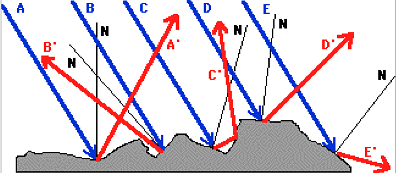
A beam of light is referred to a group of individual light rays that are parallel to each other. And each individual ray of light follows the law of reflection. However, the individual light rays meet the surface that has a different orientation on a rough surface. Meaning, the normal line is different for different rays at the point of incidence. Subsequently, according to the law of reflection, when the individual rays reflect off the rough surface they scatter in different directions.
Also check:
Difference Between Specular and Diffuse Reflection
[Click Here for Sample Questions]
We consider two different surfaces: a smooth mirror and a rough surface. The mirror reflects all parts of white light equally and the reflected light follows the same angle as the angle of incident light. The mirror does not absorb any element of any wavelength. This results in Specular Reflection.

Rough surfaces do not reflect all wavelengths of light because they absorb blue and green components and reflect only red light. This colour is visible due to the scattering of light on the surface. This results in diffuse reflection. The type of reflection depends on the surface on which the light is incident.
Specular and Diffuse Reflection Examples
[Click Here for Sample Questions]
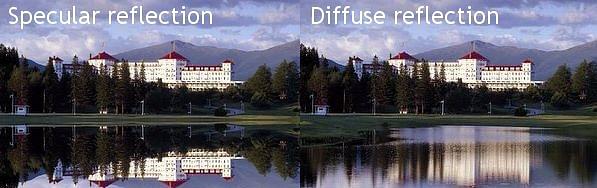
Specular reflection is most commonly known as the kind of reflection we get from a mirror. It also occurs because of other smooth surfaces like glossy tabletops, car windows, and still water surfaces. Specular reflection occurs from a calm lake because the surface is so flat that all the reflected rays bounce off in the same direction. On a number of occasions, we have seen photographs in which the photographer captures the reflection of the object in water. This too happens as a result of specular reflection. The light which reflects off the water surface exhibits specular reflection.
Specular & Diffuse Reflection Examples
Diffuse reflection occurs when reflected rays travel in multiple directions off rough surfaces. A piece of paper may look smooth on the surface to the naked eye, but at the microscopic level, there are tiny fibres that make it rough. Similar to the above example, if a gust of wind disturbs the water surface, the resulting waves and ripples would cause diffuse reflection.
We experience difficulty in driving at night on a wet road because of the glare caused due to lights of vehicles coming from the opposite direction. Normally the light rays are diffused due to the rough surface of the road but when the road is wet, water fills the irregularities present on the surface of the road. This creates a smooth surface now and we observe specular reflection instead of diffuse reflection.
Things to Remember
- There are two types of reflection of light: specular and diffuse reflection.
- When light is incident on a smooth surface it forms specular reflection.
- When light is incident on a rough surface it forms diffuse reflection.
- Smooth surfaces reflect all wavelengths of incident light.
- Rough surfaces do not reflect all wavelengths of incident light.
- The angle of incidence is equal to the angle of reflection for specular reflection.
- The angle of incidence is not equal to the angle of reflection for diffuse reflection.
Also check:
Sample Questions
Ques. Reflection mainly depends on which factor, and how can it be changed? (2 marks)
Ans. Reflection mainly depends on the type of surface on which the light rays are incident, and if we want to change the effect of reflection, we can do so by changing the angle of incidence which leads to scattering of light.
Ques. Why do the parallel incident rays that undergo diffuse reflection scatter in different directions after reflections? (2 marks)
Ans. Every individual ray strikes the surface at different points and with different orientations. And since the normal is different for each ray of light, the direction of the reflected ray will also be different.
Ques. Under what conditions does the phenomenon of total internal reflection take place? Draw a ray diagram showing how a rag of light deviates by 90° after passing through a right-angled isosceles prism. (2 Marks)
Ans. The phenomenon of total internal reflection occurs when,
(A) Angle of incidence is equaL or greater than critical angle that is i ≥ C
(B) Angle of incidence is equal or greater than critical angle that is i ≥ C In case of right-angle isosceles triangle, if light rays fall normally on face AB the light ray incident of face AC with angle of incidence greater than the critical angle.

Hence, total Internat reflection will occur with normal to the surface of BC. The phenomenon in which a ray of light travelling at an angle of incidence greater than the critical angle from denser to a rarer medium is totally reflected back into the denser medium is called total internal reflection.
Ques. Is it easier to read from glossy magazine pages or the usual pages? State your reason. (3 marks)
Ans. It is easier to read from a rough page than to read from a glossy page. This is because rough pages cause diffuse reflection while glossy pages cause specular reflection which results in glare and thus difficulty in reading. Most magazines that use glossy pages are usually the type that people view pictures rather than reading facts or news.
Ques. What causes specular and diffuse reflection? (2 marks)
Ans. When light is incident on a smooth surface (like a mirror or calm water) it leads to specular reflection. On the other hand, when light is incident on a rough surface (like a road or a piece of paper) it leads to diffuse reflection.
Ques. What are the different types of reflection? (3 marks)
Ans. The different types of reflection are:
- Specular Reflection
- Diffuse Reflection
- Multiple Reflection
Ques. Differentiate between specular and diffuse reflection. (2 marks)
Ans. Specular reflection occurs on a smooth surface, while diffuse reflection occurs on a rough surface. The angle of reflection is equal to the angle of reflection for specular reflection but the angle of reflection is not equal to the angle of reflection for diffuse reflection.
Ques. Mention and justify the type of reflection which will be observed when light strikes the following surfaces. (3 marks)
(a) A polished wooden table
(b) Chalk powder
(c) A piece of paper
(d) Marble floor with water spread on it
(e) Unpolished side of a mirror
Ans. a) A polished wooden table has a smooth surface; thus, specular reflection will be observed.
b) Chalk powder has an irregular surface; thus, diffuse reflection will be observed.
c) Paper has an irregular surface at the microscopic level, thus diffuse reflection will be observed.
d) Marble floor with water will have a smooth surface; thus, the specular reflection will be observed.
e) The unpolished side of a mirror has an irregular surface; thus, the diffuse reflection will be observed.
Ques. To a distant observer, the light appears to be coming from somewhere below the ground. The observer naturally assumes that light is being reflected from the ground, say, by a pool of water near the tall object. Such inverted images of distant tall objects cause an optical illusion to the observer. This phenomenon is called mirage. This type of mirage is especially common in hot deserts.
Based on the above facts, answer the following questions:
(A) Which phenomena is prominently involved in the formation of mirage in deserts?
(B) A diver at a depth 12 m inside water (aμω=4/3) sees the sky in a cone of semi-vertical angle. Find the angle.
(C) In an optical fibre, if n1 and n2 are the refractive indices of the core and cladding, then what will be the resultant equation?
(D) A diamond is immersed in such a liquid which has its refractive index with respect to air as greater than the refractive index of water with respect to air. Then what will happen to the critical angle of diamond- liquid interface as compared to critical angle of diamond -water interface?
(E) The following figure shows a cross-section of a ‘light pipe’ made of a glass fiber of refractive index 1.68.

The outer covering of the pipe is made of a material of refractive index 1.44.
What is the range of the angles of the incident rays with the axis of the pipe for the following phenomena to occur. (5 Marks)
Ans. (A) (i) Refraction is involved in formation of mirage in deserts. When Light passes from cold air to hot air, tight tends to bend from its path which is known as refraction. As the tight is refracted, it reaches to o point where it forms a 90° angle. Hence refraction and total internal reflection are involved in formation of mirages.
(B) Correct answer is:

(C) Correct equation is: n1 > n2
The refractive index of the core should be greater than the refractive index of the dadding.
(D) The critical angle of diamond- liquid interface as compared to critical angle of diamond -water interface will increase. Iμd = 1/sin c = μd/μ1
μ1 = μω
Thus C>C’
(E) 0<i<60°, lμ2 = 1/sinC′
SinC’= 1.441.68 = 0.8571
⇒ C = 59°
Total, internat reflection will occur if the angle i > i’c,
i.e., if i’> 59° or when r < rmax where rmax = 90° – 59°= 31°.
Using Snell’s Law.
sin imax/sin rmax = 1.68
sin imax = 1.68 x sin rmax
= 1.68 x sin 31° = 1.68 x 0.5 150 = 0.8662
Thus all incident rays which make angles in the range 0 < i < 60° with the axis of the pipe wilt suffer total internal reftections in the pipe.
For Latest Updates on Upcoming Board Exams, Click Here: https://t.me/class_10_12_board_updates
Check-Out:



Comments