



Content Writer
The resonance effect is a property of functional group that refers to the polarity generated within a molecule through interactivity between either a lone pair of electrons and a pi-bond present next to each other or between two pi bonds.
- The resonance effect is also known as Mesomeric Effect.
- The effect is observable when molecules are conjugated with double bonds or at least one lone pair of electrons and one double bond.
- It is stronger in compounds with a lower ionization potential.
The resonance effect in organic chemistry is the variation in electron behaviour when elements other than hydroges and carbon take part actively in the formation of molecular bonds.
- It also explains the delocalized electrons within certain molecules.
- Carbonate ion is the most common example of resonance ion.
| Table of Content |
Key Terms: Resonance effect, Resonance, Mesomeric Effect, Lewis Structure, Atoms, Pi Bonds, Electrons, Positive Resonance Effect, Negative Resonance Effect, Ionization Potential, Conditions of Resonance Effect, Orbitals
Resonance Effect or Mesomeric Effect in Chemistry
[Click Here for Sample Questions]
Resonance effect is defined as a type of effect when polarity is induced when a lone pair of electrons interact with a pi bond or two pi bonds interacting with nearby atoms.
- On the mesomeric effect is induced when two -bonds or a -bond and a lone pair of electrons interact.
- The resonance effect is represented by M or R symbols.
The only difference between the resonance effect and the mesomeric effect is that the first describes how a lone pair of electrons and a bond pair of electrons are used to determine its chemical structure, whereas the latter describes how the chemical structure of a molecule is stabilized using a functional group.
- An organic compound with double bonds is characterized by the resonance effect, which exists as a chemical phenomenon.
- They often have double bonds present in the structure.
- The p-orbitals of carbon atoms are typically overlapping on their two adjacent sides.
The resonance effect is most commonly in molecules with double bonds, triple bonds, or areas of high electron density. It refers to how an electron lone pair interacts with a pi bond to form polarity in a molecule.
- Also, it occurs through the interaction of two pi bonds in adjacent atoms.
- A complex Lewis structure is referred to as resonance.
- Understanding resonance in chemistry helps in figuring out the stability and energy states of a compound.

Various compounds with resonance effects are shown in the figure above.
Resonance Effect ExamplesExample: The most common example of resonance effect is benzene.
(I) and (II) have two types of carbon and carbon bonds: three C-C single bonds, whose bond length is 1.54 *, and three C=C double bonds, whose bond length is 1.34 Å. The experimental evidence suggests that all six carbon and carbon bonds are similar and that an intermediate bond of length 1.39 exists between the C-C and C+C bonds.
Resonance Effect Examples
|

Also Read:
| Related Links | ||
|---|---|---|
| Molecule | Atom Radii | Noble Gases |
| Carbocation Stability | Difference between Cations and Anions | Solids |
Types of Resonance Effects
[Click Here for Sample Questions]
There are two types of Resonance effects namely positive resonance effect and negative resonance effect whose detail description are as follows:
Positive Resonance Effect
The positive resonance effect is seen when electrons in a molecule are transferred away from an atom which is bound to the conjugated system. During the process of delocalization, the groups release electrons to the other molecules, thus creating a positive resonance effect. +R and +M are usually used to denote the groups.
- Molecular electron density increases as a result.
- Their positions with high electron densities are caused by electron displacement.
- This effect in aniline is shown as :

Example of Positive Resonance EffectExample: It include: -OH, -SH, -OR,-SR. |
Negative Resonance Effect
Negative Resonance Effect is created when the groups absorb electrons from other molecules. These groups are typically indicated by -R or -M. According to this process, the molecular electron density decreases.
- In this effect electrons are transferred towards the atom or group associated with the conjugated system.
- When an open-chain or cyclic system contains alternate single and double bonds, it is referred to as a conjugated system.
- This type of system frequently displays abnormal behavior.
- For example in nitrobenzene this electron displacement can be depicted as :

Example of Negative Resonance EffectExample: It includes -NO2, C=O, -COOH, -C≡N. |
Conditions for Resonance Effect
[Click Here for Sample Questions]
The conditions for the resonance effect are as follows:
- First and foremost, more than one Lewis structure can be represented by the molecule.
- Resonant structures differ only in electron positions and not in atom or nucleus positions.
- All structures should have an equal number of valence and unpaired electrons.
- It is also based on the suitable alignment of atoms.
Circumstances under which Resonance occurs
The conditions under which resonance takes place are as follows:
- It include the conjugation of two pi bonds
- Secondly, the process is initiated by negatively charged pi bonds and positively charged pi bonds.
- An ionic bond and a lone pair or a free radical are conjugated to produce a positive charge
- It depends on pi bond with a free radical or lone pair.
Stability of Resonance Structure
[Click Here for Sample Questions]
All resonance structures have more in common with the actual molecule than the more unstable ones. Following are some points that can help to explain the stability of resonance structures:
- Due to the identical resonance structures, each resonance hybrid contributes equally.
- The most significant contribution is from the structure with the most covalent bonds.
- The reason is bonds are formed by releasing energy, which means a molecule will be more stable.
- Due to their higher energy, structures with positive and negative charge separation tend to be less stable.
Structures composed of electronegative atoms and positively charged atoms contribute more towards resonance hybridism when atoms of different electronegativity are involved. Accordingly, the resonance structures above follow the following order in terms of stability:
- Positive charge distribution are delocalized in structures, regardless of whether they are electronegative or electropositive.
- It plays a significant role in their accumulation and functionality.
- These two structures contribute to the dispersion of positive charges.
- In general, the first structure appears to be more stable.

Application of Resonance Effect
[Click Here for Sample Questions]
Some important applications of resonance effect are as follows:
Resonance Energy
Energy derived from the difference in energy between a compound's most stable component and its resonance hybrid is called resonance energy or resonance stabilization energy.

Resonance In Electricity
When alternating current is applied to electrical circuits, resonance occurs. When resonance occurs, a maximum current is generated in the circuit. When the reactance of the inductor and capacitor are equal, it occurs in a series RLC circuit.
- As a result, the circuit's current flow is maximum due to the minimum net impedance.
Resonance Theory
Chemistry resonance is a process that occurs in the presence of a nonbonding electron or a changing position of a Pi bond (S). It is the Pi electron positions or nonbonding electron positions that change the position of an atom as a result of this process.
Things To Remember
- The resonance Effect occurs when a lone electron pair interacts with a pi bond or two pi bonds close to a molecule.
- It results in an increase in polarity in that molecule.
- The mesomeric Effect explains how a molecule can stabilize its chemical structure using a functional group.
- There are two types of resonance effect, namely positive and negative resonance effect
- The resonance structure of Lewis dot molecules, such as ozone, is called Lewis’s dot structure.
- Atoms are positioned in the same positions in various compounds, but electron positions vary.
- Lewis structures cannot fully describe the bonding between molecules; thus, resonance hybrids are used.
Also Read:
Sample Question
Ques. Draw the Lewis Dot Structure for SO42- and all possible resonance structures. Which of the following resonance structures is not favoured among the Lewis Structures? Explain why. Assign Formal Charges? (2 marks)
Ans. Below is the all-Lewis dot structure with formal charges (in red) for Sulphate (SO42-). There isn't a favourable resonance of the Sulphate ion because they are all identical in charge and there is no change in Electronegativity between the Oxygen atoms.
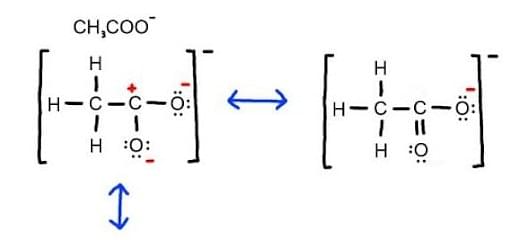
Ques. Draw the Lewis Dot Structure for CH3COO- and all possible resonance structures. Assign Formal Charges. Choose the most favorable Lewis Structure? (2 marks)
Ans. Below is the resonance for CH3COO-, formal charges are displayed in red. The Lewis Structure with the most formal charges is not desirable, because we want the Lewis Structure with the least formal charge.
Ques. Draw the Lewis Dot Structure for HPO32- and all possible resonance structures. Assign Formal Charges? (2 marks)
Ans. The resonance for HPO32, and the formal charges (in red)

Ques. Draw the Lewis Dot Structure for CHO21- and all possible resonance structures. Assign Formal Charges? (2 marks)
Ans. The resonance for CHO21-, and the formal charges (in red).
Ques. Draw the Resonance Hybrid Structure for PO43-? (2 marks)
Ans. The resonance hybrid for PO43-, hybrid bonds are in red.

Ques. Draw the Resonance Hybrid Structure for NO3-? (2 marks)
Ans. The resonance hybrid for NO3-, hybrid bonds are in red.

Ques. What is the Resonance Effect? Mention its types? (2 marks)
Ans. The resonance effect happens when two adjacent atoms interact and cause polarity in a molecule. The interaction occurs when a single electron acts on a pi bond or when two pi bonds act on each other. The resonance effect happens when two adjacent atoms interact and cause polarity in a molecule. The interaction occurs when a single electron acts on a pi bond. The two types are Positive and Negative Resonance Effect.
Ques. Explain Positive and Negative Resonance Effect? (3 marks)
Ans. Positive Resonance Effect- In the process of delocalization, electrons from the groups are released to other molecules, resulting in a positive resonance effect. In general, +R and +M are used to denote the groups. The electron density of molecules increases during this process.
Negative Resonance Effect- Delocalization, a process in which molecules withdraw electrons from one another, causes the negative resonance effect. -R or -M are usually used to identify the group. Electron density decreases during this process.
Ques. What is the difference between inductive effect and resonance effect? (4 marks)
Ans: The difference between inductive effect and resonance effect are as follows:
| Inductive Effect | Resonance Effect |
|---|---|
| Inductive Effect is a type of effects that involve polarisation of electron density. | Resonance effect is the release of electrons from a specific substituent due to delocalization of π or pi electrons through any of various canonical structures. |
| It form sigma bonds. | It form pi-bonds |
| This effect can cover only short distances. | This effect can cover only long distances. |
| Example: Alkyl groups | Example: Nitro groups |
Ques. What is the principle of resonace? (3 marks)
Ans. The principle of resonance are as follows:
- The most important principle of resonance is the effect is generated when the electron has the least charge.
- The resonance of a full octet is more powerful than that of a partial octet.
- The most stable forms are those structures in which positive charges will work with the least electronegative atom.
- The resonance structure of a molecule having the greatest covalent bond is considered the most significant.
Ques. What is the difference between resonance and mesomeric effect? (3 marks)
Ans. The difference between resonance and mesomeric effect are as follows:
| Resonance Effect | Mesomeric Effect |
|---|---|
| Resonace effect describes the interaction between lone pair of electron and bond electron of molecule. | Mesomeric effect describe the stabilization of molecules having different functional groups. |
| It effect the polarity of molecule. | It does not effect the polarity of molecule. |
| It is initiated due to presence of double bond on adjacent lone pair of electron. | It is initiated die to presence of electron donating or withdrawing groups. |
For Latest Updates on Upcoming Board Exams, Click Here: https://t.me/class_10_12_board_updates
Check-Out:



Comments