


What is valency?

Jasmine Grover logo

Jasmine Grover

Education Journalist | Study Abroad Lead

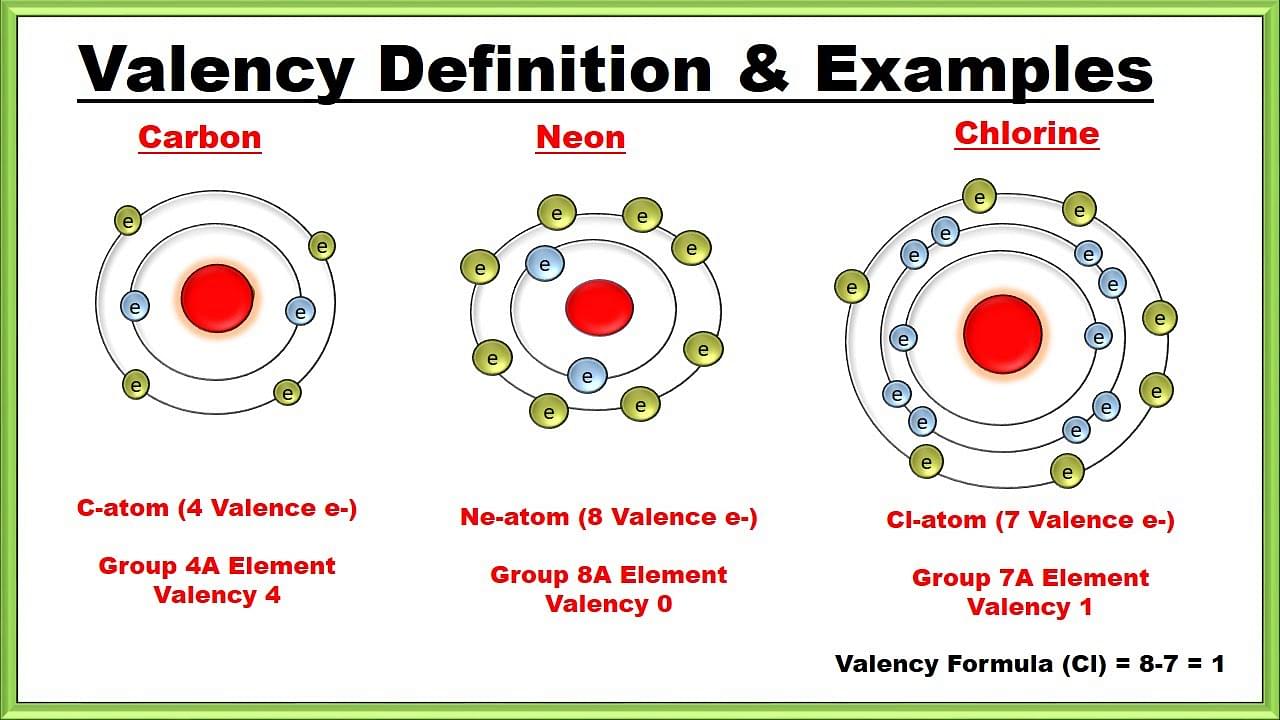
Valency is a concept in chemistry that refers to the number of chemical bonds a particular element can form with other elements. Valency is defined as the maximum number of electrons that an atom of an element can acquire or lose, gain or share to form a chemical bond.

  • The valency of an element is used to predict the formula of a compound that can be formed by combining the element with other elements.
  • It helps to determine the type of chemical bond that is likely to form between the elements.
  • Valency plays a crucial role in chemical reactions and in the structure of molecules and compounds.

For example, the valency of carbon is 4, meaning it can form 4 chemical bonds with other atoms. This is why it is often found in molecules such as methane (CH4) and ethane (C2H6).

The valency of oxygen is 2, so it can form 2 bonds, such as in water (H2O).
Valency

Also Read:

CBSE CLASS XII Related Questions

  • 1.
    Write mechanism of acid dehydration of ethanol to ethene.


      • 2.
        Predict the alkene that would be formed by dehydrohalogenation of 1-Bromo-1-methylcyclohexane.


          • 3.
            Which isomer of $C_4H_9Br$ is most reactive towards $S_N1$ reaction?


              • 4.
                Give structures of A, B and C: Aniline $\xrightarrow{Br_2/H_2O}$ A $\xrightarrow{NaNO_2+HCl, 0-5^\circ C}$ B $\xrightarrow{H_3PO_2+H_2O}$ C


                  • 5.
                    Though chlorine shows strong $-I$ effect, why is it ortho/para directing?


                      • 6.
                        Draw the structures of major products: (a) Chlorobenzene + $CH_3Cl$ / Na, dry ether
                        (b) p-Hydroxyphenethyl alcohol + HBr

                          CBSE CLASS XII Previous Year Papers

                          Comments


                          No Comments To Show
