



Education Journalist | Study Abroad Lead
Root Pressure in plants is an important natural phenomenon that is responsible for transporting important nutrients from the soil to the plant stems. It is a hydrostatic pressure generated in the roots to the shoot through the plant’s vascular tissue called Xylem. Though this process is not the sole mechanism of driving nutrition to the plant and does not occur throughout the year. There are various internal and external factors that affect the root pressure system. Root pressure is of two types which are affected by external factors like daytime or night called positive and negative root pressure.
| Table of Content |
Key Terms: Root Pressure, Transpiration, Xylem, Stem, Osmosis, Vascular Tissue, Gravity, Hydrostatic Pressure, Guttation
What Is Root Pressure?
[Click Here for Sample Questions]
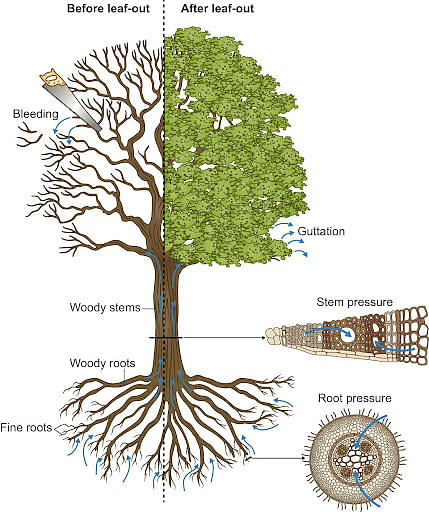
Root pressure is the transverse osmosis generated in the roots that drives sap from the soil into the plant’s vascular tissue against gravity. This tissue is known as Xylem and is responsible for transporting fluids and ions from plant stems to the leaves in an upward direction. The root pressure occurs at the time of low transpiration levels during the early morning or night when soil moisture levels are high.
Root Pressure
Process of Root Pressure
[Click Here for Sample Questions]
Root pressure occurs due to the natural process of osmosis in which the water molecules diffuse from the area of low mineral concentration to the high mineral concentration. This creates a hydrostatic pressure in the roots and the water passes freely through the root tissues, but not the minerals. This is referred to as the cohesion-tension-transpiration pull model of water transport where the water is ‘pulled’ through the plant.
Root pressure can be spotted at the time of spring when trees are cut down. The sap exudes from the stump against considerable pressure. The pressure occurs in deciduous trees or non-timber plants when the leaves are shed in early winter or when the plants are in a saturated or near-saturated condition.
Read More: Difference Between Xylem And Phloem
Positive Root Pressure
[Click Here for Sample Questions]
During night-time, when the soil moisture levels are high, the root pressure causes guttation or exudation of drops of xylem sap from the tips or edges of leaves. The ions in the soil are actively absorbed in the stems of the plants due to positive root pressure. As it causes the active accumulation of solute in xylem sap.

Guttation
Negative Root Pressure
[Click Here for Sample Questions]
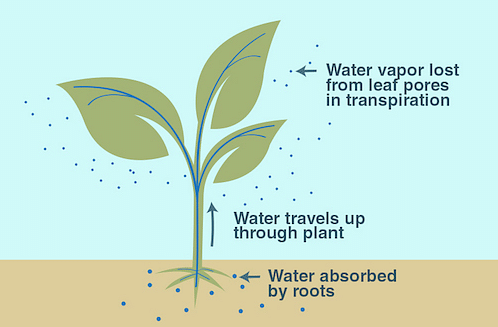
During the daytime when transpiration is at maximum levels, tension is created in the xylem vessels from the surfaces of the leaves to the tips of the roots, through the stem. This causes a loss of water resulting in the guard cells and other epidermal cells becoming saggy. Hence, the negative pressure in turn takes water from the plants.
Transpiration
Factors Affecting Root Pressure
[Click Here for Sample Questions]
The factors affecting the root pressure or the active absorption of nutrients through the Xylem or water-conducting channels are as follows:
- Climatic Conditions: Climatic conditions have a major impact on the water absorption levels of the Xylem as the pace of the root pressure is lowered.
- Temperature: Along with climatic conditions, the temperature also has an important role to play in the root pressure. When the temperature reduces due to nature or any imbalance, the root pressure will be less.
- Mineral Deficiencies: The plant deficient in calcium, magnesium, and phosphate reduces the nutrient absorption capacity of plants as they facilitate root pressure.
- Lack of Oxygen: The sufficient amount of oxygen is required to facilitate the ascent of liquid. Not receiving enough quantity of oxygen can result in a reduction of the root pressure atmosphere.
Read More: Transportation in Plants
Birch Sugaring
[Click Here for Sample Questions]
The birch syrup industry thrives on birch trees known for having the highest root pressures. The sugaring season takes place for three weeks when the soil starts getting warmed up. The tree produces a sweet sap, Albeit which has a distinct flavour from most sugar maples.
The collection of this sap takes place as the buckets are hung on the trunks to push sap from the ground. This is possible due to high root pressure. The trees are located in the forests of Alaska and northern parts of the globe.

Birch Sugaring
Read More: Excretion in Plants
Things To Remember
- Root pressure is the force that drives the nutrients from the soil to the plants in an upward direction against gravity.
- This pressure is created in the plant’s vascular tissue responsible for channelizing water known as Xylem.
- The best time to spot root pressure is at the time of spring when plants bleed a considerable amount of sap when they are cut.
- Root pressure is of two types, positive root pressure and negative root pressure and it depends on various climatic factors.
Sample Questions
Ques. Who proposed the theory of root pressure? (2 Marks)
Ans. The root pressure theory was proposed by J Priestly. However, the term was coined by Stephen Hales. When a plant is carefully cut close to the base of the stem, the stump exudes or bleeds sap. This fluid comes out forcibly because of the phenomenon of root pressure.
Ques. What is transpiration? (3 Marks)
Ans. Transpiration is the process of discharge of water from the aerial parts of the plants in the form of water vapour. It performs the function of the excretory system in plants as only small water is required by plants for their growth, rest is eliminated in the form of water vapour. It takes place from the surface of the leaves.
Ques. What is the role of phloem in plants? (2 Marks)
Ans. Phloem is the type of plant transport tissue that transports organic food material from leaves to stem and roots in a downward direction. They are in the form of a vascular bundle and act as a source in translocating the food material.
Ques. Explain why xylem transport is unidirectional and phloem transport bi-directional. (3 Marks)
Ans. Xylem transport is unidirectional and phloem transport is bi-directional because of the following reasons:
| Xylem | Phloem |
|---|---|
| Xylem transport is unidirectional because the water column flows only upwards against gravity. | Phloem transport is bidirectional because water can flow in any direction-upwards or downwards, depending on high concentration areas and low concentration areas. |
| The two major forces that cause this are transpiration pull and the positive root pressure. Transpiration causes a negative pressure whereas positive root pressure sends the water upwards. | The high pressure and low-pressure areas are created due to the accumulation of sucrose in the phloem tissue. |
Ques. Differentiate between diffusion and osmosis. (3 Marks)
Ans. The differences between diffusion and osmosis are
| Diffusion | Osmosis |
|---|---|
| When any type of substance can move from an area of higher concentration to a lower concentration it results in diffusion. | When only water or another solvent can move from a region of higher concentration to a lower concentration it results in osmosis. |
| It can take place in any medium- solid, liquid, or gas. | Osmosis occurs only in a liquid medium. |
| A semi-permeable membrane is requisite for diffusion to take place. | It does not require a semi-permeable membrane. |
Ques. Explain how mycorrhizal association helpful in the absorption of water and minerals in plants. (3 Marks)
Ans. The symbiotic association of fungi with the root systems of some plants where both the parties involved in this relationship get mutually benefitted from each other is known as a mycorrhizal association.
The fungal hyphae create a large surface area or a dense network which helps in increasing the absorption of water and minerals from the soil. In return, the host plants provide them with sugar and nitrogenous compounds. The mycorrhizal association does not take place in some plants.
Ques. What happens when a pressure greater than the atmospheric pressure is applied to pure water? (2 Marks)
Ans. When a pressure greater than the atmospheric pressure is applied to pure water the water potential increases. It leads to positive root pressure as when water diffuses into a plant cell, a pressure is built up against the cell wall which swells the cell wall.
Ques. Give the reason why pure water has the maximum water potential. (3 Marks)
Ans. Pure water has the highest concentration of water molecules present in it which maximizes the kinetic energy. This makes it easier to transport when water is in liquid form as the movement of its molecules increases. Hence, it has the highest water potential. However, when some solute is diffused in water, the water potential of pure water decreases.
Ques. What are the limitations of the theory of root pressure? (3 Marks)
Ans. The limitations of the theory of root pressure are as follows:
- The theory does not apply to plants taller than 20 m and the value of root pressure is almost zero in tall gymnosperm trees.
- Transverse osmosis can also happen in the absence of a root pressure system.
- Plants supporting active transpiration do not follow root system procedures.
Ques. Differentiate between Guttation and Transpiration. (3 Marks)
Ans. The differences between guttation and transpiration are
| Guttation | Transpiration |
|---|---|
| It occurs at night. | It occurs during day time. |
| Water is lost as a liquid that is rich in minerals. | Water is lost in the form of vapours and is pure. |
| The process occurs through hydathodes. | The process takes place through stomata. |
Check-Out:



Comments