



Content Curator
Rounding off significant figures is an important part of scientific and engineering work, as it helps to ensure that data is reported accurately and consistently.
- It is also important to round off significant figures correctly when performing calculations, as rounding off too early can lead to errors.
- To round off significant figures, we must remove one or more digits from the right side of the number until we reach the desired number of significant digits.
- To begin, we need to look at the digit on the right end of the number (to the right of the digit to which we want to round it off).
- If the digit is less than 5, the number is rounded down to the next whole number.
- If the digit is more than or equal to 5, the number is rounded up to the next whole number.
| Table of Content |
Key Terms: Significant figures, Whole numbers, Decimal numbers, Rounding off, Exact numbers, Even and odd numbers
Rounding Off
[Click Here for Sample Questions]
Rounding off implies simplifying a number by keeping its value but moving it closer to the next number.
- It is done for whole numbers as well as decimals at various hundreds, tens, and tenth places.
- Numbers are rounded off to preserve significant digits.
- The number of significant figures in a result is simply the number of figures that are reliably known.
- There are three significant figures in the number 13.2.
- Non-zero digits are always significant. 3.14159 contains six significant digits (all of the numbers are relevant).
- Therefore, 67 has two significant numbers, but 67.3 has three.
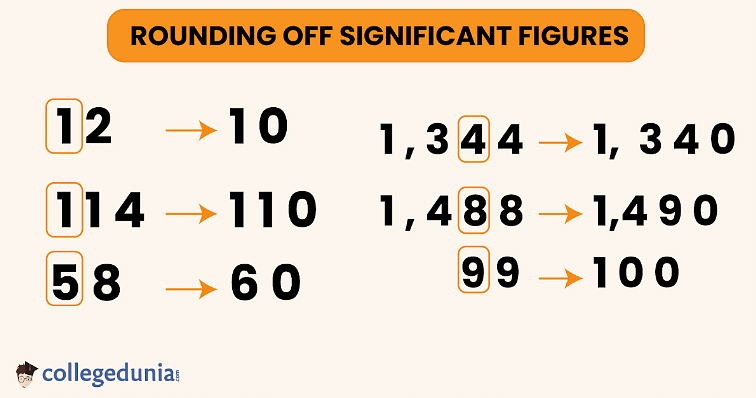
Rounding off
Also Read:
| Related Articles | ||
|---|---|---|
| Scientific Notation Formula | Measurement of Mass and Weight | Decimal Expansion of Rational Numbers |
Rules for Rounding Off Whole Numbers
[Click Here for Previous Year Questions]
The following are the rules that have to be followed while rounding off whole numbers
- Always use the smallest place value to get an accurate final result.
- Look for the next smaller place, which is to the right of the rounded-off number. When rounding off a number from the tens place, look for a digit in the one's place.
- If the insignificant digit to be dropped is more than 5, then the preceding digit is raised by 1. This is known as rounding up.
- If the insignificant digit to be dropped is less than 5, then the preceding digits are left unchanged. This is known as rounding down.
- If the insignificant digit to be dropped is 5, then the preceding digit is raised by 1 if it is odd and is left unchanged if it is even.
- When a complex multi-step calculation is involved, all the numbers occurring in the intermediate steps should retain a digit more than the significant digits present in them. The final answer at the end of the calculation, can then be rounded off to the appropriate significant figures.
- The exact numbers like π, 2, 3, 4, etc. that appear in the formulae and are known to have infinite significant figures, can be rounded off to a limited number of significant figures as per the requirements.
Rules for Rounding Off Decimal Numbers
[Click Here for Sample Questions]
The following are the rules that have to be followed while rounding off decimal numbers
- Determine the digit to be rounded off and look at the digit at the right side of the digit to be rounded off.
- If the digit on the right-hand side is less than 5, then consider it as equal to zero.
- If the right-hand side digit is greater than or equal to 5, then add +1 to that digit and consider all other digits as zero.
Examples of How to Round Off
[Click Here for Previous Year Questions]
Some examples of how to round off a number are given below
Round Off to Nearest Hundred
Let us take the number 4350. We have to round off this number to the nearest hundred places. The following steps should be followed
- First determine the digit present in the hundreds place: 3
- Next, determine the next smallest place in the number i.e tens place: 5
- Now if the number present in the smallest place is greater than or equal to 5, then the preceding number i.e. hundreds place digit is added by 1 i.e. 3 + 1 = 4. And the other digits on the right side become zero.
- So, we get the final answer as 4400
Round Off to Nearest Ten
Let us take the number 414.5. We have to round off this number to the nearest tens place. The following steps should be followed
- First determine the digit present in the tens place: 1
- Next, determine the next smallest place in the number: 4
- If the number present in the smallest place is greater than or equal to 5, then the preceding digit should be rounded up i.e. 1 is added to the preceding number.
- But in this case, the insignificant digit present in the one place is less than 5, therefore round down is followed, and hence the preceding digit remains unchanged.
- Also, all digits at the right side of the hundreds place become zero.
- So the final number is 410.
Let us consider another example of round-off to the nearest ten. Take the number 599. We have to round off this number to the nearest tens place. The following steps should be followed
- First determine the digit present in the tens place: 9
- Next, determine the next smallest place in the number: 9
- If the number present in the smallest place is greater than or equal to 5, then the preceding digit should be rounded up i.e. 1 is added to the preceding number.
- In this case, the insignificant digit present in one place is greater than 5, therefore the preceding digit is rounded up, and hence the preceding digit becomes 9 + 1 = 10 and the 1 is carried to the next place.
- As the digit in the one place is greater than 5, +1 has to be added.
- Therefore, 9+1=10, and the 1 is carried to the next place.
- So the final number is 600.
Round Off to Nearest Tenth
Let us consider an example of round-off to the nearest tenth. Take the number 0.84. We have to round off this number to the nearest tenth place. The following steps should be followed
- First determine the digit present in the tenth place: 8
- Next, determine the next smallest place in the number: 4
- If the number present in the smallest place is greater than or equal to 5, then the preceding digit should be rounded up i.e. 1 is added to the preceding number.
- But in this case, the insignificant digit present in the smallest place is less than 5, therefore round down is followed, and hence the preceding digit remains unchanged.
- So the final number is 0.8
Things to Remember
- Significant figures (or significant digits) are the number of digits in a given value or a measurement, necessary to decide the accuracy and precision of measurement.
- Rounding off means simplifying a number by maintaining its value but moving it closer to the next number.
- It is done for whole numbers as well as decimals at various hundreds, tens, and tenth places.
- If the digit to be rounded off is more than 5, then the preceding digit is raised by 1.
- If the digit to be rounded off is less than 5, then the preceding digit is left unchanged.
- If the digit to be rounded off is 5, then the preceding digit is raised by 1 if it is odd and remains unchanged if it is even.
Also Read:
Previous Year Questions
- In the given circuit, what will be the equivalent resistance between the points…. [JIPMER 2006]
- How to adjust a system of three identical capacitors to get high electrostatic energy with the given battery… [UPSEE 2006]
- The surface charge density of the Earth…. [DUET 2009]
- A point dipole with dipole moment... [KEAM]
- The time of fall of the electron, in comparison to the time of fall of the proton is….[NEET 2018]
- An electric dipole of dipole moment is placed in a uniform external electric field…. [KEAM]
- An infinite number of charge, each of charge…
- Infinite charges of magnitude q each are lying at… [JKCET 2004]
- Two long current carrying thin wires, both with current… [JEE Main 2015]
- Identify the wrong statement… [KEAM]
- An electron enters a uniform electric field maintained by parallel plates and… [KEAM]
- When a soap bubble is charged… [KCET 2020]
- Two pith balls carrying equal charges are suspended from a common point by… [NEET 2013]
- A glass rod rubbed with silk is used to change a gold leaf electroscope… [JEE Advanced 2011]
- A copper rod AB of length l is rotated about end A with a constant angular… [VITEEE 2021]
- Two charges of equal amount +Q are placed on a line… [WBJEE 2016]
Sample Questions
Ques. The number of significant digits in 1559.00 is (2 Marks)
(a) 5
(b) 6
(c) 4
(d) 3
Ans. The correct answer is b. 6
Explanation: The trailing zeroes in the number having a decimal point are significant.
Ques. How many significant figures are in the number 0.005680 x 10⁻³? (2 Marks)
Ans. The power of 10 is irrelevant in the determination of significant figures. So we have to find significant figures in 0.005680.
Now if a number is less than 1, then zero(s) on the left of the first non-zero digit are not significant. Hence, there are only 4 significant figures.
Ques. What is the number 75.66852 rounded off to 5 significant digits? (2 Marks)
(a) 75.669
(b) 75.667
(c) 75.67
(d) 75.668
Ans. The correct answer is a. 75.669
Explanation: If the digit to be rounded off is 5 and the next digit is not zero, the last remaining digit is increased by one, according to the rounding-off rules.
Given number = 75.66852
After applying rounding rules, 852 rounds off to 9
Therefore, the final answer will be “75.669”.
Ques. The time taken by the pendulum to complete 25 vibrations is 88.0 seconds. Find the time period of the pendulum in seconds, up to appropriate significant figures. (3 Marks)
Ans. The time period of oscillation is given by
T = (Total time taken)/(Number of oscillations) = 88.0/25 = 3.52 s
Out of two quantities in the data, 25 is exact and has infinite significant figures. Therefore the answer should be reported to three significant figures i.e. 3.52 seconds.
Ques. The number 0.005900, in standard scientific form, can be expressed as (2 Marks)
(a) 59 x 104
(b) 5.9 x 10⁴
(c) 5.9 x 10³
(d) 5.9 x 10²
Ans. The correct answer is c. 5.9 x 10³
Explanation: The number of significant digits in this case is four. In standard scientific form, we do not need to consider the zeros after 9 and must start with a value between 1 and 9. Hence the final answer is 5.9 x 10³
Ques. What is the importance of rounding off significant figures? (5 Marks)
Ans. The following are the importance of rounding off significant figures
- It makes communication easier: When reporting experimental or calculation results, it is essential to be specific about how accurate the results are. Scientists and engineers can achieve this without having to write out all of the numbers in their measurements or calculations by rounding off significant numbers.
- It helps to avoid introducing errors: It helps to prevent adding needless errors when completing calculations. Rounding off large figures helps in the process by ensuring that only the most precise digits are utilized in the calculations.
- It makes data more manageable: It can be time-consuming and difficult to analyze all of the data with the same degree of precision when working with huge databases. By decreasing the number of digits that must be processed, rounding off large values can help to make data more manageable.
Ques. The length and breadth of a rectangular plate are measured to be 14.5 cm and 4.2 cm respectively. Find its area to appropriate significant figures. (3 Marks)
Ans. Given
- Length = 14.5 cm (has 3 significant figures)
- Breadth = 4.2 cm (has 2 significant figures)
Area = length x breadth
⇒ Area = 14.5 x 4.2 = 60.90 cm2
The answer should be rounded off to two significant figures.
Therefore, the digit to be dropped in the answer 60.90 is 9 which is greater than 5.
So the preceding zero is raised by 1. Hence the final answer is 61 cm2
Ques. Define significant figures. (2 Marks)
Ans. Significant figures, also known as significant digits, are important digits in a number that add to measurement accuracy. They are used to report a measured or determined value to the right number of decimal places or digits to show the accuracy of the value.
Ques. What is meant by rounding off significant figures? (1 Mark)
Ans. Rounding off significant figures is the process of reducing the number of digits in a number while preserving the most accurate digits.
Ques. What are the advantages of rounding off significant figures? (3 Marks)
Ans. The following are the advantages of rounding off significant figures
- Scientists and engineers can express the accuracy and precision of their measurements and calculations in a concise way by rounding off significant numbers.
- Rounding off significant figures helps to avoid introducing unnecessary errors into calculations by only using the most accurate digits.
- When working with huge datasets, rounding off significant numbers helps make data easier to understand.
Ques. Round off the following numbers up to three significant figures (3 Marks)
(a) 2.520
(b) 4.645
(c) 22.78
(d) 36.35
Ans. The round-off values of up to three significant figures of the given numbers are given as
- 2.520: Since 0 is less than, the preceding digit is left unchanged. Hence the final answer is 2.52.
- 4.645: Since the digit to be dropped is 5 and the preceding digit 4 is even. So it is kept unchanged. Hence the final answer is 4.64.
- 22.78: Since 8 is greater than 5, the preceding digit is increased by 1. Hence the final answer is 22.8.
- 36.35: Since the digit to be dropped is 5 and the preceding digit is odd, so it is increased by 1. Hence the final answer is 36.4.
Ques. A cube has a side of length 1.2 x 10⁻² m. Calculate its volume. (2 Marks)
Ans. The volume of a cube is given by the formula
Volume (V) = (Side)3
Given the length of a side of the cube is 1.2 x 10⁻² m, therefore
V = (1.2 x 10⁻²)3
⇒ V = 1.728 x 10⁻⁶ m3
Correcting the above result up to 2 significant figures, we get
V = 1.7 x 10⁻⁶
Ques. What are the rules for rounding off? (5 Marks)
Ans. The following are the rules for rounding off
- If the digit to be dropped is more than 5, then the preceding digit is raised by 1.
- If the insignificant digit to be dropped is less than 5, then the preceding digits are left unchanged.
- If the digit to be dropped is 5, then the preceding digit is raised by 1 if it is odd and is left unchanged if it is even.
- When a complex multi-step calculation is involved, all the numbers occurring in the intermediate steps should retain a digit more than the significant digits present in them. The final answer at the end of the calculation, can then be rounded off to the appropriate significant figures.
- The exact numbers like π, 2, 3, 4, etc. that appear in the formulae and are known to have infinite significant figures, can be rounded off to a limited number of significant figures as per the requirements.
Ques. The number of significant digits in 435.00 is (2 Marks)
(a) 3
(b) 4
(c) 5
(d) 6
Ans. The correct answer is c. 5
Explanation: The trailing zeroes in the number having a decimal point are significant.
Ques. How many significant figures are there in the measured values? (3 Marks)
(a) 227.2 g
(b) 3600 g
(c) 0.00602 g
Ans. The number of significant figures present in the measured values is
- 227.2 g has all non-zero digits. Hence it has four significant figures.
- Trailing zeros are not significant figures. Hence in 3600 g, there are 2 significant figures.
- The zeros at the beginning are not significant. Hence, in 0.006.2 g has 3 significant figures.
For Latest Updates on Upcoming Board Exams, Click Here: https://t.me/class_10_12_board_updates
Check-Out:



Comments