


Content Curator
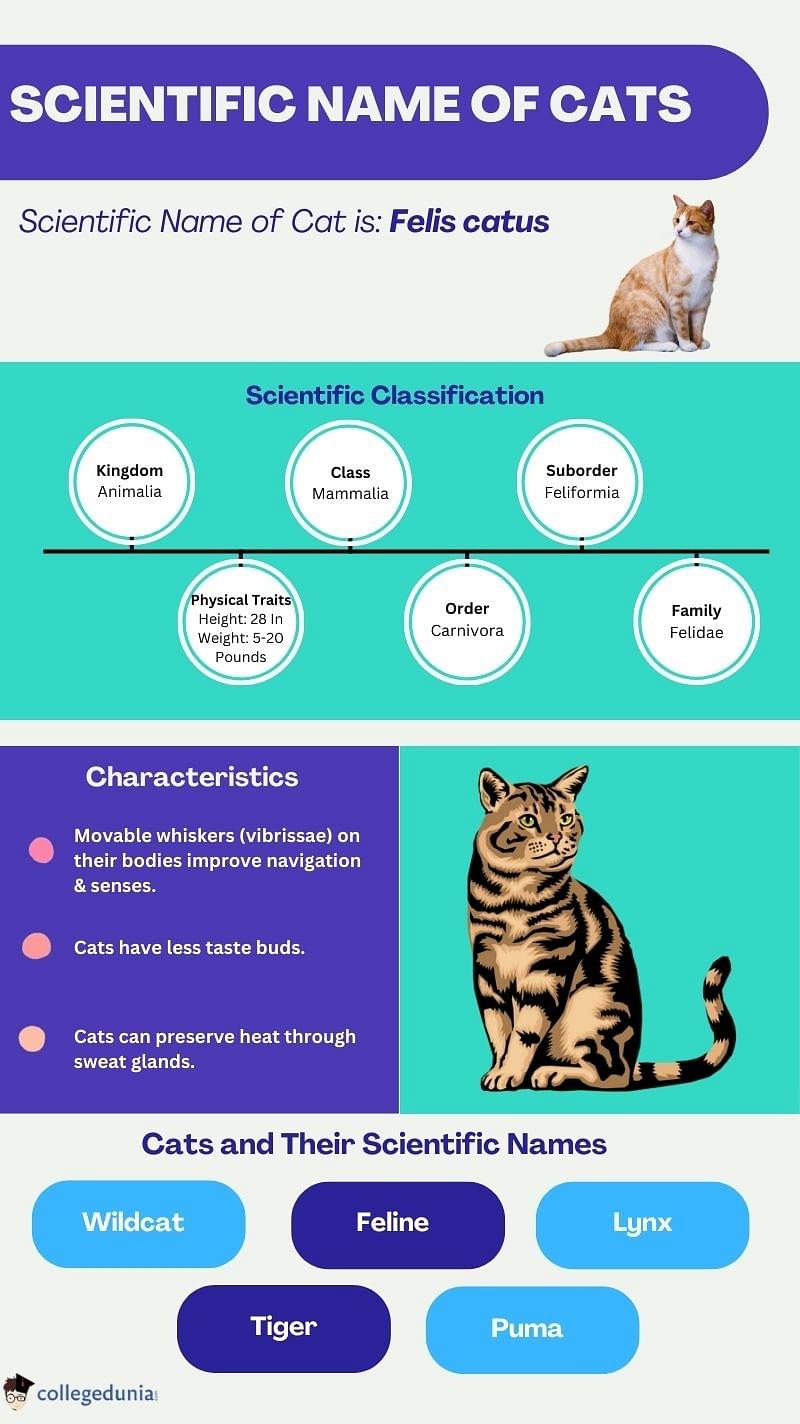
Felis catus is the scientific name of cat. In the Felidae family, cats are one of the tiniest carnivores. Cats are known to have retractable claws which help them defend themselves from potential predators and also prey on smaller animals. Cats fall amongst the earliest animals to be largely domesticated. Cats are a member of the genus Felis, belonging to the family Felidae, from which the domestic cat is derived from. There are approximately 60 different cat breeds. Feline hypercarnivores can be described as animals that consume large quantities of meat, like cats and other members of the Felidae.
Key Terms: Cats, Felis Catus, Feline, Felidae, Mammalia, Animalia, Kingdom, Phylum
Scientific Name of Cat
[Click Here for Sample Questions]
The scientific name of Cat is Felis catus. The domestic cat generally belongs to the genus Felis and the family Felidae. Cats are hypercarnivores in nature, like the other members of their family. It means that cats have a diet that contains at least 70 percent of meat. The average weight of a cat is around 4 kg and 5 kg. Domesticated cats often mate with feral cats, producing hybrid offspring. The oldest recorded evidence of an African wildcat, F. Lybica, being tamed by humans was found close to a Neolithic cemetery at Shillourokambos, Southern Cyprus, around 7200 BC.
Also Check:
Scientific Classification of Cat
[Click Here for Previous Years' Questions]
Cats can be further classified into the following categories:
| Type | Parameters |
|---|---|
| Kingdom | Animalia |
| Physical Traits | Height: About 28 inches, Weight: 5 to 20 pounds |
| Scientific Name | Felis Catus |
| Class | Mammalia |
| Order | Carnivora |
| Suborder | Feliformia |
| Family | Felidae |
Characteristics of Cats
[Click Here for Sample Questions]
There are several characteristics a cat can have. Some of them are listed below:
- Cats are known to possess numerous movable whiskers (vibrissae) on their bodies, most of which can be found on their faces. This helps enhance the navigation and senses of cats.
- Unlike humans, cats only have fewer taste buds.
- Cats can preserve heat. In fact, they possess sweat glands that further aid evaporative cooling.
Read More: Red Fox
Cats and Their Scientific Names
[Click Here for Previous Year Questions]
There are different cats around the world. The scientific names of different cats are as mentioned below:
Wildcat
Wildcat (from the species Felis silvestris), which is a small wild member of the cat family (Felidae) can be found in Eurasia and Africa. Right now, there are almost three to five subspecies that fall under this species. The term “wildcat” also refers to feral domestic cats, alongside many other smaller wild species of the cat family which aren’t domesticated. The European wildcat, the scientific name of which is Felis silvestris silvestris, is the nominate subspecies. It can be located in forested areas, from Scotland to the continental parts of both Europe and western Asia.
Feline
Feline, which come from the family of Felidae, have almost 37 cat species, including the puma, cheetah, jaguar, lion, leopard, lynx, tiger, and the domestic cat. Cats can be found in almost every region of the world, excluding Australia and Antarctica. In spite of the fact that they are not carnivorous mammals that are found in numerous habitats, felines are very commonly found in the woodlands.
Lynx
There are about four species of short-tailed cats (family Felidae), in the genus Lynx, which can be located in forests of Europe, Asia, and North America. The two North American Felids, Lynx (Lynx canadensis) and bobcat (Lynx rufus), can be found in the wilderness. These two European lynxes are called “Eurasian lynx” and the “Iberian lynx”, respectively, which are both related to one another.
Tiger (Panthera tigris)
Tiger is one of the most dangerous among all the feline creatures. From the Far Russian East to all the parts of North Korea, India, China, and Southeast Asia to parts of the Indonesian island of Sumatra, tigers are now endangered. The Siberian, or Amur, tiger (which is scientifically called P. tigris altaica) can grow up to the size of 4 meters (13 feet) in total length and can also weigh up to 300 kg. The largest tigers weigh up to 660 pounds.
Puma
Puma is also called the mountain lion, cougar, panther (as per the eastern United States), and catamount (according to the archaic times). Puma is a gigantic, brownish New World cat which is very close in size to the jaguar and the only other large cat that can be located in the Western Hemisphere. A member of the Felidae family, Puma has the widest distribution amongst all New World mammals, with a range which vastly stretches from southeastern Alaska to southern Argentina and Chile.
Things to Remember
- The scientific name of Cat is Felis catus.
- Cats are among the earliest animals to be largely domesticated.
- Cats are known to preserve heat.
- Domestic cats typically belong to the genus Felis and family Felidae.
Previous Year Questions
- Botanical name or scientific name of banana is … (COMEDK UGET 2011)
- As per Engler and Prantl's system … (COMEDK UGET 2011)
- Which of the following taxonomic categories of housefly is… (KEAM)
- Small mammals and birds are rarely found in polar regions … (KCET 2021)
- Which of the following is not an attribute of a population … (NEET 2020)
- The zoological name of Indian buffalo is … (COMEDK UGET 2005)
- Bladderworm/cysticercus is the larval stage of… (NEET 1991)
- Read the statements given below and identify the incorrect … (KCET 2012)
- Edaphology is… (KCET 2007)
- Which one of the following is oviparous?... (NEET 2015)
- The process of growth is maximum during … (NEET 2020)
- Which one of the following statements about certain given animals is correct?... (NEET 2010)
- A biologist studied the population of rats in a barn … (NEET 2013)
- A sedentary sea anemone gets attached … (NEET 2013)
- Which of the following organisms possesses characteristics of a plant and an animal? (NEET 1995)
Sample Questions
Ques. Which suborder do cats belong to? [1 mark]
Ans. Feliformia is the suborder cats belong to.
Ques. What is the scientific name of cats? [1 mark]
Ans. The scientific name of cats is Felis catus.
Ques. What is the weight of an average male feline o the largest breed? [1 mark]
Ans. The average male feline of the largest breeds can weigh roughly around 20 pounds.
Ques. List two characteristics of cats. [2 marks]
Ans.The two characteristics of cats include:
- Like dogs, cats also have whiskers on the backside of their front legs.
- Cats have very limited number of taste buds.
Ques. Which family do cats belong to? [1 mark]
Ans. Felidae is the family cats belong to.
Ques. Do cats have minimum color vision? Elaborate. [2 marks]
Ans. Cats do have minimum color vision. Although they aren’t entirely colorblind, most cats can only see blue and yellow with clarity.
Read More:



Comments