



Content Curator
Red foxes are creatures belonging to class Mammalia having long snouts and red fur on the face, back, sides,and tail. They have a grayish-white abdomen, chin, and throat. They are Carnivora and Canidae members.
| Table of Contents |
Key Terms: Red Fox, Taxonomy, Binomial Nomenclature , Zoology, Zoological Terminology, Vulpes
What are Red Foxes?
[Click Here for Previous Year Questions]
Red foxes are creatures having long snouts and red fur on the face, back, sides, and tail are characteristics of red foxes. They have a grayish-white abdomen, chin, and neck. Black paws and wide, pointed ears with a black tip are characteristics of red foxes.
The fluffy white-tipped tail of the red fox is one of its most distinguishing features. About three feet long and two feet tall,red foxes.
The red fox is a common emblem of animal cunning and is the topic of a lot of legend. Red foxes are also kept professionally for their pelts and killed for fun and fur.

Red Fox
Scientific Name of Red Fox
[Click Here for Sample Questions]
The scientific name of Red Fox is Vulpes vulpes.
- The red fox, the biggest of the genuine foxes, is also one of the most widely dispersed species in the order Carnivora.
- Inhabiting nearly all of North America, most of Europe, much of Asia, and portions of North Africa.
- The IUCN has classified it as having least concern.
What do Red Foxes eat?
Red foxes are omnivores who eat both plants and animals.
- The primary food of red foxes consists of tiny animals that resemble mice, such as gerbils, voles, rabbits, opossums, raccoons, and squirrels.
- They could even like eating carrion or decaying cadaver meat.
- Numerous vegetation, including grasses, acorns, tubers, grains, and even fungus, are consumed by red foxes.
- Although red foxes like foliage, they like eating fruits in the fall.
- Some of their preferred fruits include cherry, persimmon, mulberry (blueberry), grape, plum, apple, and raspberry.
What is the Habitat and Origin of Red Fox?
They thrive in a variety of settings, from the Arctic tundra to the dry desert, although varied landscapes are their ideal environment. Red fox populations may be found in many big towns and suburbs, and they do particularly well in places with agriculture and woodlands.
What is the Terminology used to describe Red Fox?
Young cubs are referred to as kits, females as vixens, and males as tods or dogs. The only fox native to Western Europe is the red fox, which is simply referred to as "the fox" in informal British English.
The Arctic fox has a tiny native population in northern Scandinavia, while the corsac fox's territory extends into European Russia.
Taxonomy of Red Fox
[Click Here for Previous Year Questions]
Biology defines the class of Red Fox as Class Mammalia in taxonomy.The following are the taxonomic classifications-
| Classification | |
|---|---|
| Kingdom | Animalia |
| Phylum | Chordata |
| Order | Carnivora |
| Family | Canidae |
| Class | Mammalia |
| Genus | Vulpes |
Different Species of Red Fox
[Click Here for Sample Questions]
There are a lot of species of red fox prevalent in the world,Some of which are mentioned below:
Ezo Red Fox (Vulpes vulpes schrencki)
- A red fox subspecies with a large distribution in Hokkaido, the Kuril Islands, and the nearby islands of Japan is the Ezo red fox.
- Ezo red foxes may be found in both grasslands and alpine regions.
- They mostly consume insects, birds, rodents, and mountain hares.
- In the autumn, they also consume berries and nuts.
- As wild animals, ezo red foxes have always been thought to be resistant to human intervention, including supplemental food.

Ezo Red Fox
Arabian Red Fox (Vulpes vulpes arabica)
- The Hajar and Dhofar Mountains in Oman, as well as the UAE, Syria, Jordan, Saudi Arabia, and Yemen, are home to the Arabian red fox a subspecies of the red fox that is indigenous to the Arabian Peninsula.
- The common red fox and the Arabian red fox have a similar colouring.
- Despite having significantly bigger ears and a smaller body than the red fox, this fox is more suited to living in the desert than its parent species.
- At night, they are most active.

Arabian Red Fox
Korean Red Fox (Vulpes vulpes peculiosa)
- The Korean fox, or Korean red fox, is a subspecies of the red fox that inhabits Korea, Russia, and northeastern China.
- It weighs 4.1–5.9 kg and measures 66–68 cm in length with a 42–44 centimeter tail.
- In its natural habitat, the Korean fox is regarded as endangered. Numerous reasons have contributed to the reduction in its population.
- Because it is used to produce mufflers, fox fur is highly sought after in the apparel business.

Korean Red Fox
Cascade Red Fox (Vulpes vulpes cascadensis)
- A red fox subspecies that is indigenous to Washington in the United States is called the Cascade red fox.
- They feed on tiny animals and birds that can only be found in mountainous areas. As a result, they have a different ecology than lowland red foxes.
- Estimated to cover 4500 km2, but maybe as much as 4000 km2, is the Cascade red fox's range.
- It inhabits the open woods on the eastern slope of the Cascade Mountains as well as the subalpine meadows and parklands of those mountains.

Cascade Red Fox
White-footed fox ((Vulpes vulpes pusilla)
- A tiny, Asiatic subspecies of red fox called the white-footed fox, sometimes known as the desert fox, is found in much of the northwest Indian subcontinent, Pakistan's desert provinces from Rawalpindi to Rajasthan, and Kutch in India.
- The eyes are darkly marked, and the face is rufous overall.The chest's centre and chin are both white.
- Its behaviours are similar to those of the hill fox, but because of the more arid area it inhabits
- its diet is more carnivorous than that of other subspecies, and its prey is more limited to gerbils and sand rats.
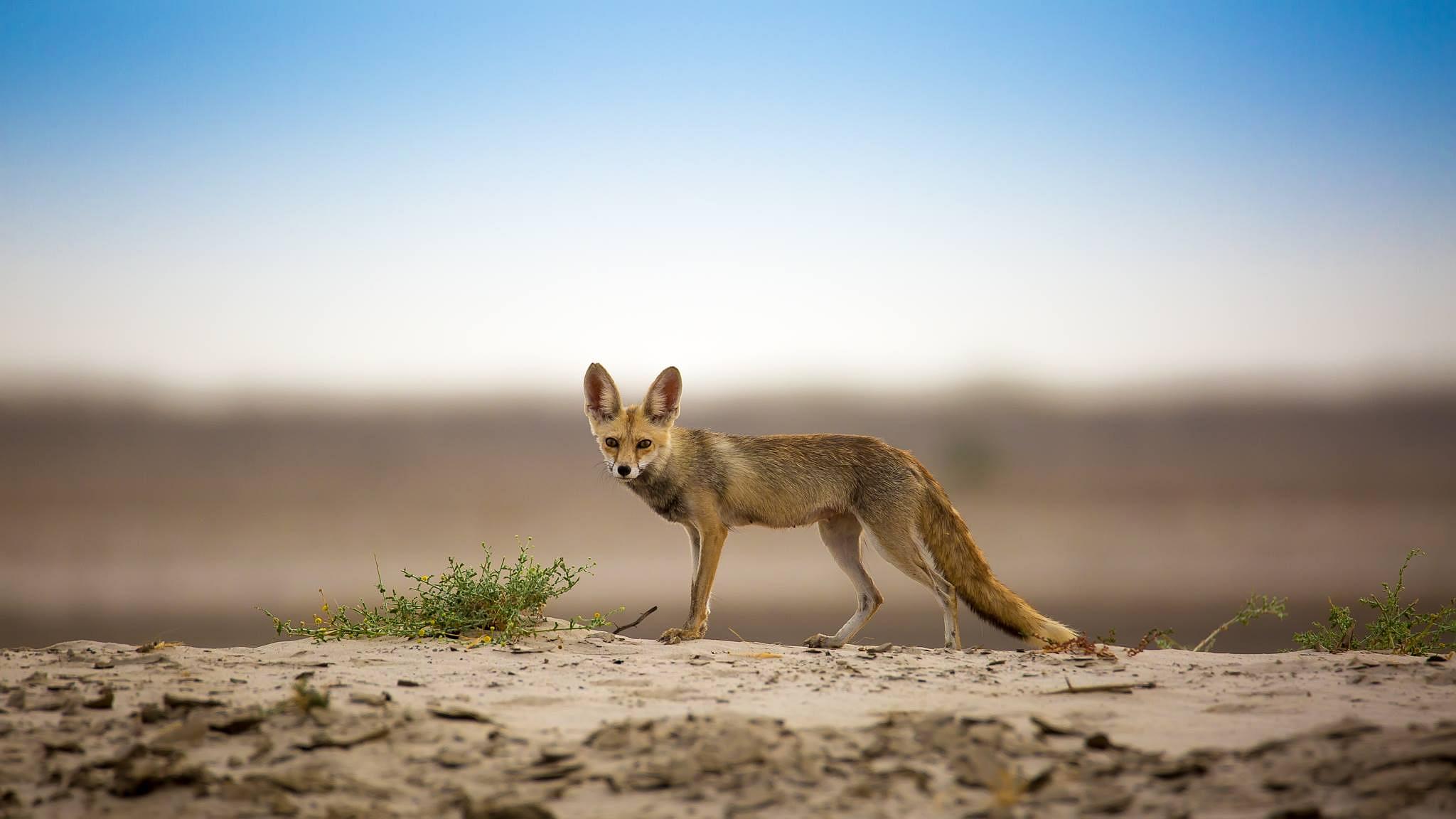
White-Footed Fox
What is the difference between Red Fox and Gray Fox?
Difference between Red Fox and Gray Fox are as follows:
| Type | Red Fox | Gray Fox |
|---|---|---|
| Size | Larger,weighs between 6.5-24 pounds | Smaller,weigh 7-14 pounds on average |
| Ability | Cannot climb trees | Fully rotating ankles and partly retractable claws Can climb trees |
| Appearance |
|
|
| Hunting |
|
|
| Lifespan | Upto 5 years | Upto 6 years |
Behavior and Appearance of Red Fox
[Click Here for Previous Year Questions]
The red fox is primarily nocturnal, however it occasionally goes outside during the day. In contrast to other animals, the red fox has excellent low-frequency hearing. It regularly excavates in the snow or mud to capture prey because it can hear small creatures burrowing beneath the surface.
Like a cat, the fox hunts its prey. It approaches its victim as closely as it can before pouncing and chasing it.
The fox rarely makes use of a den, with the exception of breeding females. It would occasionally sleep outside while encircling its bushy tail over its nose to keep warm.
Also Check:
| Concepts Related to This Unit | ||
|---|---|---|
| Genus | Reproduction | Extinction |
| Taxonomic Groupings | The Living World | Cellular Organization |
| Biodiversity Hotspot | Biodiversity | Five Kingdom Classification |
Things to Remember
- The scientific name of the Red Fox is Vulpes vulpes.
- Biology defines the class of Red Fox as Class Mammalia in taxonomy.
- Red foxes have the characteristics consisting of Long snouts and red fur on the face, back, sides,and tail.
- Red foxes are omnivores who eat both plants and animals.
- Gray foxes have Fully rotating ankles and partly retractable claws which helps the to climb trees.
Previous Year Questions
- Consider the following questions….
- The commercial bath sponges belong to the….
- Earthworms have no skeleton but during burrowing….
- Urinary bladder is absent in all birds except….(UPSEE 2018)
- Which one pair set exhibit….
- Ambulacral system is mainly used for….
- Adult animal in this phylum….(KCET)
- The kind of epithelium found in….(KCET)
- Which one occurs in….(NEET 1991)
- An insect regarded as greatest mechanical….(NEET 1991)
- Metamorphosis of insects is(NEET 1991)
- Classification of porifera is regarded as….(NEET 1991)
- Which one of the following is oviparous….(NEET 2015)
- Which one of the following statements about….(NEET 1998)
Sample Questions
Ques. What is the scientific name for a Red Fox? (1 mark)
Ans. The scientific name of Red Fox is Vulpes vulpes.
Ques. What is genus and class of Red fox? (1 mark)
Ans. The genus is Vulpes and class is Mammalia.
Ques.What is the scientific name of Gray fox? (1 mark)
Ans. The scientific name of Red Fox is Urocyon cinereoargenteus.
Ques.Is fox a good pet? (2 marks)
Ans. The truth is that they don't make good pets, and keeping one is against the law in several places. Foxes are considered to be wild animals because they are not domesticated. Foxes don't adapt well to living indoors, unlike other species like dogs and cats that have been bred to get along with people.
Ques.Do foxes bark? (2 marks)
Ans. Foxes also frequently bark, which is typically employed as a different kind of contact call to get the attention of allies. The bark is comparable to a dog's, except it's a little higher pitched and occasionally strident.
Ques.Why do foxes howl at the moon? (2 marks)
Ans. When the moon is out, they wail. Because the moon is at its brightest during those hours and hunting is at its greatest. However, since howling is how they communicate, they are howling to other wolves.
Ques.Are red foxes there in India? (2 marks)
Ans. Except for Antarctica, every continent hosts the red fox. It can be found in India in the semi-arid states of Rajasthan and Gujarat as well as throughout the Himalayan mountain range. The desert fox and the Himalayan fox are the two subspecies of red fox found in India.
Ques. What is the scientific name of Indian fox? (1 mark)
Ans. An Indian fox is called Vulpes Bengalensis
Ques.What are Baby foxes called ? (1 mark)
Ans. Baby foxes are called Kits.
Also check:



Comments