



Content Curator
Tiger (Panthera Tigris) belongs to the Felidae family and the Mammalia class. It is the largest living cat species and a member of the genus Panthera. The most recognisable feature of the tiger is its dark vertical stripes on orange fur with a white underside. Tigers are animals that live in both warm and cold areas of Asia. They are carnivores that hunt for their prey at night. These big cats are solitary and have their own territory, and are one of the world’s apex predators.
| Table of Content |
Key Takeaways: Tiger, Taxonomy, Zoology, Bengal Tiger, South China Tiger, Apex Predators, Endangered Species
Taxonomy of Tiger
[Click Here for Sample Questions]
There are various types of Tigers and they have different characteristics.Therefore, the scientific names of the Tigers vary from one type to the other. Before understanding their scientific names, let’s have a look at their basic taxonomy-
| Common Name | Tiger |
| Class | Mammalia |
| Kingdom | Animalia |
| Family | Felidae |
| Order | Carnivora |
| Phylum | Chordata |
| Genus | Panthera |
| Species | Panthera Tigris |
Read More: Classification of Animal Kingdom
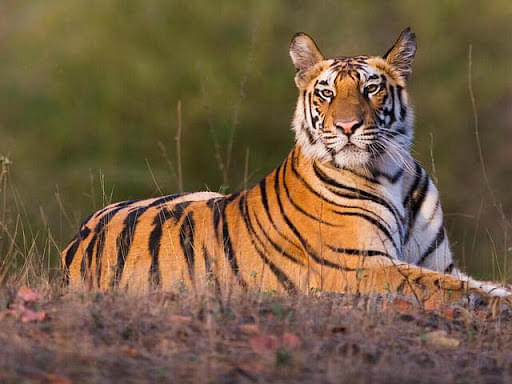
Tiger (Panthera Tigris)
Characteristics of Tiger
[Click Here for Previous year's Questions]
Here are the basic characteristics of a Tiger-
- A tiger has a heavy coat of reddish-orange hair featuring a pattern of black stripes.
- Each has its own pattern of stripes like the human’s fingerprints.
- It has a long tail as well as sharp teeth and claws.
- Its body measures from 5 to 10.5 feet long and it can weigh from 240 to 675 pounds, depending on the subspecies. As an example, a 6-foot tiger is equal in length to a full-size bed.
- Tiger’s striped tail measures about 3 feet long.
- It uses its tail to maintain balance when making quick turns as it runs after prey.
- It uses its 4-inch claws to grab onto prey.
- In addition, its paws allow it to walk quietly while stalking its next meal.
- Also, they have webbed feet making them excellent swimmers if they have to cross a river, stream or other body of water in search of prey.
- These big cats try to stay out of sight of humans and other animals but can be aggressive if their territory is invaded.
Also Check:
Habitat of Tiger
[Click Here for Sample Questions]
- Tigers are animals that live in South and Southeast Asia as well as the eastern part of Russia and China.
- Some live in temperate climates while others live in tropical environments.
- Siberian tigers live in cold climates where it snows.
- Their heavy fur coat and an extra layer of fur on their paws protect them from the cold temperatures.
- Also, they have an extra layer of fur around their neck that’s sometimes called a scarf. This insulates them from the cold even more.
- Tigers live in different habitats including swamps, grasslands, deciduous and mangrove forests.
- The type of habitat each of the subspecies lives in depends on its species.
- Malayan tigers live in tropical broadleaf forests while Indo-Chinese tigers live in hilly, mountainous areas.
- Bengal tigers live in rainforests while the Sumatran tigers live in lowland forests and around swamps.
- Tigers sometimes migrate short distances in order to find a larger supply of prey.
- Also, they may migrate to an area with less snow and warmer temperatures in the cold weather months.
Facts about Tiger
[Click Here for Previous year's Questions]
- Tigers are good swimmers and love the water.
- They are hunted for their skin, fur, and other body parts.
- They mark their territory with urine to keep other tigers out.
- Their teeth measure about 4 inches long.
- This creature’s long tail helps it to keep its balance.
- The tiger is the national animal of India, Bangladesh, Malaysia, and South Korea.
- Tigers also have a prominent white spot on the back of their ears, surrounded by black. These spots are thought to play an important role in communication between individuals.
Subspecies of Tiger
[Click Here for Sample Questions]
There are eight recognized subspecies of tiger, five of which exist now (Bengal, Amur, Indo-Chinese, Sumatran and South China tigers). These subspecies are distinguished by their geographic distribution and physical characteristics such as size, hair length and/ or thickness and striping.
When considering the eight subspecies, the Siberian tiger is the largest of the group. It grows to about 10.5 feet long. It’s also the heaviest, weighing in at 660 pounds. The Sumatran tiger is known as the smallest classification of the species weighing around 260 pounds and growing to be about 8 feet long.
The Bengal Tiger (Panthera tigris tigris)
- It has reddish-orange colored fur with dark brown-black vertical stripes.
- Bengal tigers may weigh up to 220 kg (480 lbs.) and are about 2.9 m (9.5 ft) in length.
- They inhabit the Indian subcontinent, India, Nepal, Bangladesh and Burma.
- This is the subspecies found at Busch Gardens Tampa Bay.
The Amur Tiger (Panthera tigris altaica)
- It is the largest living cat species, weighing up to 300 kg. (660 lbs.) and is about 3.3 m. (10.9 ft) in length.
- Historically they were called Siberian tigers but have since been renamed because they are currently found near the Amur River region of Russia, China and North Korea, not Siberia.
- Amur tigers have lighter and fewer stripes than other tiger subspecies.
- They have long and thick hair to help them stay warm in their cold climate.
The Indo-Chinese Tiger (Panthera tigris corbetti)
- It is one of the smallest tiger subspecies, weighing up to 182 kg (400 lbs.) and is about 2.8 m (9ft) in length.
- They have a large range encompassing continental southeast Asia region (southern China, Laos, Vietnam, Cambodia, Malaysia, Thailand and eastern Burma).
The South China tiger (Panthera tigris amoyensis)
- They are native to South Central China.
- They may weigh up to 150 kg (330 lbs.) and are about 2.5 m (8 ft) in length.
- South China tigers are the most critically endangered of all tiger subspecies with a population estimate between 30 to 80 individuals.
The Sumatran Tiger (Panthera tigris sumatrae)
- It is the smallest living tiger subspecies, weighing up to 120 kg (265 lbs.) and is about 2.4 m (8 ft) in length.
- They are found in Sumatra, part of Indonesia.
- The Sumatran tiger's fur is darker in coloration than other tiger species with a deep orange to reddish coat and black stripes.
The Javan Tiger (Panthera tigris sondaica)
- It was exclusively found in Java Indonesia and went extinct in the early 1980's.
- They had thin black stripes that were usually double-looped.
- The Javan and Bali tigers were very similar in their small size weighing only 90 to 90 kg (200 to 220 lbs.)
The Caspian Tiger (Panthera tigris virgata)
- It was native from Turkey through central and west Asia and went extinct around the 1950's.
- They had a distinctive style for hunting in that they stalked migrating prey over long distances rather than holding territories like other tiger subspecies.
The Balinese Tiger (Panthera tigris balica)
- It was exclusively found in Bali in Indonesia and went extinct in the early 1930's.
- The Javan and Bali tigers were very similar in their small size weighing only 90 to 90 kg (200 to 220 lbs.).
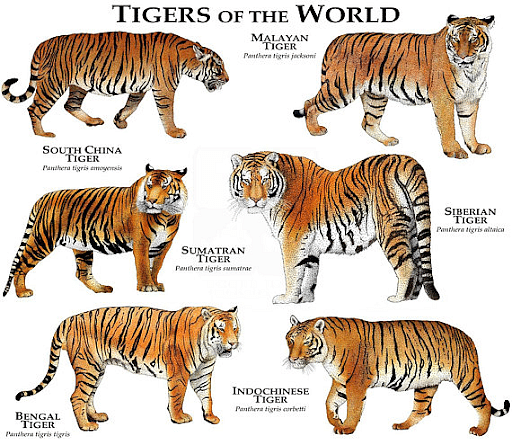
Species of Tiger
Predators and Threats to Tiger
[Click Here for Previous year's Questions]
- Humans are predators of tigers.
- Elephants and bears can also pose a threat to them.
- Hyenas, crocodiles, and snakes are just a few of the predators of cubs.
- Habitat loss through deforestation is a threat.
- The number of tigers around the world is currently dwindling due to loss of habitat, poaching and black market trade.
- They are hunted for their skin, fur, teeth, and other body parts.
- Many tigers are captured and sold to individuals as exotic animals which is illegal. These creatures do not receive proper care when sold as exotic pets.
- In many cases, they are starved by their owners and not given the proper medical care, shelter or exercise.
- Tigers are also kept as exotic pets and have been known to attack and injure or kill the people who purchased them.
The conservation status of the tiger is endangered with a decreasing population. Fortunately, they are now protected by the Convention of International Trade in Endangered Species of Wild Fauna and Flora (CITES). The International Union for Conservation of Nature (IUCN) estimates that there are between 3,062 and 3,948 tigers remaining in the wild (2015).
Also Check:
Things To Remember
- The scientific name of the tiger is Panthera tigris.
- They belong to the Felidae family and the Mammalia class.
- A tiger has a heavy coat of reddish-orange hair featuring a pattern of black stripes.
- The Bali, Javan and Caspian tigers are now extinct. This is due to poaching activity as well as loss of habitat.
- Tigers are animals that live in South and Southeast Asia as well as the eastern part of Russia and China.
- Some live in temperate climates while others live in tropical environments.
- Siberian tigers live in cold climates where it snows.
Important PYQs Related to This Topic
- Tetradynamous conditions occur in (NEET 2001)
- The correct sequence of taxonomic hierarchy is (KCET 2018)
- Read the statements given below and identify the incorrect statement (KCET 2012)
- Reason of diversity in living beings is (NEET 2001)
- Which of the following pairs of specific names belongs to the same common genus?
- Moss peristome takes part in (NEET 1990)
- In which of the following animals post anal tail is found? (NEET 2001)
- In Hydra, waste material of food digestion and nitrogenous waste material are removed respectively from (NEET 2001)
- Engler and Prantl published a phylogenetic system in the monograph (KEAM)
- In the classification of plants, the term cladistics refers to the (KEAM)
- The heterosporous pteridophyte belonging to the class lycopsida is (KEAM)
- A well developed archegonium with neck consisting of 4-6 rows and neck canal cells, characterises (NEET 1995)
- The antherozoids of Funaria are (NEET 1999)
- Select the correct statement (NEET 2016)
- Which one among the following groups of plants is placed in the beginning of Engler and Prantl's system of classification? (COMEDK UGET 2011)
- In Pinus; the pollen grain has 6 chromosomes then in its endosperm will have (NEET 1992)
- Dichotomous branching is found in (NEET 1999)
- Scyphozoan medusae are commonly known as (COMEDK UGET 2010)
- External fertilization occurs in majority of (DUET 2009)
- Karyotaxonomy is the modern branch of classification which is bassed on (MU OET 2013)
Sample Questions
Ques - Are tigers omnivores, herbivores, or carnivores? (2 Marks)
Ans - Tigers are carnivores eating deer, antelope, and boars as well as monkeys, snakes, and sloth bears.
Ques - How long do tigers live? (2 Marks)
Ans - The lifespan of a tiger is 10 to 15 years. But they can live to be 20 years old or more in captivity.
Ques - Where do white tigers live? (2 Marks)
Ans - Bengal and Siberian tigers with a recessive gene have white fur instead of the familiar reddish-orange coat with black stripes. Bengal tigers live in India in grasslands and tropical rainforests. Siberian tigers live in the forests of Russia. These forests provide them with shelter from the elements and keep them hidden.
Ques - What Kingdom do Tigers belong to? (1 Mark)
Ans - Tigers belong to the Kingdom Animalia.
Ques - What is the scientific name for the Tiger? (1 Mark)
Ans - The scientific name for the Tiger is Panthera Tigris.
Ques - What phylum to Tigers belong to? (1 Mark)
Ans - Tigers belong to the phylum Chordata.
Ques - Who has bigger claws between an eagle and a tiger? (2 Marks)
Ans - Harpy eagles have claws as long as 5 inches, which are bigger than a typical tiger’s claws which grow up to 4 inches in length.
Ques - What family do Tigers belong to? (1 Mark)
Ans - Tigers belong to the family Felidae.
Also Check:



Comments