



Education Journalist | Study Abroad Lead
Secondary growth of plants refers to growth of lateral meristem tissues. It means that an increase in stem thickness takes place due to lateral meristem activity.
- Two types of lateral tissues are involved in the secondary growth of plants, namely, vascular cambium and cork cambium.
- When secondary growth occurs, these two tissues produce secondary phloem and secondary xylem.
- As a result, the root and shoot thickens.
| Table of Content |
Keyterms: Plants, Tissue, Meristem tissues, Phloem, Xylem, Vascular cambium, Cork cambium, Root
Primary Vs. Secondary Growth in Plants
[Click Here for Sample Questions]
When length of the root and shoot increases by cell division in shoot apical meristem, it is termed as the primary growth of plants. On the other hand, increase in thickness of roots and shoots due to activity of lateral meristem is called secondary growth of plants.
- Primary growth occurs in apical meristem.
- It is found at the tips of shoots and roots.
- Secondary growth occurs at lateral meristem that involves vascular and cork cambium.
Pictorial representation of primary and secondary growth in plants is given below.

Primary growth in plant, due to growing apical meristem.
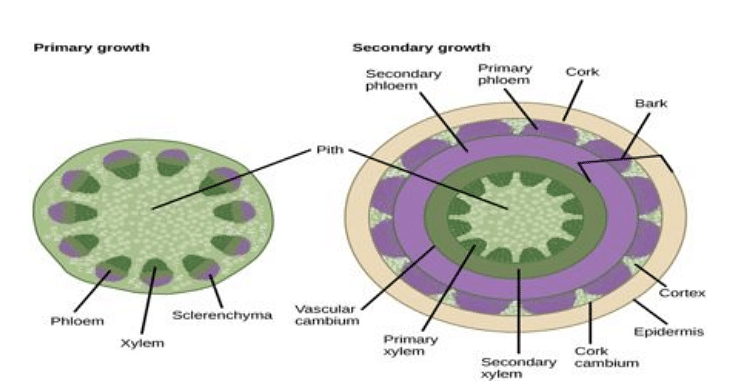
Secondary growth in plant, development of secondary cambium, xylem, and phloem
Also Read:
Secondary Growth in Vascular Cambium
[Click Here for Sample Questions]
Vascular cambium is a lateral meristem which is responsible for thickness of the root. In the initial growth phase, a layer of meristematic tissues are situated between the vascular tissues- primary xylem and primary phloem. This layer grows as patches and upon maturity, the patch separates the vascular tissues. This tissue is called secondary cambium. An active cambial ring initiates the differentiation of new cells. The newly grown cells in the center region form the xylem while the cells in the periphery develop into phloem.
Secondary Growth in Cork Cambium
[Click Here for Sample Questions]
Cork cambium is the outermost lateral meristem in woody plants. It is also termed as phellogen. The cambial ring activity leads to crushing the outer layers such as cortex cells and epidermal cells. At this time, cork cambium develops as a new protective layer and starts to differentiate cells that form outer cork (phellem and inner secondary cortex (phelloderm). Phellogen, phellem and phelloderm together, makes up the periderm. The secondary phloem and periderm collectively called the bark of trees.
Things to remember
- The secondary growth in plants is due to lateral meristematic activity.
- During secondary growth, roots and shoots get thick.
- Secondary xylem and phloem are developed during the secondary growth phase.
- Two tissues are involved in this phase i.e. vascular cambium and cork cambium.
- The xylem is developed by vascular cambium and the phloem is formed during the growth of cork cambium.
- Increase in the length of root and shoot is called primary growth while increase in thickness is due to the secondary growth.
Also Read:
Sample Questions
Ques. Differentiate primary and secondary growth in plants. (2 marks)
Ans. Primary growth of the plant involves apical meristem growth which means increase in the length of shoot. Whereas secondary growth of plants is due to lateral meristematic activity which involves two tissues i.e. vascular cambium and cork cambium. The secondary growth of the plant results in thickness of the root and shoot.
Ques. How secondary growth results in increased thickness of root? (2 marks)
Ans. SIn the secondary growth phase, lateral meristem undergoes cell division and differentiation, which develop the vascular cambium and cork cambium. These lateral meristematic tissues are responsible for developing secondary xylem and phloem that ultimately tickens the root, stem and shoot of the plant.
Ques. What is the secondary growth in vascular cambium? (1 mark)
Ans. Vascular cambium is formed due to the secondary growth phase. An active cambial ring of the secondary cambium causes the differentiation of new cells. The newly grown cells in the center region form the xylem while the cells in the periphery develop into phloem.
Ques. How does cork cambium form phloem? (2 marks)
Ans. Cork cambium or phellogen is developes as a new protective layer during the crushing of outer layers cells like cortex and epidermal cells.when cells differentiates, cork cambium forms outer cork (phellem) and inner secondary cortex (phelloderm). Phellogen, phellem and phelloderm altogether, makes up the periderm.
Ques. The length of the tip is increasing. What kind of plant growth is this? (1 mark)
(a) Primary
(b) Secondary
(c) Tertiary
(d) Quaternary
Ans. a. Primary
Explanation: When length of root and shoot is increasing it is due to primary growth of apical meristem and it is located at the tip of shoot. Therefore, the correct answer is option a.
Ques. Write a note on how periderm is developed during the secondary growth phase. (2 marks)
Ans. Periderm is developed during the secondary growth phase, in the growth of cork cambium. When cork cambium develops as a new protective layer, it starts to differentiate cells that develop outer cork named as phellem and inner secondary cortex which is named as phelloderm. Phellogen, phellem and phelloderm together develop the periderm.
Ques. What among the following is called the bark of a tree? (1 mark)
(a) Mesoderm
(b) Periderm
(c) Xylem, phloem, periderm
(d) secondary phloem and periderm
Ans. d. secondary phloem and periderm
Explanation: Periderm is formed by phellogen, phellem and phelloderm. Xylem is developed by vascular cambium and not related to phloem or periderm development. Mesoderm is the layer of skin. Secondary phloem and periderm are collectively called the bark of a tree. Therefore, d is the correct answer.
Ques. Define the vascular cambium and cork cambium during the secondary growth phase. (3 marks)
Ans. When a plant is in the secondary growth phase, lateral meristematic tissue develops the secondary cambium. The vascular cambium is developed via an active cambial ring and during the cell differentiation process, the newly grown cells in the center region form the xylem while the cells in the periphery develop into phloem.
The cork or phellogen develops a new protective layer when the cortex and epidermal cells are crushed by the activity of the cambial ring. Cork cambium starts to differentiate into phellem and phelloderm. All three tissues-phellogen, phellem and phelloderm make the periderm. Collectively the Periderm and secondary phloem is called the bark of a tree.
For Latest Updates on Upcoming Board Exams, Click Here: https://t.me/class_10_12_board_updates
Check-Out:



Comments