



Education Content Expert
Semantics is a branch of philosophical and scientific study. It refers to the study of the meaning of any word or sentence. Logic and Analytics are the two aspects covered under semantics. The logical aspect of semantics covers the purpose of a word, sentence, or text while the analytical aspect covers the analysis of word, senses, and their significance between them. Semantics focuses on how the same word can signify different meanings in a conversation or hold a different degree of significance for different individuals.
| Table of Content |
Key Terms: Semantics, Linguistics, Logic, Words, Behaviorist Semantics, Ideational Semantics, Referential Semantics
What is Semantics?
[Click Here for Sample Questions]
Semantics is a branch of linguistics that focuses on the meaning of words, phrases, and sentences.
- Semantics was first understood in terms of linguistics in the 19th century.
- Gottlob Frege, a mathematician, and Bertrand Russell, a British philosopher, studied semantics in detail regarding human reasoning.
- They concluded that every word has a different meaning for different people due to its experiential and emotional backgrounds.
- The effect of mathematical logic and thinking changed the focus on Semantics.
- Compositional semantics deals with how smaller components, like words, combine and interact to generate the meaning of bigger expressions, like sentences.
- Lexical semantics studies the nature of the meaning of words, their context, ambiguity, vagueness, entailment, and presuppositions.
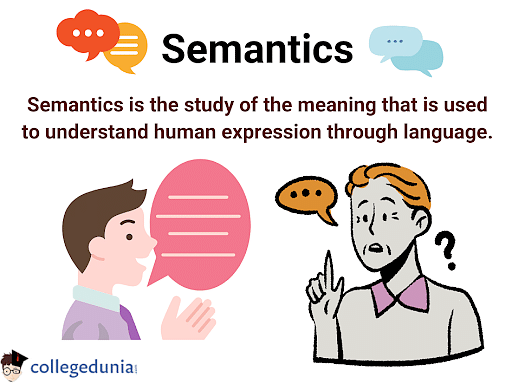
Semantics
Read More:
| Important Biology Articles | ||
|---|---|---|
| Acoustic Neuroma | Allee Effect | Cryptobiosis |
| Photomorphogenesis | Nuclear Winter | Cytopathic Effect |
| Fosters Rule | Migration | Ecosystem Services |
Contemporary Theories of Semantics
[Click Here for Sample Questions]
Semantics has many theories that focus on educational philosophy, behavioral patterns, scientific approaches, and the conceptual role. The subject of semantics has been studied in these fields and philosophies over time.
Behaviorist Semantics
American Psychologist B.F. Skinner (1904–1990) proposed that the correct semantics for a natural language is behavioristic. The meaning of an expression, as uttered on a particular occasion, is either
- The reason for that particular behavior.
- To check the response to that behavior outcome.
- A combination of both of these situations.
The compositionality of the sentence and its words is a limitation of this theory.
Ideational Semantics
According to British empiricist John Locke, words are used to encode and transmit thoughts or ideas.
- For communication to be effective, the listener must appropriately translate the speaker's words into the ideas they refer to.
- However, the limitation of this theory is that the meaning in the speaker’s sense can be studied in a different light than the listener.
- Thus, the generality of the purpose was ignored in this theory of semantics.
- For instance, if a person says that it is a cloudy day, it can hold a different meaning. Maybe the speaker means the sky, while the listener could interpret it as rain.
- Thus, the basic conversion is misunderstood between the speaker and the listener.
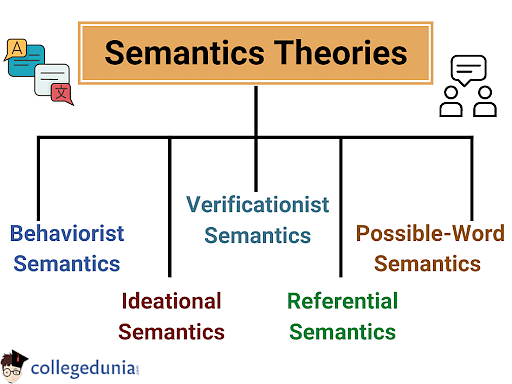
Contemporary Theories of Semantics
Read More: Difference Between Data and Information
Referential Semantics
John Stuart Mill defined referential semantics as overcoming the limitation of a word and its worldly relation.
- According to him, the expression refers to its actual original meaning and nothing else.
- The limitation of this field is that some specific terms are not particular or have two different meanings.
- Thus, proper names are meaningless, and some common nouns do not offer definite descriptions.
Possible-Word Semantics
Possible-word semantics is the complete way a word is or could have been.
- The words are used as a device in logic, philosophy, and linguistics in order to provide a modal logic.
- The meaning of a word is related to what it means in the actual world and what it would mean to different possible worlds.
- The drawback of this study is that it leaves out the meaningful expressions of the words.
Verificationist Semantics
In this study, semantics were studied in a discussion group of Vienna Circle.
- It states that a sentence is based on the experiences on which it can be verified.
- The sentences that cannot be verified are meaningless.
- The basic principle on which this theory works is the links from previous experiences.
Semantic Differential
[Click Here for Sample Questions]
Semantic Differential (SD) is a measurement tool that uses a series of bipolar scales to assess an individual's subjective perception and affective responses to the characteristics of concepts, objects, and events.
- One's thoughts, attitudes, and values toward various ideas, things, and events are evaluated using the SD in a valid and controlled manner.
- Respondents are required to select their position on a series of scales that include polar descriptors (for example, "sweet-bitter", and "fair-unfair").
- SD can be assumed to be more trustworthy, valid, and resilient than other measurement scaling methods like Likert scaling.
Read More:
Things to Remember
- Semantics is the study of the meaning and interpretation of words and sentences.
- The two aspects of semantics are the Logical aspect and the Analytical aspect.
- Logical aspect of semantics focuses on the purpose of a word while the Analytical aspect analyzes the word and its senses.
- Ideational, Behaviourist Referential Semantics, Possible-Word, and Verificationist Semantics are the contemporary theories of semantics.
- Semantic Differential is the rating scale used to understand the attitude toward the object, event, or concept.
Sample Questions
Ques. Define Semantics. (2 Marks)
Ans. The term semantics refers to the interpretation of a word based on its way of thinking. Words can be interpreted differently by different people, leading to various conclusions. For instance, a father would tell his kid to water the plants as part of his regular routine. Now, the son can think that he should water the plants during the day in general, but the father could be asking him to water the plants at that time. The interpretation of the sentence is different for both people, but the meaning was the same.
Ques. What is Semantic Satiation? (1 Mark)
Ans. Semantic Satiation is the phenomenon whereby a word seems to lose its meaning after being repeated numerous times in a short period of time. It is yet unclear why this impact exists.
Ques. What is Semantic Differential? (2 Marks)
Ans. Semantic Differential is a rating scale designed to measure the connotative meaning of objects, events, and concepts. This scale is utilized to understand the attitude towards the object, event, or concept.
Ques. Where did Semantics begin? (3 Marks)
Ans. In the 19th century, linguistics was the first field to study semantics. Nevertheless, it became significantly more significant when British philosopher Bertrand Russell and mathematician Gottlob Frege explored it in-depth with reference to human reasoning. They said that each word had a unique meaning for each individual based on their personal experiences and emotional histories. The impact on mathematical reasoning and logic altered the emphasis on semantics.
Ques. List the various contemporary theories of Semantics. (3 Marks)
Ans. The various contemporary theories of Semantics are
- Ideational Semantics
- Behaviourist Semantics
- Referential Semantics
- Possible-Word Semantics
- Fregean Semantics
- Verificationist Semantics
Ques. What is the difference between Semantics and Pragmatics? (2 Marks)
Ans. Pragmatics refers to the study of the context. It focuses mostly on the analysis of context and how it affects linguistic comprehension. Semantics, in contrast, is the study of the relationship between linguistic concepts and their intended uses.
Ques. What is the difference between Semantics and Semiotics? (3 Marks)
Ans. Semantics and Semiotics are two terms that originated from the same place but have different meanings. Both Semantics and Semiotics observe the pattern of a linguist methodology of communication. Semantics studies the meaning of a word or a sentence and its different implications, however, Semiotics is the study of signs and symbols and their use of interpretation. Secondly, the types of Semantics are conceptual and associative, while Semiotics has five fields namely linguistic, visual, audio, gestural, and spatial. Semiotics is a broader field than Semantics.
Ques. What are the two aspects covered in Semantics? (2 Marks)
Ans. The two aspects of Semantics are
- Logical Aspect: It covers the purpose of a word, sentence, or text.
- Analytical Aspect: It covers the analysis of words, senses, and their significance between them.
Ques. What are the advantages of semantic web technologies for media and publishing? (3 Marks)
Ans. Semantic Web technologies can be used to store, organize, and present content in the following ways:
- The ability of your audience to find, explore, and share your material is improved with semantically enhanced content.
- Simple topic correlation across papers, sites, blog posts, etc. to provide readers with the most pertinent content.
- Supports incorporating content into fresh items to provide customers with more value.
Ques. What distinguishes the semantic web from other technologies? (2 Marks)
Ans. Semantic refers to meaning or comprehension. The main difference between Semantic Web technologies and other data-related technologies (such as relational databases or the World Wide Web itself) is therefore that the Semantic Web is focused on data meaning rather than structure.
Check-Out:



Comments