



Education Journalist | Study Abroad Lead
The spherical capacitor is a type of capacitor consisting of a hollow sphere with a positively charged inner surface and a negatively charged exterior surface. It serves the same work purpose as any other capacitor. Placing two electrical conductors at a distance from each other one capacitor can be formed to store energy.
- A capacitor consists of two conductive metal plates made of aluminum or such materials and those plates are separated by a dielectric material to stop passing the current flow.
- Putting a dielectric in a capacitor makes the positive and negative charges get collected on two different metal plates.
- Capacitor’s ability to store charges is known as capacitance.
- The formula can be described as C = Q / V, where C is the capacitance of the capacitor, Q is the applied charge and V is the potential difference between the two conducting plates.
Read More: Energy Stored in a Capacitor
| Table of Content |
Key Terms: Capacitor, Capacitance, Dielectric material, Charge, Electric field.
What is a Capacitor?
[Click Here for Sample Questions]
The capacitor is a two-dimensional electrical component that stores energy in the form of electrical charge and compared with other similar size charge storage components (such as Batteries), substantially less energy can be stored in a capacitor which works as a very useful element in various electrical circuits.
- A capacitor is an electronic component storing energy in the form of an electric field.
- Capacitor consists of two metal plates and one dielectric material separating them.
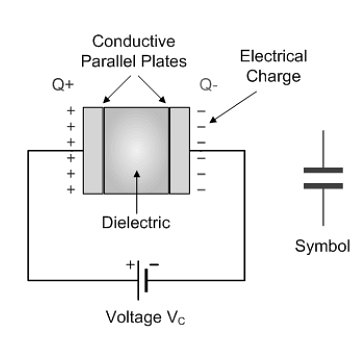
Capacitor
- Putting a dielectric in a capacitor makes the positive and negative charges get collected on two different metal plates and the insulating dielectric material between those plates makes the current stop flowing in the circuit.
- The net charge stored in the capacitor will be the same whether the dielectric is there or not.
- Capacitors can hold a charge at a low voltage.
- The formula of a parallel plate capacitor’s capacitance can be expressed as – C = εA/d, here, C is capacitance, ε is permittivity, A is the area of the parallel plate, and d is the distance between the two capacitor plates.
Read More: Electrostatic Potential and Capacitance
The capacitance of a Capacitor
[Click Here for Sample Questions]
The capacitance of a capacitor describes the capacitor’s ability to store charges. The capacitance of a capacitor is dependent on the dielectric material which is separating the conducting metal plates. The capacitance of a capacitor is expressed as Farad (F).
- When a capacitor is completely charged, a potential difference exists between its plates.
- The larger the area of the plates and/or the smaller the distance between them, the higher the charge that the capacitor can carry and the greater its capacitance.
- Considering Q1 and Q2 are the charges on the conducting plates and the charge applied to the conducting plates influences the electric field between the conducting plates. Then, the potential difference (V) is directly proportional to the electric field.
Q ∝ C
Q = CV
C = Q / V
Here, C is the capacitance of the capacitor, Q is the applied charge and V is the potential difference between the two conducting plates.
Also Read:
Working Principle of a Capacitor
[Click Here for Sample Questions]
To describe the principle of a working capacitor a parallel plate capacitor is considered here.

Working Principle of a Capacitor
- A parallel plate capacitor consists of two parallel plates separated by a small distance and that gap is filled by a dielectric material.
- After connecting a battery across the capacitor, the first plate is connected to the positive end of the battery, and the second plate is connected to the negative end.
- After the emergence of the electric field, The positive plate will gather a positive charge from the battery as time passes, whereas the negative plate will accumulate a negative charge from the battery.
- The positive plate will gather a positive charge from the battery as time passes, whereas the negative plate will accumulate a negative charge from the battery.
- After a specific period, the capacitor stores the maximum amount of charge as determined by its capacitance about this voltage, this period is referred to as the capacitor’s charging time.
- When two endpoints of both plates are linked to a load, a current will flow through the load from the first plate to the second plate until all charges from both plates have dissipated, this period is referred to as discharging time of a capacitor.
Read More: Electrostatic conductor
The formula of Spherical Capacitor
[Click Here for Sample Questions]
Just like normal capacitors consist of two metal conducting plates separated by one dielectric media in between them; spherical capacitors consist of a hollow sphere whose inner surface of radius r is positively charged and the outer surface of radius R is negatively charged. Both surfaces are separated by the distance between their radius.

The formula of Spherical Capacitor
Now, if the potential of the inner and outer surface of the spheres are v1 and v2 respectively.
If the electric field generated by this sphere after applying charge Q will be–
E = Q/4πε0r2 →(1)
From the relation between electric field and potential difference–
E = −dV/dr →(2)
Now, by comparing eq 1 and 2 –
− dV/dr = Q/4πε0r2
⇒ − dV = (Q/4πε0r2) . dr
Now, integrating the above equation –

The difference in potential is described by ΔV = V2 − V1
The capacitance can be described as,
C = Q/ΔV
Now putting ΔV value from equation 3–

Read More: Cylindrical capacitor formula
Things to Remember
- Capacitors are electrical components that store electric charge.
- Capacitor’s ability to store energy is known as capacitance.
- Capacitor consists of two metal plates and one dielectric material separating them.
- Capacitance can be described as C = Q / V, here, C is the capacitance of the capacitor, Q is the applied charge and V is the potential difference between the two conducting plates
- A parallel plate capacitor consists of two parallel plates separated by a dielectric material.
- Spherical capacitors consist of a hollow sphere whose inner surface is positively charged and the outer surface is negatively charged.
Sample Questions
Ques: What are the uses of a capacitor? (2 Marks)
Ans: Capacitors are used to store energy in gadgets. Capacitors are used in signal-processing devices, filters, energy storage systems, engine starters, etc.
Ques: What will be the ratio of the intensities of an electric field, at any two points between the plates of a capacitor? (1 Mark)
Ans: The ratio in such a case will be one; so it’ll be the same at any two points along the plates of a capacitor.
Ques: What are the various factors on which the capacitance of a parallel plate capacitor depends? (2 Marks)
Ans: The three factors on which the capacitance of a parallel plate capacitor depends are– Area of the plates, the Nature of the dielectric medium present in between the plates, and The separation between the 2 plates of the parallel plate capacitor.
Ques: What role does the dielectric play in a capacitor's capacitance? (2 Marks)
Ans: Dielectric decreases the effective potential on plates, increasing capacitance. It enables a capacitor to maintain a bigger potential difference and hence more charge and energy.
Ques: Define the dielectric constant of a medium. What is its unit? (2 Marks)
Ans: Dielectric constant of a media is described as the ratio between the absolute permittivity of a media and free space. K = ε/ε0, here ε is the permittivity of a media and ε0 is the permittivity of free space.
It is a unitless quantity.
Ques: A metal plate is introduced between the plates of a charged parallel plate capacitor. What is its effect on the capacitance of the capacitor? (1 Mark)
Ans: The capacitance of a parallel plate capacitor will become infinite.
Ques: A sphere has a radius of 10 cm. Find the capacitance on it and also find the potential difference required to give it a charge of 10-8 C. (2 Marks)
Ans: C = 4πεo x F
C = 4 × 3.14 × 8.85 × 10−12 × 10 × 10−2
C = 111.156 × 10⁻¹³
C = 1.11 × 10⁻¹¹ F
Now, Q = CV
Therefore V = 10-8 / 1.11 × 10⁻¹¹
So, V = 900.9 V
Ques: In the above problem find how much charge will it take for the capacitor to raise its potential from 0 to 10,000 V. (2 Marks)
Ans: The capacitance of the spherical capacitor is C = 2.593 × 10⁻¹²F.
The charge, Q = CV. where V is the potential difference.
Potential difference V is 1000-0 = 1000V
Therefore, Q = 3.7052 × 10-12 × 1000
Q = 2.593 × 10⁻⁹C
For Latest Updates on Upcoming Board Exams, Click Here: https://t.me/class_10_12_board_updates
Check-Out:



Comments