



Content Curator
The parallel plate capacitor is the simplest form of capacitor that has an arrangement of dielectric (insulating material) and electrodes. A parallel plate capacitor can only store a limited amount of energy before the dielectric breakdown occurs. It can be constructed using two metal or metalized foil plates at a distance parallel to each other, being fixed by the surface area of the conductive plates and the distance of separation between them.
| Table of Contents |
Key Terms: Parallel plate capacitor, parallel plate capacitor formula, electric field, electric current, electrodes, electric charge, dielectric constant, Relative permittivity
What is a Parallel Plate Capacitor?
[Click Here for Sample Questions]
In a Parallel Plate Capacitor the parallel plates that are connected across a battery, are charged and an electric field is established between them.
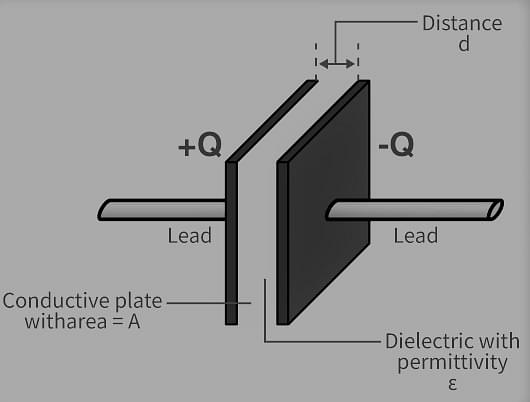
The type of capacitor that has two conducting metal plates known as electrodes and an insulating medium between them called dielectric medium, separating them is known as a parallel plate capacitor.
- The electrodes are arranged parallel and connected to each other through a power supply (battery).
- The conducting plate connected to the positive terminal acquires positive charges whereas the one connected to the negative terminal acquires negative charges.
- The charges are trapped within the plates of the capacitor due to attraction between them.
- The dielectric medium is an insulator like a vacuum, air, glass, paper wool, mica, or electrolytic gel.
- The capacitor is capable of storing finite energy due to the breakdown of the dielectric medium.


The video below explains this:
Capacitance Detailed Video Explanation:
Also Read:
Working Principle of Parallel Plate Capacitor
[Click Here for Previous Year Questions]
The Parallel Plate Capacitor works on the following principle –
- Due to its non-conductive nature, the dielectric does not permit the flow of electric current.
- However, the atoms in the dielectric material get polarized under the influence of electricity from a power source.
- This leads to the formation of negative and positive charges on the plates of the parallel capacitors.
- Due to the accumulation of opposite charges on both plates, a charging current flows through the capacitor till the potential difference between the plates equalizes the source potential.
- The parallel plate capacitors can be considered rechargeable DC battery that stores electrostatic energy in the form of charge.
- If the applied voltage exceeds the threshold limit then there is a short circuit in the capacitors due to dielectric breakdown.
- So, it must be ensured that the working voltage always remains within the threshold voltage.
Parallel Plate Capacitor Formula
[Click Here for Sample Questions]
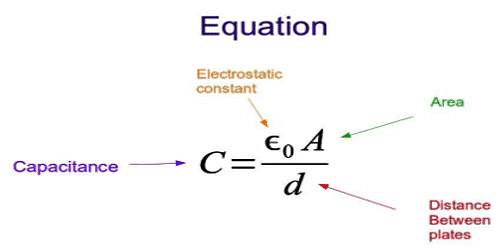
Each capacitor has its capacitance which is the amount of electric charge the capacitor can store. A parallel plate capacitor has two metal plates of area A separated by distance d. So, the parallel plate capacitor is given by –
| C = k∈0 |
Where
- C = capacitance
- K = relative permittivity of the dielectric medium
- ∈0 = 8.854 × 10⁻¹² F/m which is known as permittivity of space
- A = area of metal plates
- d = distance between plates
When there is no dielectric medium present i.e. the gap between the plates is filled with air or vacuum, the value of k = 1, therefore the capacitance of the capacitor is
C = ∈0A/d
Parallel Plate Capacitor Derivation
[Click Here for Previous Year Questions]
We know that both metal plates carry equal and opposite charges, so +Q and –Q can be assigned to both plates. The distance between both the plates can be denoted as ‘d’ and the area of each plate is denoted as ‘A’. The distance separating both the plates is much smaller compared to the area of each plate hence d << A, so d can be ignored and the effect of the plates is considered as infinite plane sheets.
Parallel Plate Capacitor
- The electric field generated by both plates is considered to be the electric field of an infinite plane sheet with uniform surface charge density. The density can be denoted as:
- In the same way, for plate 2 with a total charge is equal to –Q and area A, the surface charge density can be given as,
- The total area around the parallel plate capacitor can be divided into 3 parts with area 1 assigned to the left side of plate 1, area 2 assigned to the area between the 2 plates, and area 3 assigned to the area right side of plate 2.
- Region A: The electric field of plates 1 and 2 are of the same magnitude due to infinite parallel sheets at any given point, but due to opposing forces they cancel out each other. Hence, the electric field can be denoted as:
E =
- Region B: The direction and the magnitude of the electric field in both the metal plates 1 and 2 are the same, hence, the electric field can be denoted as:
E =
- Region C: As in region A, in this region also the direction of the electric field is on the opposite side whereas the magnitude is the same, so both the charges cancel out each other.
E =
- Hence, the electric field flows from the positive plate to the negative and it remains uniform throughout.
- The potential difference of the capacitor can be estimated by multiplying its electric field by the distance separating both plates. It can be denoted as:
- Therefore, the capacitance for the parallel plate capacitor can be denoted as:
Solved ExamplesQues. A parallel plate capacitor kept in the air has an area of 1.00m2 and is separated by a distance of 0.02m. Calculate the capacitance of the parallel plate capacitor. Solution: Given
Therefore, Capacitance (C) = k∈0A/d = 8.854×10−12 × 1/0.02 = 4.427×10⁻¹⁰ F Ques. If the capacitance of a parallel plate capacitor is 25 nF and the distance separating both the plates is 0.04m, then calculate the area of the plate of the parallel plate capacitor. Ans. Given
The formula of capacitance is: C=k∈0A/d So, the area of the plates would be (A)= Cd/k∈0 = 25 x 10−9 x 0.04/1 x 8.854 × 10−12 = 112.94m2 Therefore, the area of the parallel plate capacitor is 112.94 m2. |
Read More:
Things to Remember
- Parallel Plate Capacitors are constructed by an arrangement of electrodes and insulating material or dielectric.
- The parallel plate capacitors can be considered rechargeable DC battery that stores electrostatic energy in the form of charge.
- The capacitance of a parallel plate capacitor, when air/vacuum is filled between the gap of the plate, is given by
C = ∈0A/d
- When the gap between the plates of the capacitor is filled with a dielectric medium having dielectric constant k, then capacitance is given by
C = k∈0A/d
Sample Questions
Ques: An air-filled parallel plate capacitor has to be constructed that can store 12μC of charge when operated at 1200V. What can be the minimum plate area of the capacitor? The dielectric strength of air is 3 x 10⁻⁶ V/m. (2 marks)
Ans: Given,
Q = 12μC
V = 1200V
v/d = 3 x 10⁻⁶ V/m
d = V/(v/d) = 1200/(3 x 10-6 ) = 4 x 3 x 10-4 m
c = Q/v = (12 x 10-6 )/ 1200 = 10-8 f
Therefore, C = ε0 A/ d = 10-8 f
→ A = 10-8 x d/ ε0 = 10-8 x 4 x10-4 / 8.854 x 10-4 = 0.45 m2
Ques: A charge of 1μC is given to one plate of a parallel plate capacitor of capacitance 0. 1μF and a charge of 2μC is given to the other plate. What is the potential difference developed between the plates? (2 marks)
Ans: q1 = 1μC = 1 x 10⁻⁶ C C = 0.1 μF = 1 x 10⁻⁷ F
q2 = 2 μC = 2 x 10⁻⁶ C
Net q = q1 - q2/2 = (1 - 2) x 10-6/ 2 = -0.5 x 10⁻⁶ C
Potential V = q/c = 1 x 10⁻⁷/ -5 x 10-7 = -5 V
Ques: A parallel-plate capacitor has a plate area of 100cm2 and a plate separation of 1.0cm. A glass plate of thickness 6.0mm and an ebonite plate (dielectric constant 4.0) are inserted one over the other to fill the space between the plates of the capacitor. Calculate the new capacitance. (2 marks)
Ans:

Let the capacitances be C1 & C2 net capacitance ‘C’ = C1C2/(C1 + C2)
Now C1 =
C2 =
C = =
= 4.425 × 10⁻¹¹ C = 44.25pc.
Ques: A parallel-plate capacitor possessing a plate area 25cm2 and separation 1.00mm is connected to a battery of 6.0V. Find the charge flown through the battery. How much work has been done by the battery during the process? (2 marks)
Ans:

A = 25cm2 = 2.5 × 10⁻³cm2
d = 1mm = 0.01m
V = 6V Q = ?
C = ε0A/d =
Q = CV =
= 1.32810 × 10⁻¹⁰C
W = Q × V = 1.32810 × 10–10 × 6 = 8 × 10⁻¹⁰J.
Ques: A parallel-plate capacitor with a plate area of 25.0cm2 and a separation of 2.00mm between the plates, is connected to a battery of 12.0V.
(a) What is the charge on the capacitor?
(b) The plate separation is decreased to 100mm. Calculate the extra charge given by the battery to the positive plate. (3 marks)
Ans:

Plate area: A = 25cm2 = 2.5 × 10⁻³m
Separation: d = 2mm = 2 × 10⁻³m
Potential v = 12v
(a) We know that, C = ε0A/d = (8.85 x 10-12 x 2.5 x 10-3)/(2 x 10-3) = 11.06 x 10⁻¹²F
C = q/v => 11.06 x 10-12 = q/12
=> q1 = 1.32 x 10⁻¹⁰c
(b) Then d = decreased to 1mm
Therefore, d= 1mm = 1 x 10⁻³m
C = ε0A/d = q/v = (8.85 x 10-12 x 2.5 x 10-3)/(1 x 10-3) = 2/12
= q2 = 8.85 x 2.5 x 12 x 10-12 = 2.65 x 10⁻¹⁰ C
∴ The extra charge given to plate = (2.65 – 1.32) × 10-10 = 1.33 × 10⁻¹⁰C.
Ques: A parallel-plate capacitor of the capacitance 5μF is attached to a battery of emf 6V. The separation between the plates is 2mm.
(a) What is the charge on the positive plate?
(b) Find the electric field between the plates.
(c) A dielectric slab of thickness 1mm and dielectric constant 5 is inserted into the gap in order to occupy the lower half of it. Find the capacitance of the new combination.
(d) Find the amount of charge that has flown through the battery after the slab is inserted. (5 marks)
Ans: Given:
C = 5μf
V = 6V
d = 2mm = 2 × 10⁻³m.
(a) the charge on the positive plate q = CV = 5μf × 6 V = 30μc
(b) E =V/d = 6V/ 2 x 10⁻³ m = 3 x 10³ V/M
(c) d = 2 x 10⁻³m
t = 1 x 10⁻³ m
k = 5, or C = ε0A/d = 5 x 10⁻⁶
When the dielectric is placed on it, then:
C1 = =
= C1 = = x 10-5 = 0.00000833 = 8.33 μf
(d) C = 5 x 10⁻⁶ f
V = 6V
Therefore, Q = CV = 3 x 10⁻⁵ f = 30 μf
C’ = 8.3 x 10⁻⁶ f
V = 6V
Therefore, Q’=C’V = 8.3 x 10-6 x 6
Therefore, charge flown = Q’-Q = 20μf
Ques: A parallel-plate capacitor is placed in a glass vessel that is connected to a battery, as shown in the figure given below. Switch A is closed. The e.m.f. of the battery is 12V, the area of the capacitor plates is 100 cm2, and the distance between plates is 1 mm. What is the charge on the plates of the capacitor in the following cases:

(a) Switch A is opened and at the same time, the vessel is filled to the top with transformer oil whose dielectric constant is 2.2,
(b) The vessel is primarily filled with the oil and then switch A is opened. Show in each case how the electric field intensity changes in the capacitor when the oil is poured in. (5 marks)
Ans: Q1 = Sξ/4Πd = 3.2 e.s.u.;
Q2 = Sξ/4Πd = 3.2 e.s.u.
Explanation: In the first case, the charge on the plates stays unchanged when the oil is poured into the vessel and the capacitance of the capacitor increases to e times its previous value. Due to this, the difference in potential between the plates and the field intensity in the capacitor drops to 1/ε times its initial value.
In the second case, the charge on the plates increases to ε times its initial value when the oil is poured in, owing to the increase in capacitance. However, the difference in potential and the field intensity remain unchanged.
For Latest Updates on Upcoming Board Exams, Click Here: https://t.me/class_10_12_board_updates
Also Read:



Comments