



Content Curator
A capacitor is an electronic component storing electrostatic energy in an electric field. The capacitor stores energy in the form of an electrical charge and produces a potential difference across its plates, like a small rechargeable battery. Capacitance is the ability of a capacitor to store energy in the form of an electric charge. Therefore, capacitance is the storing ability of a capacitor that is measured in farads.
The capacitor formula is given as
C = εA/d
In this equation,
- C is capacitance;
- ε is the permittivity of the medium, (how well the dielectric material stores the electric field);
- A is the area of the parallel plate, and
- d is the distance between the two capacitor plates
Key Terms: Dielectric, Electrical Device, Capacitor, Capacitance, Electric charge, Farads, Voltage, Current
What is a Capacitor?
[Click Here for Sample Questions]
A capacitor is a two-terminal electrical device that stores energy in the form of an electric charge.
- A capacitor is made up of 2 electrical conductors separated by distance.
- Capacitors are also called electric condensers.
- The space between these conductors might also be filled with a vacuum or an insulating material that is called a dielectric.
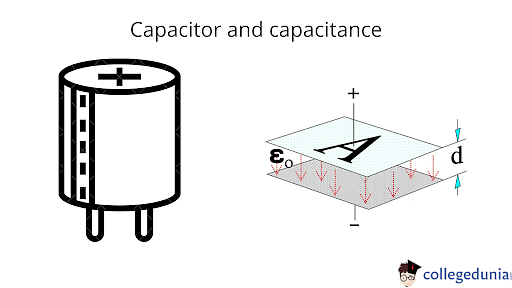
Capacitor and capacitance
Capacitors are able to store energy by holding pairs of opposite charges apart. The simplest design of a capacitor is a parallel plate capacitor that has two metal plates and a gap between them.
- When used in a direct current circuit, a capacitor charges to the supply voltage.
- However, it blocks the flow of current as the dielectric of a capacitor is basically an insulator as it is non-conductive.
- However, when connected to an alternating current circuit, the flow of current appears to pass straight through the capacitor with little to no resistance.
The video below explains this:
Capacitance Detailed Video Explanation:
Read More:
How Does a Capacitor Work?
[Click Here for Previous Year's Questions]
Let us take a parallel plate capacitor that consists of 2 parallel plates that are separated from each other by a dielectric.
- When a DC voltage source is connected across a capacitor, plate 1 is connected to the positive end and plate 2 to the negative end.
- When the potential of the battery is applied across the capacitor, the first plate becomes positive.
- The current tries to flow through the capacitor at the steady-state condition from the positive to its negative plate.
- However, the current is unable to flow as a result of the separation by an insulating material.

Parallel plate capacitor
- When an electric field is applied across the capacitor, the positive plate accumulated positive charge and the negative plate accumulates negative charges from the battery.
- After a point, the capacitor has the maximum amount of charge according to its capacitance with respect to this voltage. The time span is known as the charging time of the capacitor.
- When the battery is removed, the two plates have a negative and positive charge for a certain time.

Parallel plate capacitor
If the plates are connected to a load, current flows from Plate I to Plate II to load until all charges are dissipated from both plates. This time span is called the discharging time of the capacitor.

Capacitor
Capacitance
[Click Here for Sample Questions]
The ability of a capacitor to store electric charges is called its capacitance. In other words, capacitance can be understood as the storing ability of a capacitor. Capacitance is measured in farads.
Capacitance Formula
When a capacitor is charged by connecting two uncharged conductors to the terminals of a battery, the two conductors carry charges of equal magnitudes but of opposite signs. More the charge on a capacitor higher is the potential of the conductor i.e.
Q ∝ C
⇒ Q = CV
Where the constant of proportionality C is the capacitance of the capacitor, given by
C = \(\frac{Q}{V}\)
Capacitance is therefore the ratio of the electric charge change in a system to the corresponding change in its electric potential.
Capacitance depends on the shape and size of the capacitor. It also depends on the insulator between the conducting plates.
Factors Affecting Capacitance
[Click Here for Sample Questions]
Capacitance mainly depends on the space between the plates, their area, and the dielectric -
- Dielectric: The greater the permittivity of the dielectric will be, the greater the capacitance. In a similar way, the lesser the dielectric permittivity, the lesser the capacitance. Materials with greater permittivity allow more field flux, therefore greater charge is collected in the capacitor.
- Spacing between the plate: Capacitance is inversely proportional to the distance between the plates of the capacitor. Mathematically it is denoted as:
C ∝ \(\frac{1}{d}\)
- Area of the Plates: The capacitance is directly proportional to the area of the plates. The larger the plate area, the more the value of capacitance. Mathematically it is represented as -
C ∝ A
Read More:
Energy Stored in a Capacitor
[Click Here for Previous Year's Questions]
Once the opposite charges are placed on either side of a parallel-plate capacitor, the charges can be used to do some work as they are allowed to move towards each other through a circuit. The total energy extracted from a fully charged capacitor is given by the equation:
U = 1/2 CV2
Using Q = CV, we can also write energy stored in a capacitor as
U = 1/2 Q2/C = 1/2 QV
Capacitors work like rechargeable batteries. The main difference between a battery and a capacitor is in the way they store energy.
- Capacitors store energy based on their physical design allowing them to hold positive and negative charges apart.
- Batteries, on the other hand, store energy through chemical reactions.
Standard Units of Capacitance
[Click Here for Sample Questions]
The unit of capacitance is Farad. However, Farad is a large unit so capacitance is usually measured in its sub-units such as microfarads (µF) or pico-farads (pF).
The common units of capacitance used for its measurement are -
- 1 mF (millifarad) = 10−3 F
- 1 μF (microfarad) =10−6 F
- 1 nF (nanofarad) = 10−9 F
-
1 pF (picofarad) = 10−12 F
Capacitance of a Parallel Plate Capacitor
[Click Here for Previous Year's Questions]
The parallel plate capacitor has two identical conducting plates with surface area A separated by a distance d. When V voltage is applied to these plates, Q charge is stored.

Parallel plate capacitor
The force between these charges increases with the values of the charge and decreases with the distance between them. The bigger the area of the plates, the more charge they are able to store. Therefore, for a greater value of A, C is also greater. In a similar way, the closer the plates are, the greater the attraction of opposite charges on them. Therefore Capacitance is greater for a smaller d.
The charge density on the plates is given by the formula -
σ = Q/A
When d is small, the electric field between the plates is uniform and its magnitude is calculated by:
E = σ/ ∈0
As the electric field is uniform, the potential difference between the plates is calculated by
V = Ed = σd/∈0 = Qd/A∈0
Substituting this value in the capacitance formula, we get
C = Q/V
C = (Qd/A∈0 )/Q
The capacitance of a parallel plate capacitor when no dielectric medium is inserted between the plates, is given by
C = ∈0 A/d
When a dielectric medium of dielectric constant k is inserted between the plates of the capacitor, then the capacitance is given by
C = k∈0 A/d
Read More:
Capacitance of a Spherical Capacitor
Spherical capacitors have two concentric conducting spherical shells with radii R1 and R2. The shells have equal and opposite charges +Q and –Q respectively. The electric field between the shells is directed radially outward.
Through Gauss law over a spherical Gaussian surface with r as radius, the magnitude of the field can be deduced
The enclosed charge is +Q, therefore
\(\oint\)S \(\overrightarrow{E}\). \(\hat{n}\)dA = E(4πr2) = \(\frac{Q}{\in _0}\)
The electric field between the conductor is\(\overrightarrow{E}\) = \(\frac{1}{4 \pi \in_0} \frac{Q}{r^2} \hat{r}\)
If we integrate E along the radial path between the shells, we getThe potential difference between two conductors is given by the formula
VB – VA = – \(\int_A^B \overrightarrow{E} \overrightarrow{dL} \)
The potential difference between the plates isV = – (V2 – V1) = V1 – V2
On substituting the value of V in the formula of capacitance formula, we getC = \(\frac{Q}{V}\) = 4π∈0 \(\frac{R_1R_2}{R_2 - R_1}\)
The capacitance of a spherical capacitor is, therefore,C= 4π∈0 \(\frac{R_1R_2}{R_2 - R_1}\)
Properties of Capacitors
[Click Here for Sample Questions]
The properties of capacitors can differ from one another. Some of the characteristics of capacitors are:
Capacitance (C)
Capacitance is an important characteristic of a capacitor that is measured in pico-Farads (pF), micro-Farads (µF), and nano-Farads (nF). This value is printed on the body of the capacitor in the form of a text or number.
Working Voltage
Working Voltage is the total amount of direct current (DC) or alternating current (AC) that is applied to a capacitor without any failure in the lifetime of the capacitor.
Tolerance
The tolerance rating of a capacitor varies from plus to minus values.
Leakage Current
The small DC current flow in the Nano-Amps (nA) region is known as the leakage current of a capacitor. Leakage current is formed due to the electrons physically making their way through the dielectric medium.
What are the Applications of Capacitors?
[Click Here for Previous Year's Questions]
The capacitors are mainly used to store electrical energy. Individual capacitors are not able to hold a great deal of energy, so they only provide enough power for electronic devices to use when additional power is needed or during temporary power outages. There are various applications of capacitors as energy sources such as -
- Audio equipment
- Camera Flashes
- Power supplies
- Magnetic coils
- Lasers
The capacitors with high capacitances up to 2 kF that is able to store large amounts of energy are known as supercapacitors.
Capacitors for Power Conditioning
An important application of capacitors is the conditioning of power supplies. Capacitors, when charged, allow only alternating current signals to pass through them while blocking the DC or direct current signals.
This characteristic of a capacitor is mainly used in separating electrical circuits in order to reduce noise to improve the overall efficiency.
Capacitors as Sensors
Capacitors are used as sensors to measure humidity, fuel levels, mechanical strain, etc. The distance between the plates of a capacitor is used in sensing to detect mechanical changes such as pressure and acceleration. While the material between the capacitor plates is used to sense air humidity.
Capacitors for Signal Processing
Capacitors are used in the field of information technology. They are used by DRAM (Dynamic Random Access Memory) devices in order to represent binary information in the form of bits. Capacitors are used with inductors to tune the electrical circuits to certain frequencies. This effect is used by radio receivers, analog equalizers, and speakers.
Solved Examples
Ques. Calculate the capacitance of an empty parallel-plate capacitor with metal plates having an area of 1 m2 which are separated by 1 mm distance.
Ans. Using the capacitance formula, the capacitance can be calculated as follows:
C = ∈0 A/d
On substituting the values in the given equation, we get
C = (8.85 x 10⁻¹² F/m) \(\frac{1 m^2}{1 \times 10^{-3} m}\)
= 8.85 x 10⁻⁹ F
= 8.85 nF
Therefore, the empty parallel plate capacitor with plates of 1 m2 area separated by 1 mm distance has a capacitance of 8.85 nF.
Ques. A parallel plate capacitor is filled with a dielectric medium of dielectric constant 2.6. The distance between the plates of the capacitor is 0.0002 m. Find the plate area, if the capacitance of the capacitor is 3.4 μF.
Ans. Given
- The capacitance of the parallel plate capacitor, C = 3.4 μF = 3.4 x 10⁻⁶ F
- Dielectric constant, k = 2.6
- Distance between the plates of the capacitor, d = 0.0002 m
We have, C = k∈0 A/d
Therefore, the area of the plates of the capacitor is
A = Cd/k∈0
⇒ A = (3.4 x 10-6 x 0.0002) / (2.6 x 8.85 x 10-12)
⇒ A = 29.6 m2
Things to Remember
- Capacitors are electrical devices that store electric charge.
- The storing ability of capacitors is known as capacitance.
- Most capacitors are formed of two electrical conductors that are separated by metallic plates.
- The capacitance of a conductor depends on the shape and size of the capacitor and the insulator between the conducting plates.
- If C is capacitance, Q is electric charge and V is the potential difference, Q = CV.
Previous Year Questions
- A spherical drop of capacitance … [KCET 2004]
- In a certain region of space with volume … [NEET 2020]
- A hollow cylinder has a charge q … [NEET 2007]
- What is the effective capacitance between points … [NEET 1999]
- Two equal capacitors are first connected in series … [JEE Mains 2021]
- A point charge +q is placed at the centre of a cube … [NEET 1996]
- The energy stored in a capacitor of capacity C and potential V is given by … [NEET 1996]
- What is the flux through a cube of side A, if a point charge … [NEET 2012]
- When air is replaced by a dielectric medium of constant K … [NEET 1999]
- A conducting sphere of radius … [NEET 2004]
- In a region, the potential is represented by … [NEET 2014]
- The electrostatic force between the metal plate … [NEET 2018]
- Three charges, each +q, are placed … [NEET 2011]
- A capacitor of capacitance C1 … [NEET 2002]
- A capacitor is charged by a battery … [NEET 2017]
Sample Questions
Ques. What are the various factors on which the capacitance of a parallel plate capacitor depends? (3 marks)
Ans. The factors on which the capacitance of a parallel plate capacitor depends are as follows:
- Area of the plates
- The separation between the 2 plates of the parallel plate capacitor
- Nature of the dielectric medium present in between the plates
Ques. What will be the ratio of the intensities of an electric field, at any two points between the plates of a capacitor? (1 mark)
Ans. The ratio of the electric field intensities is one. At all points, the electric field remains the same.
Ques. What is the relationship between the electric field E, and the displacement vector, D? (1 mark)
Ans. The relationship between E and D is given as follows: \(\overrightarrow{D} = \) ∈0
\(\overrightarrow{E} + \overrightarrow{P}\)Ques. What will happen if the plates of a charged capacitor are connected to each other suddenly with the help of a wire? (1 mark)
Ans. Once the plates of a charged capacitor are connected to each other by wire, the capacitor will be discharged immediately.
Ques. Why we can not place a capacitor of 1 Farad capacitance in the house? (1 mark)
Ans. The capacitor with capacitance 1 Farad will have such a large surface area due to it will not be possible to place it in a house.
Ques. What are the applications of capacitors? (3 marks)
Ans. Capacitors are used in applications like
- Power circuits
- Power supply units
- Electronic circuits
Ques. What are the uses of a capacitor? (3 marks)
Ans. Capacitors are used in the devices to store energy. In case of a temporary power outage, this energy can later be used by the device for additional power. Capacitors are used in signal-processing devices, filters, engine starters, energy storage systems, etc.
Ques. List the advantages and disadvantages of a capacitor. (5 marks)
Ans. The advantages of a capacitor are:
- Energy can be stored in the capacitor very fast.
- The stored energy can be quickly released
- The maintenance cost of a capacitor is not high
- The method to operate the capacitor is very simple.
- Capacitors can work in both AC and DC circuits.
Disadvantages of a capacitor are -
- The capacity of a capacitor is way less compared to batteries.
- The capacitors have a very limited amount of energy storage.
- Energy depletes over a long period of time.
- The level of stored voltage can vary
Ques. List the various types of capacitors. (3 marks)
Ans. The various types of capacitors are:
- Film Capacitors
- Ceramic Capacitors
- Electrolytic Capacitors
- Paper Capacitors
- Power Film Capacitors
Ques. How do capacitors help in controlling the speed of the fan? (3 marks)
Ans. The voltage across the motor of the fan is adjusted. Whenever the capacitance is increased, the voltage across a capacitor decreases and this results in an increase in the voltage across the fan’s motor. So, in this way, the speed of a fan can be increased or decreased.
Ques. A spherical capacitor exists with an inner sphere of 12 cm radius cm and an outer sphere of 13 cm radius. The outer sphere is earthed and the inner sphere is given a 2.5 µC charge. If the space between the concentric spheres is filled with a liquid of 32 dielectric constants, what is the capacitance of the capacitor? (4 marks)
Ans. It is given to us that:
The radius of the outer sphere, R1= 13 cm = 0.13 m
The radius of the inner sphere, R2 = 12 cm = 0.12 m
Charge on the inner sphere, q = 2.5 μC = 2.5 x 10⁻⁶ C
The dielectric constant of a liquid, ∈r = 32
Therefore, the capacitance of a spherical capacitor is given by the equation:
C= 4π∈0 \(\frac{R_1R_2}{R_2 - R_1}\)
Where ∈0 = Permittivity of free space = 8.85 x 10⁻¹² C2 N-1 m-2
\(\frac{1}{4 \pi \in_0}\) = 9 x 10⁹
On substituting the values in the equation we get
C = \(\frac{32* 0.12 * 0.13}{9 * 10^9(0.13 - 0.12)}\)
C = 5.5 x 10⁻⁹ F
Read More:



Comments