


How does the surface charge density of a parallel-plate capacitor change when the plates are not exactly parallel?

Jasmine Grover logo

Jasmine Grover

Education Journalist | Study Abroad Lead

When the plates of a parallel-plate capacitor are not exactly parallel, the surface charge density of the capacitor will not be uniform.

  • Specifically, the charge density will be higher at the end of the plates that are closer together and lower at the end of the plates that are further apart.
  • Despite this non-uniform distribution of charge density, each plate of the capacitor will have the same potential at each point.

This is because the electric field between the plates will be perpendicular to the surface of the plates, and any difference in charge density will be compensated by a difference in electric potential.
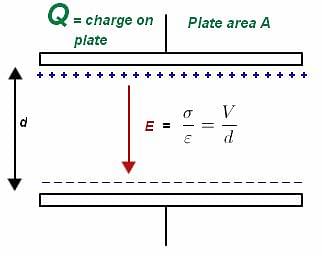
Parallel plate capacitor

However, it's worth noting that the capacitance of the capacitor will be affected by the non-parallelism of the plates, and will be lower than that of a parallel-plate capacitor with perfectly parallel plates.

Read More:

CBSE CLASS XII Related Questions

  • 1.
    Two thin lenses of focal length \( f_1 \) and \( f_2 \) are placed in contact with each other coaxially. Prove that the focal length \( f \) of the combination is given by \[ f = \frac{f_1 f_2}{f_1 + f_2}. \]


      • 2.
        Draw the number of scattered particles versus the scattering angle graph for scattering of alpha particles by a thin foil. Write two important conclusions that can be drawn from this plot.


          • 3.
            A long solenoid of length \( L \) and radius \( r_1 \) having \( N_1 \) turns is surrounded symmetrically by a coil of radius \( r_2 \, (r_2>r_1) \) having \( N_2 \) turns (\( N_2 \ll N_1 \)) around its mid-point. Derive an expression for the mutual inductance of solenoid and coil. Is \( M_{12} = M_{21} \) valid in this case?


              • 4.
                Two parallel plate capacitors X and Y are connected in series to a 6 V battery. They have the same plate area and same plate separation but capacitor X has air between its plates, whereas capacitor Y contains a material of dielectric constant 4. Calculate the capacitances of X and Y, if the equivalent capacitance of the combination of X and Y is \( 4 \, \mu\text{F} \). Calculate the potential difference across the plates of X and Y.


                  • 5.
                    The figure shows three point charges kept at the vertices of triangle ABC. The net electric field, due to this system of charges, at the midpoint M of base BC will be:

                      • \( \frac{q}{4 \pi \epsilon_0 l^2} \) pointing along MA
                      • \( \frac{q}{\pi \epsilon_0 l^2} \) pointing along AM
                      • \( \frac{q}{2 \pi \epsilon_0 l^2} \) pointing along AM
                      • Zero

                    • 6.
                      What is displacement current (\( i_d \))? Considering the case of charging of a capacitor, show that \( i_d = \varepsilon_0 \frac{d\Phi_E}{dt} \). What is the value of \( i_d \) for a conductor across which a constant voltage is applied?

                        CBSE CLASS XII Previous Year Papers

                        Comments


                        No Comments To Show
