



Education Journalist | Study Abroad Lead
A capacitor is a small rechargeable battery that stores energy in the form of an electrical charge. On the basis of its structure, there are three capacitor types – Fixed Capacitors, Variable Capacitors, and Trimmer Capacitors. A capacitor is made of 2 transmitters isolated by a dielectric material. These dielectric materials are plates that collect charges (one for positive and one for negative charges).
Comparisons between the different types of capacitors are made on the basis of dielectric used between the plates. Capacitance refers to the impact of a capacitor. Capacitance is the ratio of electric charge (Q) to voltage (V). C = Q/V. The different types of capacitors are –
- Ceramic Capacitors are created by covering two sides of tiny porcelain or ceramic disc with silver and stacking them together.
- Film Capacitors are the most commonly used capacitors, and they are made up of different sets of capacitors.
- Electrolytic Capacitors are a type of capacitor that has a metallic anode coated with an oxidized layer as a dielectric.
- Paper Capacitors, also known as fixed capacitors, use paper as the dielectric material.
| Table of Content |
Key Terms: Capacitors, 3 phase capacitors, Fixed capacitor, Variable capacitor, Trimmer capacitor, Capacitor values, Electric field, non-conducting medium, dielectric
What is a Capacitor?
[Click Here for Sample Questions]
Capacitors are passive components, similar to a resistor. Charges are usually stored in the form of an "electrical field" in a capacitor. There are different types of capacitors such as ceramic capacitors, paper capacitors, etc.
- Many electrical and electronic circuits rely heavily on these.
- A capacitor is made up of two parallel metal plates that are not connected to one another.
- The capacitor's two plates are separated by a non-conducting medium (insulating medium), which is called a dielectric.

Capacitors
The video below explains this:
Capacitance Detailed Video Explanation:
Also check:
Classification of Capacitors
[Click Here for Previous Year Questions]
Capacitors come in a variety of sizes and shapes, ranging from very small capacitors used in resonant circuits to enormous capacitors needed to stabilize HVDC (High Voltage Direct Current Transmission) lines. Capacitors are mainly divided into Fixed and Variable capacitors. Some common types of capacitors are:
- Ceramic capacitors
- Silver mica, glass, silicon, air-gap, and vacuum capacitors
- Film and paper capacitors
- Double-layer capacitors
- Aluminum, tantalum, and niobium electrolytic capacitors
- Polymer capacitors
- Hybrid capacitors
- Pseudo capacitors
The different types of capacitors based on their structure are as follows:
Fixed Capacitors
A fixed capacitor stores a specific amount of electric charge (capacitance) that cannot be changed at any time. Their values are mostly set during the production process. In electric appliances or gadgets, a fixed capacitor helps in maintaining a steady charge and energy output.
Variable Capacitors
A variable capacitor is one that can have its capacitance changed. The capacitance changes as the relative effective area between the pole metal plates or the distance between the plates changes. In radio receiving circuits, it is commonly used as a tuning capacitor. It's also used in a variety of circuits, including tuning and amplification, frequency selective oscillation, and others.
Trimmer Capacitors
Trimmer capacitors are variable types of capacitors that are used to calibrate equipment throughout the production or repair process.

Types of Capacitors
Capacitors are also classified based on their polarisation:
Polarized Capacitors
A polarized capacitor, also known as an electrolytic capacitor, is a crucial component in an electrical circuit. To produce a high capacitive density, these capacitors are utilized.
Unpolarized Capacitors
Unpolarized capacitors are preferred over polarised capacitors because they can be utilized in pure AC circuits and are not damaged by reverse voltage. Because they don't have positive and negative ends, they can also be used in DC circuits. The unpolarized capacitor has a high frequency and a low leakage current.
Read More: Capacitors in Parallel
Types of Capacitors
[Click Here for Sample Questions]
Different types of capacitors and their applications are mentioned below:
Ceramic Capacitors
Ceramic capacitors are created by covering two sides of tiny porcelain or ceramic disc with silver and stacking them together.
- Ceramic capacitors are also non-polar devices, which makes them useful in either direction in a circuit.
- They are created by covering two sides of tiny porcelain or ceramic disc with silver and stacking them together.
- Ceramic capacitors can be made with low or high capacitance by varying the thickness of the ceramic disc utilized.

Ceramic Capacitors
Key Points on Ceramic CapacitorsTypes of Ceramic CapacitorsOn the basis of the temperature range, temperature drift, and tolerance, types of ceramic capacitors are –
Applications of Ceramic Capacitors
|
Also read: Electric Displacement
Film Capacitors
Film Capacitors are the most commonly used capacitors, and they are made up of different sets of capacitors. The only difference is their dielectric properties.
- They come in a wide range of sizes and voltages, up to 1500 volts.
- They are available in a range of tolerances ranging from 10% to 0.1%.
- Film capacitors are also available in a variety of forms and housing types.
- Film capacitors are divided into two types: Radial Lead and Axial Lead.
- Film capacitors are physically larger and more expensive, but they are not polarised, thus they may be used with AC power, and their electrical properties are significantly more stable.

Film Capacitors
Based on the capacitance and dissipation factor, it can be used to replace Class 1 ceramic capacitors in frequency-stable applications.
Power Film Capacitors
Similar materials and construction techniques are used in power film capacitors and ordinary film capacitors. Polypropylene film is used as a dielectric here.
Types of Film CapacitorsOn the basis of the used dielectric material and its applications, the different types of film capacitors are:
Applications of Film Capacitors
|
Also check: Electrostatic Conductor
Electrolytic Capacitors
In an electrolytic capacitor, a metallic anode coated with an oxidized layer is used as a dielectric. These are the most often used capacitors with a large tolerance capacity. Tantalum and Aluminium are the two most common types of electrolytic capacitors.

Electrolytic Capacitor
Key Points on Electrolytic CapacitorsThe dielectric of electrolytic capacitors is used to classify them further:
Applications of Electrolytic Capacitors
|
Also read: NCERT Solutions Chapter 2 Electrostatic Potential and Capacitance
Paper Capacitors
A Paper capacitor is also known as a fixed capacitor in which paper is used as the dielectric material.
- At the power line frequency, a capacitor with a capacitance of 1nF to 1uF is utilized.
- It has a fixed amount of electric charge stored in it.
- It is made up of two metallic plates with paper serving as a dielectric material placed between them.

Paper Capacitor
Applications of Paper Capacitors
|
Also read: Electrostatic Shielding
Capacitor Values
[Click Here for Previous Year Questions]
Capacitors are necessary components of an electronic circuit that are used for a variety of purposes, including smoothing AC ripples in power supplies, coupling, and decoupling signals, and serving as buffers. In circuits, different types of capacitors are utilized, such as electrolytic capacitors, Disc capacitors, Tantalum capacitors, and so on. The value of an electrolytic capacitor is printed on the body so that the pins can be easily identified.
- The large pin is usually affirmative.
- The polarity is indicated by the black strip around the negative terminal.
- However, because only a number is printed on the body of a disc capacitor, determining its value in PF, KPF, uF, n, and other units is extremely difficult.
- The value of some capacitors is displayed in units of uF, whereas others have an EIA code.

Capacitor Values
As a result, the following are some methods for reading capacitor values on different capacitor types:
- The capacitor's capacitance value is measured in picofarads. For instance, 8 signifies 8PF
- The value of a capacitor is stated as P if the third number is zero, for example, 100 = 100PF.
- If a capacitor contains three numbers, the third number represents the capacitor's number of zeros, for example, 104 = 10 – 0000 PF.
- If the value is in PF, it is simple to convert it to KPF or uF.
Also read: Electrostatic Potential and Capacitance
Working Principle of Capacitor
[Click Here for Sample Questions]
A capacitor is made up of two conductors separated by a dielectric. The working principle of capacitors is:
- When the potential difference between the two conductors is large enough, an electric potential is generated.
- The capacitor will charge and discharge as a result of this.
- When a battery (a DC source) is attached to the capacitor, the current begins to flow across the circuit.
- As a result, a negative charge builds up on one plate while a positive charge builds upon the other.
- This procedure is repeated until the capacitor voltage equals the supply voltage.
- Even though the battery is attached, when the charging voltage equals the supply voltage, the capacitor stops charging.
- When the battery is removed, two plates with positive and negative charges will accumulate.
- As a result, the charge is held in the capacitor.
- When the supply voltage comes from an AC source, however, it constantly charges and discharges.
- The rate of charging and discharging is determined by the source's frequency.
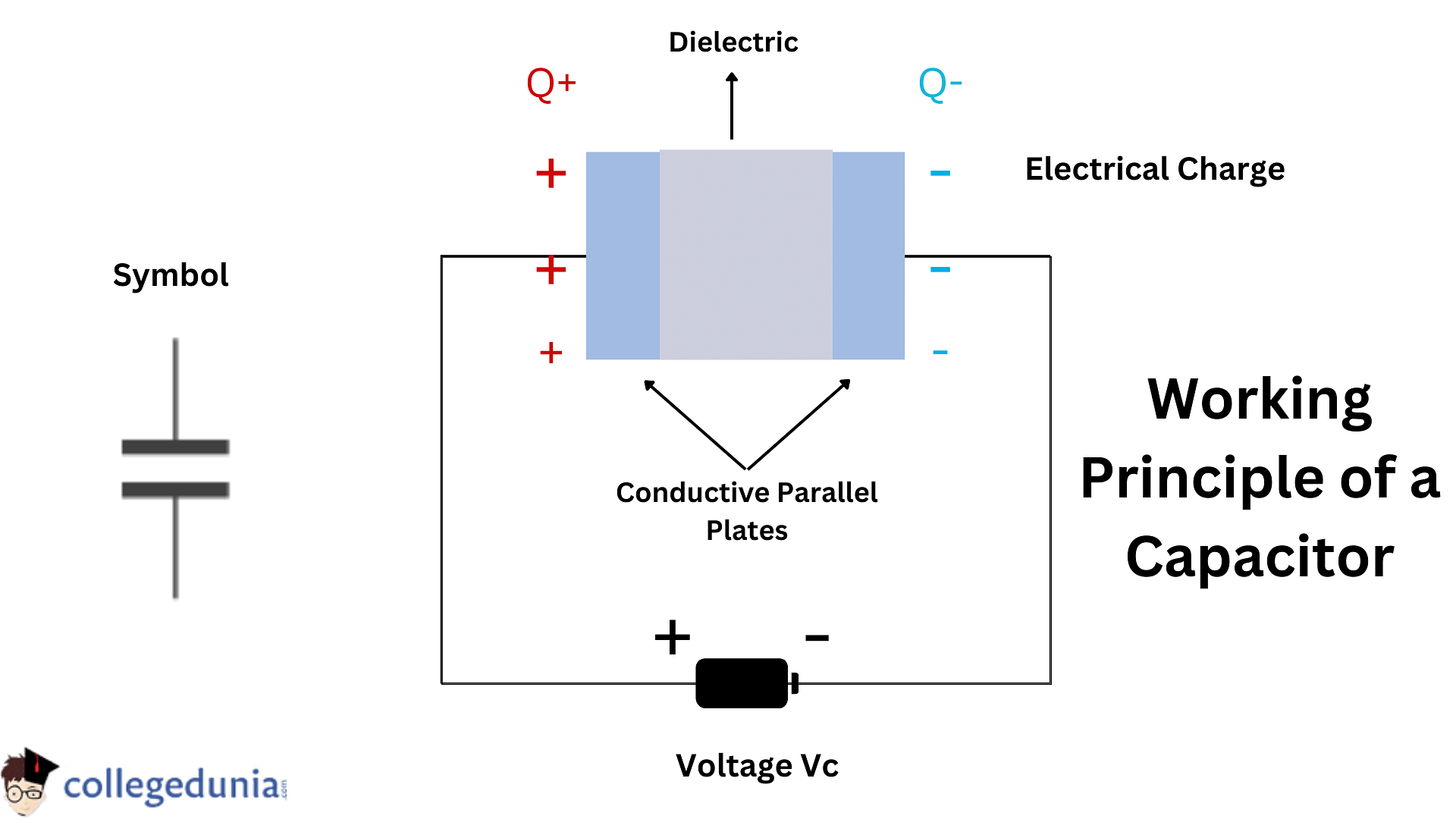
Working Principle of a Capacitor
Check Out:
Things to Remember
- A capacitor is a device that stores electrostatic potential energy and, in most circumstances, acts as a filter to inhibit DC.
- The two main types of capacitors are fixed capacitors and variable capacitors.
- Capacitors are often utilized to store both analogue and digital data.
- The most common types of capacitors are Ceramic Capacitors, Electrolytic Capacitors, Film Capacitors, and Paper Capacitors.
- The values of disc capacitors are expressed in PF, uF, KPF, and other units.
- The negative terminal of the capacitor is represented by a black strip.
Previous Year Questions
- A spherical drop of capacitance 1μF is broken into eight drops of equal radius… [KCET 2004]
- Two equal capacitors are first connected in series and then in parallel… [JEE Main 2021]
- The energy stored in a capacitor of capacity C and potential V is given by… [NEET 1996]
- What is the flux through a cube of side a if a point charge of q is at one… [NEET 2012]
- What is the effective capacitance between points X and y… [NEET 1999]
- When air is replaced by a dielectric medium of constant K… [NEET 1999]
- A conducting sphere of radius R is given a charge Q… [NEET 2014]
- In a region, the potential is represented by… [NEET 2014]
- Three charges, each +q, are placed a at the corners of an isosceles triangle… [NEET 2011]
- A capacitor of capacitance C1 is charged to a potential V and then… [NEET 2002]
- A capacitor is charged by a battery. The battery is removed and… [NEET 2017]
- Point charges +4q, - q and +4q are kept on the X -axis at… [NEET 1988]
- An electric dipole of moment is lying along a uniform electric field… [NEET 2006]
- A thin conducting ring of radius R is given a charge +… [NEET 2008]
- A charge Q is situated at the corner of a cube, the electric flux passed through… [NEET 2000]
Sample Questions
Ques. What is a capacitor? (3 marks)
Ans. The capacitor is one of the most widely utilized components in electrical circuit design. It is used in a variety of embedded applications. It is made up of two metal plates separated by a dielectric or non-conductive layer.
Capacitors are energy storage devices that can hold electrical charges across their plates. As a result of their ability to store charge, capacitors store energy, and an ideal capacitor would not lose its stored energy.
Ques. What is the capacitor's working principle? (1 mark)
Ans. A capacitor works on the premise of an insulated conductor whose capacitance steadily increases when an uncharged conductor is placed next to it.
Ques. Identify the metal used in the capacitor. (2 marks)
Ans. The plates of capacitors are made of metals such as aluminium, silver, and other metals. Paper, ceramic, or rubber dielectric materials are utilized between these metallic plates, depending on the capacitor's use.
Ques. What is the best way to determine the value of a capacitor? (2 marks)
Ans. The values of capacitors vary depending on the type of capacitor. Electrolytic capacitors, for example, have their values printed on the body as well as the pins. The values of disc capacitors are expressed in PF, uF, KPF, and other units. The negative terminal of the capacitor is represented by a black band.
Ques. What Is the Primary Purpose of a Capacitor? (3 marks)
Ans. Two metal plates are separated by a dielectric plate in the capacitor. Many insulating materials, such as air, glass, paper, and plastic, can be used to create the dielectric. A capacitor is a device that can store electrical charges and electricity. The greater the capacitance value, the more charge the capacitor can store.
The greater load the capacitor can carry, the larger the area of the plates or the smaller their separation. When the voltage between the plates of the capacitor equals the supply voltage, it is said to be "completely charged."
Ques. Determine the difference between a start and a run capacitor. (1 mark)
Ans. The start capacitor is utilized when there is a need for current to voltage lag, whereas the run capacitor is used to boost the current supply.
Ques. What is the best way to assess capacitor quality? (2 marks)
Ans. A digital multimeter is used to assess the capacitors' quality. The capacitor plates' ends are attached to the multimeter. The capacitor's positive end is connected to the multimeter's red lead, while its negative end is attached to the multimeter's black lead. The capacitor is deemed to be in good condition if the reading goes from zero to infinity.
Ques. What role does the dielectric play in a capacitor's capacitance? (2 marks)
Ans. If a dielectric slab of thickness t exits a capacitor with plates separated by a distance d, changing the slab's distance from the parallel plates has no effect on the equivalent capacitance.
Ques. Define the dielectric constant of a medium. What is its unit? [Delhi 2011c] (3 Marks)
Ans. When a dielectric slab is introduced between the plates of a charged capacitor or in the region of the electric field, an electric field EP induces inside the dielectric due to the induced charge on the dielectric in a direction opposite to the direction of the applied external electric field.
Hence, the net electric field inside the dielectric gets reduced to £0 – £P, where £0 is an external electric field. The ratio of the applied external electric field and a reduced electric field is known as the dielectric constant K of the dielectric medium.
Ques. A metal plate is introduced between the plates of a charged parallel plate capacitor. What is its effect on the capacitance of the capacitor? [Foreign 2009] (2 Marks)
Ans. If a metal plate is introduced between the plates of a charged parallel plate capacitor. The capacitance of a parallel plate capacitor will become infinite.
For Latest Updates on Upcoming Board Exams, Click Here: https://t.me/class_10_12_board_updates
Check out:



Comments