



Education Journalist | Study Abroad Lead
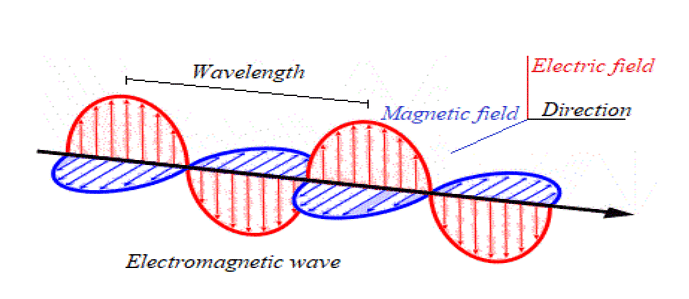
Electromagnetic waves are travelling waves in which electric and magnetic fields are perpendicular to each other. The direction in which electromagnetic waves travel is also perpendicular to the direction of electric and magnetic fields. Therefore, the nature of electromagnetic waves is transverse.
The basic sources of electromagnetic waves are -
- An electric charge at rest only produces an electric field around it but not a magnetic field.
- A charge moving with uniform velocity produces both electric and magnetic fields but of static nature.
- An accelerating charge and oscillating charge produces both electric field and magnetic field which varies with time.
- Hence the accelerating and oscillating charge is the basic source for the production of electromagnetic waves.
| Table of Content |
Key Terms: Electromagnetic waves, Transverse waves, Longitudinal Waves, Electric flux, Magnetic field, electric field
Electromagnetic Waves
[Click Here for Sample Questions]
According to Faraday's law of electromagnetic induction, a changing magnetic field with time gives rise to an electric field which also changes with time.
Maxwell pointed out, there is symmetry in nature. Therefore, a changing electric field also produces a changing magnetic field.
He concluded that:
- The changing electric and magnetic fields create a disturbance in space which has wave-like characteristics.
- These waves propagate through space without using any physical medium and are referred to as Electromagnetic waves.
Since, these electric and magnetic fields are perpendicular to each other and the direction of propagation of electromagnetic waves are perpendicular to both. Hence, electromagnetic waves are referred to as Transverse in nature.
The figure below clearly represents the direction of propagation of an electromagnetic wave which is perpendicular to both electric and magnetic fields.
Electromagnetic Waves
History of Electromagnetic Waves
Maxwell was the first to predict the presence of electromagnetic waves
- Hertz produces and detected electromagnetic waves of wavelength 6 m experimentally.
- J.C. Bose produced electromagnetic waves of wavelength ranging from 5 mm to 25mm.
- Marconi successfully transmitted the electromagnetic wave up to a few kilometers.
Some of the examples of electromagnetic waves are visible light rays, Ultraviolet rays, X- rays, Microwave rays, Radio waves and Gamma rays (ℽ- rays)
Also check:
| Related Concepts | ||
|---|---|---|
| Types of Radiation | Impedance of free space | Scintillation Counter |
| Electromagnetic Waves MCQ | Maxwell Equations | Wavelength Formula |
Transverse Wave and Longitudinal Wave
[Click Here for Sample Questions]
There are two types of waves: 1) Transverse waves 2) Longitudinal waves.
Transverse waves
- Transverse waves are the waves in which the constituents of the medium oscillate perpendicular to the direction of wave propagation.
- All electromagnetic waves are transverse waves.
Longitudinal waves
- Longitudinal waves are the waves in which the constituents of the medium oscillate along the direction of wave propagation.
- Sound waves are longitudinal waves.
Transverse Nature of Electromagnetic waves
[Click Here for Sample Questions]
When a charge accelerates or oscillates a time varying electric and magnetic field develops that are perpendicular to each other.
- Due to this oscillating electric and magnetic field, a disturbance is created in space.
- This disturbance travels along the direction perpendicular to oscillating electric and magnetic fields.
- This gives rise to electromagnetic waves which propagate perpendicular to both electric and magnetic fields.
- In a transverse wave, the constituents of the medium oscillate perpendicular to the direction of wave propagation.
- Due to this fact, we conclude that electromagnetic waves are Transverse in nature.
Evidence of Transverse nature of electromagnetic waves by phenomenon of Polarization
- Light is also a form of electromagnetic waves. The oscillation of electric and magnetic fields can occur in numerous planes.
- A light wave that is vibrating in more than one plane is known as unpolarized light.
- Polarized light waves are those in which the vibrations occur in a single plane.
- The process of transforming unpolarized light into polarized light is known as polarization.
- Polarization explains the transverse nature of electromagnetic waves, as the polarization only works for transverse waves but not for longitudinal waves.
- Therefore, the transverse nature of the electromagnetic wave is evident by the phenomenon of polarization.
Proof of Transverse Nature of Electromagnetic Waves
[Click Here for Sample Questions]
Consider a plane electromagnetic wave traveling along x- direction passing through an imaginary cube.
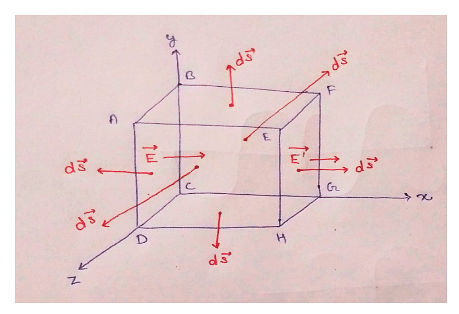
Let electric field intensity at face ABCD is E and at face EFGH is E’.
According to Gauss’ Law, the total electric flux across the cube is zero because it does not enclose any charge.


Since Electric field intensity at face ABCD of the cube is E and at face EFGH is E', therefore, we can write above equation as,

The above equation shows that the value of the x- component of the electric field does not change with time, that means the y- component of the electric field will change. Hence, the electric field is perpendicular to the direction of propagation of the wave.
Similarly, it can be proved that the magnetic field is perpendicular to the direction of propagation of the wave.
Since, both electric and magnetic fields are perpendicular to the direction of the wave. So, “electromagnetic waves are transverse in nature”.
Also check:
Things to Remember
- Electromagnetic waves propagate perpendicular to the direction of mutually perpendicular electric and magnetic fields.
- Accelerating and oscillating charges are the sources of electromagnetic waves.
- In Transverse waves, the constituents of the medium oscillate perpendicular to the direction of wave propagation.
- Polarization of light is also evidence of the transverse nature of electromagnetic waves.
- All electromagnetic waves are transverse in nature.
- Maxwell was the first to predict the presence of electromagnetic waves.
Sample Questions
Ques. What is meant by the transverse nature of electromagnetic waves? (2 marks)
Ans. The direction of propagation of electromagnetic waves are perpendicular to both mutually perpendicular oscillating electric and magnetic fields. Therefore, the nature of electromagnetic waves is Transverse.
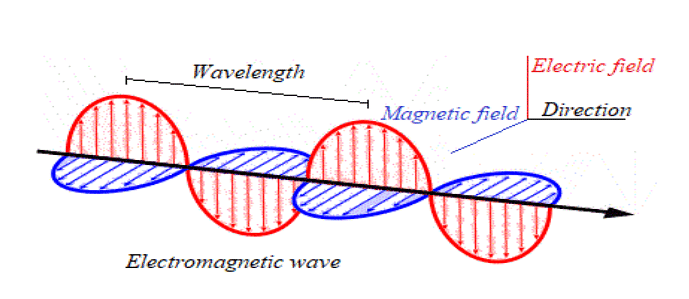
Ques. Draw a diagram showing the propagation of an electromagnetic wave along X-direction, indicating clearly the directions of oscillating electric and magnetic fields associated with it. (2 marks)
Ans. Below diagram clearly shows the propagation of electromagnetic waves along X- direction.
Ques. Transverse nature of electromagnetic waves is demonstrated by …… (2 marks)
(a) Interference experiment
(b) Diffraction experiment
(c) Polarization experiment
(d) Optical activity experiment
Ans. Option (c) is correct.
The phenomenon in which the oscillations of a wave are restricted in a direction perpendicular to the motion of a wave is known as the polarization of a wave.
Transverse waves are the waves in which the constituents of the medium oscillate perpendicular to the direction of wave propagation. Therefore, the transverse nature of electromagnetic waves is demonstrated by the Polarization experiment.
Ques. What is an example of a transverse electromagnetic wave? (2 marks)
Ans. Visible lights are the best example of electromagnetic waves.
Visible lights are the part of electromagnetic spectrum whose wavelengths are ranging from 380 nm to 400 nm.
Ques. Why are electromagnetic waves transverse? (2 marks)
Ans. The direction of propagation of electromagnetic waves is perpendicular to oscillating electric and magnetic fields. Therefore, we can say that electromagnetic waves are transverse.
Ques. What are 4 types of transverse waves? (2 marks)
Ans. Electromagnetic waves, Ripples on the surface of water, waves on a stretched string and secondary waves or S-waves of Earthquakes.
Ques. What is the relationship between an electromagnetic wave's electric and magnetic field vectors? (2 marks)
Ans. In electromagnetic waves, electric and magnetic field vectors are perpendicular to each other and both of these are also perpendicular to the direction of propagation of electromagnetic waves.
Ques. How Transverse waves differ from Longitudinal waves? (3 marks)
Ans. Transverse waves are the waves in which the constituents of the medium oscillate perpendicular to the direction of wave propagation.
All electromagnetic waves are transverse waves.
Longitudinal waves are the waves in which the constituents of the medium oscillate along the direction of wave propagation.
Sound waves are longitudinal waves.
Ques. Define Transverse wave? (2 marks)
Ans. Transverse waves are the waves in which the constituents of the medium oscillate perpendicular to the direction of wave propagation.
Ques. Are seismic waves longitudinal or transverse? (2 marks)
Ans. Seismic waves are of two types:
- Primary waves or P-waves
- Secondary waves or S-waves
P-waves are longitudinal, where the Earth compresses and stretches in the direction of wave propagation. S-waves are transverse, where the Earth moves up and down as the wave travels.
For Latest Updates on Upcoming Board Exams, Click Here: https://t.me/class_10_12_board_updates
Also Read:



Comments