



Content Writer
Triglyceride or triacylglycerols is one of the most common types of fat found in food items. It is a type of ester derived from three fatty acids and glycerol.
- It is basically used to supply energy to different cells of the body.
- Triglyceride is stored in the adipose tissue, which is broken down when the body requires energy.
- The main components of Triglyceride are chain length, position, number and presence of double bonds.
- A diglyceride is formed when two carboxylic acids combine with two ester bonds.
- They are basically derived from particles like butter and oils.
- Some of the common functions of triglycerides include lubricants and nutrition providers in the food.
| Table of Content |
Key Terms: Adipose tissue, Triglyceride, Carboxylic Acids, Glycerol, Fat, Ester, Cells, Diglyceride
What is Triglyceride?
[Click Here for Sample Questions]
Triglycerides are esters which are composed of glycerol and three fatty acids. When all the molecules of fatty acid are identical, then it is called simple triglycerides.

Triglyceride
- When two or three fatty acids are found in the molecule, it is called mixed triglyceride.
- In triglyceride formation, three carboxylic acids react with three ester bonds.
- It is formed when excess amounts of glucose are generated and stored in the adipose tissue.
- Some common examples of simple triglycerides include stearin and palmitin.
- Stearic is derived from the stearic acid, and palmitin will be derived from palmitin acid.
Structure of Triglyceride
[Click Here for Previous Year Questions]
Triglycerides are an important component which is incorporated in the food design model. It involves the reaction of pancreatic lipase enzymes with the ester bonds.
- It is formed by combining three hydroxyl groups of a single glycerol molecule.
- The hydroxyl molecule combines with carboxylic acid to form the required ester bonds.
- The length of the fatty acid is almost 16, 18 and 20 carbon atoms.
- These 16, 18 and 20 chains of fatty acids are called long-chain triglycerides.
CH(OH)(CH2OH)2 + RCOOH + R'COOH + R"COOH → RC(O)OCH2−CH(OC(O)R')−CH2C(O)OR" + 3H2O
Read Also: Aldehydes, Ketones and Carboxylic Acids
Types of Triglyceride
[Click Here for Sample Questions]
Triglyceride are long-term storage molecules which is divided into two broad categories:
Saturated Fat
Saturated fat is the first category of triglycerides in which fatty acids are connected with a single bond.
- The fats of animals belong to the category of saturated Fat.
- In saturated fat, a double bond of carbon chain reacts with the pair of hydrogen atoms to form a single chain of carbon atoms.
- Some common examples of saturated food include baked goods and fatty meats.
Unsaturated Fat
Unsaturated fat is the second category of Triglycerides in which fatty acids are connected with at least one double bond.
- The fats of plants and fish belong to the category of unsaturated fat.
- In unsaturated fats, carbon atoms are bonded to hydrogen atoms along with some groups of atoms.
- Unsaturated food is further classified into monounsaturated fat and polyunsaturated fat.
- Monounsaturated fat is an unsaturated fatty acid in which a single, double bond exists between fatty acid chains.
- In polyunsaturated fat is an unsaturated fatty acid with more than a single, double bond between fatty acid chains.
Read More: Gattermann Reaction
Functions of Triglyceride
[Click Here for Previous Year Questions]
Triglyceride plays an important role in the functioning of cells in the human body. They are the main component of blood cells and are stored in adipose tissue. Some common functions of triglycerides are as follows:
- It helps in the release of energy molecules during the process of respiration.
- Triglycerides are considered the storage powerhouse which helps in the consumption of carbohydrates and proteins required for the body.
- Since triglycerides are stored in adipose tissue, they help in the protection of vital organs of the body.
- They help provide buoyancy to the aquatic animals, preventing them from sinking in the water.
- Triglyceride helps in regulating the body temperature.
Read More About: Clemmensen reduction
Hydrolysis Process of Triglyceride
[Click Here for Sample Questions]
Hydrolysis is the process in which molecules of water break into one or more chemical molecules. In the case of hydrolysis of triglyceride, an aqueous base called sodium hydroxide is used.
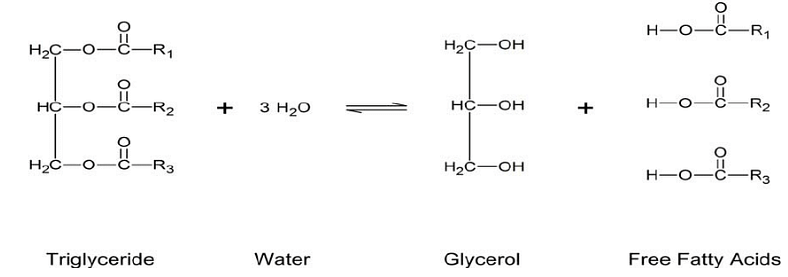
Hydrolysis of Triglyceride
- The process of hydrolysis of triglyceride is called saponification.
- In this, fatty acid reacts with base to form salts and glycerol.
- The process is repeated thrice to produce three fatty acids.
- They are important elements of the oleochemical industry.
Difference between Triglyceride and Cholesterol
[Click Here for Previous Year Questions]
The difference between triglycerides and cholesterol is provided as below:
| Triglyceride | Cholesterol |
|---|---|
| It is a type of fat used to provide energy to the body. | It is a fatty substance that is produced by the liver. |
| It cannot be easily produced by the body. | Cholesterol can easily be produced by the body. |
| Triglycerides cannot be mixed with the blood. | Cholesterol can easily be dissolved in the blood |
| It provides protection to vital organs of the body. | It helps in the digestion and normal functioning of the hormones. |
Normal Range of the Triglycerides in Human Body
[Click Here for Sample Questions]
The normal range of triglycerides for different age group is provided in the table below:
| Category | Adults | Children in the age group of 10-19 |
|---|---|---|
| Normal | under 150 mg/dL | Under 90 mg/dL |
| Borderline | 150 mg/dL - 190 mg/dL | 90 mg/dL - 120 mg/dL |
| High | Over 200 mg/dL | Over 130 mg/dL |
| Very High | Over 500 mg/dL | N/A |
Check More:
| Related Topics | ||
|---|---|---|
| Binary Fission | Difference between Cell and Tissue | Difference between Saturated and Unsaturated Fats |
| Difference between Lipids and Fats | Animal Tissues | Fatty Liver |
Things to Remember
- Triglycerides is a type of fat molecule obtained from glycerol and fatty acids.
- They act as a storage cell in the body.
- Long chain triglycerides are composed of long chains of fatty acids in which 16, 18 carbon atoms are attached.
- The hydrolysis of triglycerides takes place with the help of sodium hydroxide.
- Triglycerides are divided into saturated and unsaturated fat.
- It helps in maintaining the temperature of the body.
Previous Year Questions
- Extraction of metal from the ore cassiterite involves...[JEE Advanced 2011]
- Commonly used vectors for human genome sequencing are...[NEET UG 2014]
- Interfascicular cambium and cork cambium are formed due to..
- Pneumotaxic centre is present in...[UP CPMT 2007]
- Reaction of HBr with propene in the presence of peroxide gives….[NEET UG 2004]
- Assuming the expression for the pressure exerted by the gas on the walls of the container, it can be shown that pressure is...[MHT CET 2016]
- Which among the following is the strongest acid?...[TS EAMCET 2017]
- Isopropyl alcohol on oxidation forms..
- A vector is not changed if..
- Which of the following arrangements does not represent the correct order of the property stated against it?...[JEE Main 2013]
- The major product of the following reaction is...[JEE Main 2019]
- Major product of the following reaction is..[JEE Main 2023]
- The percentage of nitrogen in urea is about..
- The electric field at a point is
- Which of the following statements is true?..[JKCET 2006]
Sample Questions
Ques. What are triglycerides? (2 mark)
Ans. Triglycerides are a type of fat that is used to provide energy to different parts of the body. In scientific terms, they are esters composed by combining three fatty acids with glycerol. Some common examples of triglycerides include oleo distearin, which comprises two molecules of stearic acid and one molecule of oleic acid.
Ques. How many types of triglycerides are present? (3 marks)
Ans. There are two types of triglycerides, which are as follows:
- Saturated Fat: In saturated fat, fatty acids are connected with a single body of carbon atoms. The most common example of saturated fat includes fatty meat, frozen food and baked food.
- Unsaturated Fat: In unsaturated fat, carbon atoms are linked to hydrogen atoms and other different types of atoms. It is divided into monounsaturated and polyunsaturated fats.
Ques. What are the functions of triglycerides? (3 marks)
Ans. Triglycerides is incorporated into our food system for many reasons:
- They are a storage unit of the body which is used when energy is required by the body.
- Triglycerides are stored as oil in various types of fruits and seeds.
- They act as a shield to the vital organs of the body.
Ques. Explain the process of hydrolysis of triglycerides? (3 marks)
Ans. Hydrolysis of triglycerides is a three-step process which takes place with the help of an aqueous base like sodium hydroxide.
- In the first, triglycerides are broken down into carboxylic acids.
- Next, the base is catalyzed to produce glycerol and three fatty acids.
- The fatty is broken down into an enzyme called acetyl enzyme.
- In the last step, enzymes are broken down into water and carbon dioxide.
Ques. What is the chemical reaction of triglycerides? (1 mark)
Ans. The chemical reaction of triglycerides is as follows:
CH(OH)(CH2OH)2 + RCOOH + R'COOH + R"COOH → RC(O)OCH2−CH(OC(O)R')−CH2C(O)OR" + 3H2O
Ques. What is the difference between triglycerides and cholesterol? (3 marks)
Ans. The below table highlights the important difference between triglycerides and cholesterol:
| Triglyceride | Cholesterol |
|---|---|
| Triglyceride is used to provide energy to the body. | It is a lipoprotein that is used for building of cells. |
| It act as a shield for the organs of the body | It helps in the smoothing of digestion cycle. |
| Triglycerides are used as unused calories. | Cholesterol helps in the generation of vitamin D. |
Ques. What is the normal range of triglycerides in adults? (2 marks)
Ans. The normal range of triglycerides in adults are as follows:
- Normal: Under 150 mg/dL
- Borderline: 150 mg/dL - 190 mg/dL
- High: Over 200 mg/dL
- Very High: Over 500 mg/dL
Ques. Explain: (2 marks)
(A) Monounsaturated Fat
(B) Polyunsaturated Fat
Ans. (A) Monounsaturated Fat: Monounsaturated Fat is a type of unsaturated fat in which a single double bond exists between molecules of the fatty chain.
(B) Polyunsaturated Fat: Polyunsaturated Fat is a type of unsaturated fat in which more than single double bond exists between molecules of the fatty chain.
For Latest Updates on Upcoming Board Exams, Click Here: https://t.me/class_10_12_board_updates
Check-Out:



Comments