



Content Curator
Bar and atm are the units of pressure. Pressure is measured in different units as per the need. The different units representing pressure are pascal, torr, bar, atm, barye (Ba), millimetres of mercury (mmHg) etc. These units are used for different purposes like the mmHg unit is used while measuring blood pressure. The different units of pressure can also be converted into one another and help in solving problems related to pressure. The relation between bar and atm is,
1 atm = 1.01325 bar
or
1 bar = 0.986923 atm
| Table of Content |
Key Takeaways: Pressure, Bar, Standard Atmospheric Unit, Pascal, Gauge Pressure, Atmospheric Pressure, Absolute Pressure
What is Pressure?
[Click Here for Previous Year Questions]
Pressure is defined as the force per unit area. This force is applied perpendicular to the surface. It is denoted by an uppercase or lowercase ‘p’. It is a scalar quantity and its formula is given as;
P = F/A
where,
F = Force
A = area
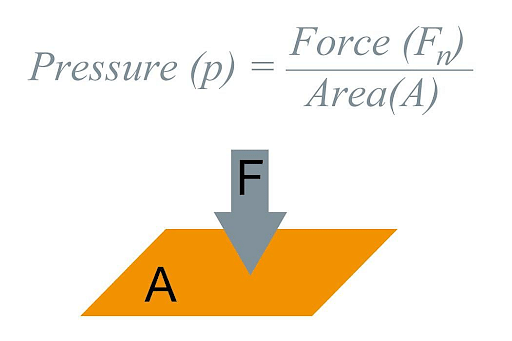
Pressure
The SI unit of pressure is pascal (Pa). One pascal is equal to a force of 1 N applied on an area of 1 m2. The CGS unit of pressure is barye (Ba) which is equal to 0.1 Pa or 1 dyne per cm2.
Read More:
Types of Pressure
[Click Here for Previous Year Questions]
Pressure is of different types-
- Atmospheric Pressure
- Absolute Pressure
- Differential Pressure
- Gauge Pressure

Types of Pressure
Absolute pressure refers to the total pressure relative to vacuum. Whereas the gauge pressure is the pressure relative to atmospheric pressure. The absolute pressure is equal to the sum of gauge pressure and atmospheric pressure.
Pabsolute = Pgauge + Patm
Relation Between Bar and Atm
[Click Here for Previous Year Questions]
Pressure is measured in different units all over the world. These units are torr, barye, atm, bar, mmHg etc. The units are used as per the need. Two of these units and their relation is explained below:
Bar
Bar is the metric unit of pressure. One bar is equal to 100 kPa (or 100,000 Pa). Bar can also be defined as the atmospheric pressure on earth at an altitude of 111 metres and a temperature of 15°C.
Atm
Atm stands for standard atmospheric unit. It is defined as the average atmospheric pressure of earth at sea level. The standard atmospheric unit is used as the reference pressure. One atm is equal to 101,325 Pa.
The atmospheric air pressure is usually measured in millibars. The standard atmospheric pressure is equal to 1.01325 bar (or 101.325 kPa).
1 atm = 1.01325 bar
1 bar = 0.986923 atm
Conversion of Different Units of Pressure
[Click Here for Previous Year Questions]
The conversion values of different units of pressure is given below:
| Unit | Pa | atm | Torr | bar | psi | mmHg |
|---|---|---|---|---|---|---|
| Pa | 1 | 9.869 10-6 | 7.5 10-3 | 10-5 | 1.45 10-4 | 7.5 10-3 |
| atm | 101,325 | 1 | 760 | 1.013 | 14.69 | 760 |
| Torr | 133.3 | 1.316 10-3 | 1 | 1.333x 10⁻³ | 0.0194 | 1 |
| bar | 100,000 | 0.987 | 750.06 | 1 | 14.50 | 750.06 |
| psi | 6,893 | 0.068 | 51.71 | 0.0689 | 1 | 51.71 |
| mmHg | 133.3 | 1.316 10-3 | 1 | 1.333x 10⁻³ | 0.0194 | 1 |
Uses of Bar
[Click Here for Previous Year Questions]
For a lot of purposes, the bar is used as a unit for measuring pressure. Some of its main uses are listed below:
- Meteorologists and weather reporters usually measure atmospheric air pressure in millibars.
- In oceanography, decibars are used as a unit of pressure.

Analog Pressure Gauge
- In scuba diving, the pressure is measured mainly in bars.
- The tire pressure is also often measured in bars.
- In vacuum engineering, residual pressures are expressed in millibars.
Read More:
| Read more topics from Mechanical Properties of Fluid | ||
|---|---|---|
| Bernoulli’s principle | Venturi-meter | Viscosity |
| Stokes’ Law | Surface tension | Barometer |
| Reynolds Number | Unit of Viscosity | Density |
| Buoyant Force | Fluid Friction | Value of R in atm |
| Hydrostatic Paradox | Hydraulic Lift | Pressure Formula |
Things to Remember
- Pressure is defined as the force applied on a certain area. Its SI unit is pascal (Pa).
- The bar is the metric unit of pressure.
- The average atmospheric pressure of earth at sea level is called the standard atmospheric unit (atm).
- One atm is equal to 1.01325 bar.
- The atmospheric air pressure is generally expressed in millibars.
Sample Questions
Ques 1. A 50 kg girl wearing high heel shoes balances on a single heel. The heel is circular with a diameter 1.0 cm. What is the pressure exerted by the heel on the horizontal floor? (3 marks) [NCERT]
Ans. Mass of girl (m) = 50 kg
Force on the heel (F) = mg = 50 9.8 = 490 N
Diameter of the heel (d) = 1.0 cm = 1 10-2 m
Area (A) = π r d2/4
= 3.14 (1 10-2)2 / 4 = 7.85 10-5 m2
Pressure (P) = F/A = 490 / 7.85 10-5 = 6.24 106 Pa
Ques 2. A hydraulic automobile lift is designed to lift cars with a maximum mass of 3000 kg. The area of cross-section of the piston carrying the load is 425 cm2. What maximum pressure would the smaller piston have to bear? (2 marks) [NCERT]
Ans. Pressure on the piston due to car = weight of car / Area of Piston
P = 3000 9.8 / 425 10-4 Nm-2
= 6.92 105 Pa
Ques. A U tube contains water and methylated spirit separated by mercury. The mercury columns in the two arms are level with 10.0 cm of water in one arm and 12.5 cm of spirit in the other. What is the relative density of spirit? (3 marks) [NCERT]
Ans. For water column in one arm of U tube, h1 = 10.0 cm; ρ1 (density) = 1 g cm-3
For the spirit column in the other arm of the U tube, h2 = 12.5 cm; ρ2 =?
As the mercury columns in the two arms of the U tube are in level, therefore pressure
exerted by each is equal.
Hence h1ρ1g = h2ρ2g or ρ2 = h1ρ1/h2 = 10 x 1/12.5 = 0.8 g cm-3
Therefore, relative density of spirit = ρ2/ρ1 = 0.8/1 = 0.8
Ques 3. A U tube contains water and methylated spirit separated by mercury. The mercury columns in the two arms are in level with 10.0 cm of water in one arm and 12.5 cm of spirit in the other, if 15.0 cm of water and spirit each are further poured into the respective arms of the tube, what is the difference in the levels of mercury in the two arms? (Relative density of mercury = 13.6) (4 marks) [NCERT]
Ans. Height of the water column, h1 = 10 + 15 = 25 cm
Height of the spirit column, h2 = 12.5 + 15 = 27.5 cm
Density of water, ρ1 = 1 g cm-3
Density of spirit, ρ2 = 0.8 g cm-3
Density of mercury = 13.6 g cm-3
Let h be the difference between the levels of mercury in the two arms.
Pressure exerted by height h, of the mercury column = hρg
= h × 13.6g … (i)
Difference between the pressures exerted by water and spirit:
= ρ1h1g – ρ2h2g
= g(25 × 1 – 27.5 × 0.8)
= 3g … (ii)
Equating equations (i) and (ii), we get:
13.6 hg = 3g
h = 0.220588 ≈ 0.221 cm
Thus, the difference between the levels of mercury in the two arms is 0.221 cm.
Ques 4. What is the significance of Reynold’s Number? (2 marks)
Ans. Reynold’s Number is given by;
NR = Dvc /
where,
= Density of liquid
D = Diameter of tube
vc = critical velocity
= coefficient of viscosity
If the value of NR lies between 0 to 2000, the flow of liquid will be streamlined and if its value lies above 3000, the flow of liquid will be turbulent.
Ques 5. If the rate of flow of liquid through a horizontal pipe of length l and radius R is Q. What is the rate of flow of liquid if length and radius of tube is doubled? (3 marks)
Ans. According to Poiseuille’s formula, the rate of flow of liquid through a tube of radius R
and length l is given by;
Q = R4 / 8l ……… (i)
If R and l are doubled, then the rate of flow will be
Q’ = (2R)4 / 8(2l)
Q’ = 16R4 / 2(8l) ……… (ii)
Comparing eq. (i) and (ii)
Q’ = 8Q
Thus, the rate of flow of liquid will increase 8 times.
Ques 6. Glycerine flows steadily through a horizontal tube of length 1.5 m and radius 1.0 cm. If the amount of glycerine collected per second at one end is 4.0 10-3 kg s-1, what is the pressure difference between the two ends of the tube? (Density of glycerine = 1.3 103 kg m-3 and viscosity of glycerine = 0.83 Pa s). (3 marks) [NCERT]
Ans. l = 1.5 m , r = 1 10-2 m
Volume/s , V = (Mass/s) / Density
= 4 10-3 / 1.3 103 m3 s-1 = 4/1.3 10-6 m3 s-1
= 0.83 Pa s
Now, V = pr4 / 8l (where, p is the pressure difference across the capillary)
p = 8Vl / r4
p = 8 4/1.3 10-6 0.83 1.5 7/22 1/10-8 Pa
= 9.75 102 Pa
Reynold's number is 0.3. So, the flow is laminar.
Ques 7. Explain why the water on a clean glass surface tends to spread out while mercury on the same surface tends to form drops. (2 marks)
Ans. Water on a clean glass surface spreads because the force of cohesion of water is much less than the force of adhesion due to glass. In the case of mercury, the force of cohesion due to mercury is very strong as compared to adhesion force due to glass. As a result, mercury does not make the glass wet and tends to form drops.
Ques 8. State the law of floatation? (2 marks)
Ans. Law of floatation states that a body will float in a liquid, if weight of the liquid displaced by the immersed part of the body is at least equal to or greater than the weight of the body.
Ques 9. The blood pressure of humans is greater at the feet than at the brain? (2 marks)
Ans. The height of the blood column in the human body is more at the feet than at the brain. We know that pressure is directly dependent on the height of the column. Thus, pressure is more at the feet than at the brain.
Ques 10. What is surface tension? (2 marks)
Ans. Surface tension is the tension caused at the surface caused by the attraction of particles in the surface layer by the bulk of the liquid, which tends to minimize surface area.
Ques 11. Does Archimedes principle hold in a vessel in a free fall? (2 marks)
Ans. Archimedes’s Principle will not hold in a vessel in a freefall. This is because the acceleration due to gravity is zero and hence buoyant force will not exist.
Ques 12. Why is oil is sprinkled on sea waves to calm them? (2 marks)
Ans. Surface tension of water is much higher than in oil. Thus by adding oil to water, the water without oil pulls the oily water in the direction of the breeze, and sea waves calm down.
Ques 13. A drop of oil placed on the surface of water spreads out, but a drop of water placed on oil contracts. Why? (2 marks)
Ans. The cohesive forces between the oil molecules are less than the adhesive force between the oil molecules. The drop of oil spreads out and reverse holds for a drop of water.
Ques 14. The diameter of ball A is half that of ball B. What will be the ratio of their terminal velocities in water? (2 marks)
Ans. The terminal velocity is directly proportional to the square of the radius of the ball, therefore the ratio of terminal velocities will be 1:4.
Ques 15. What is viscosity? (2 marks)
Ans. Viscosity is the property of fluids by which the particles experience an internal friction that affects the flow of the fluid. This is why honey pours slowly than water.
Ques 16. What is Reynold’s number? (2 marks)
Ans. Reynold’s number is given by,
\(\frac{SDV_c}{n}\)
Where,
S is density of liquid
D is diameter of tube
Vc is critical velocity
n is coefficient of viscosity
Ques 17. Give two applications of Bernoulli’s theorem. (2 marks)
Ans. Bernoulli’s theorem is applied in atomizers and in the lift of an aeroplane wing.
Ques 18. What is conserved in Bernoulli’s theorem? (2 marks)
Ans. In Bernoulli’s theorem, mass, energy and linear momentum are conserved.
Ques 19. Can Bernoulli"s equation be used to describe the flow of water through a rapid in a river? Explain. (2 marks)
Ans. No. Bernoulli"s equation cannot be used to describe the flow of water through a rapid in a river because of the turbulent flow of water. This principle can only be applied to streamlined flow.
Ques 20. Why are dams of water reservoirs made thick at the bottom? (2 marks)
Ans. As pressure column is high at the bottom, there is a high probability for cracks to be developed at the bottom. This is why dams are made thick at the bottom to counteract this pressure.
Ques 21. Why is it difficult to stop bleeding from a cut in human body at high attitudes? (2 marks)
Ans. The atmospheric pressure is low at high altitudes. Due to greater pressure differences in blood pressure and atmospheric pressure, it is difficult to stop bleeding from a cut in the body.
Ques 22. What is the dimensions of coefficient of viscosity and surface tension? (2 marks)
Ans. [n] = M1L-2T-2
[S] = M1T2L0
Do Check Out:



Comments