



Education Journalist | Study Abroad Lead
Diode is a semiconductor-based dispositive with two terminals or electrodes (di-ode) that function as an on-off switch. When the diode is "on," it creates a short circuit and allows all current to flow through it. It acts like an open circuit and doesn't pass any current when it is off. The anode and cathode terminals of a diode are made of P and N type materials. The voltage provided to these terminals can be controlled to operate diodes. The diode is considered to be in Forward Bias when the voltage applied to the anode is positive in relation to the cathode. Diodes are used as rectifiers, for radio modulation, power conversion, in logic gates and even for measuring the temperature of electronic circuits.
| Table of Content |
Key Takeaways: Diode, LED, Zener Diode, Diode Equations, Power consumption of diode, Electrodes, P types, N types, Rectifier, Anode, Electronic circuits, Cathode
What is a Diode?
[Click Here for Sample Questions]
- Diode is a semiconductor device that functions as a current one-way switch.
- Diode permits current to flow freely in one direction while drastically restricting current flow in the other direction.
- Diodes are also known as rectifiers because they convert alternating current (AC) to intermittent direct current (DC).

Diode
Also Read:
Uses of Diode
[Click Here for Previous Year Questions]
Diode serve a variety of functions and have multiple applications:
Protection Diodes
- Integrated circuits are frequently protected against electrostatic discharge by diodes.
- A rapid discharge of charge between two bodies at different potentials is known as an electrostatic diode event.
- During the manufacturing and lifetime of a chip whose pins come into touch with equipment and occasionally humans, Electrostatic discharge accidents are quite likely to occur.
- A pair of diodes can be added at the input and output pins to safeguard the chip from significant harmful voltages.

Protection Diodes
Diode as a Rectifier
- The most common and significant application of a diode is the rectification of AC to DC electricity.
- Different types of rectifier circuits can be built using diodes.
- Half wave, full wave centre tapped and full bridge rectifier circuits are the most common types. In most power conversion applications, a single or a combination of four diodes is used.

Diode as Rectifier
Radio Demodulation
- Demodulation of amplitude modulated radio broadcasts was the diode's first application.
- Amplitude Modulation signal is made up of alternating positive and negative voltage peaks whose amplitude or "envelope" is proportional to the original audio signal but has a zero average value.
- The crystal diode rectifies the Amplitude Modulation signals resulting in a signal with the desired average amplitude.
- A simple filter is used to retrieve the average value that is then put into an audio transducer which produces sound.

Radio Demodulation
Use of Diode as Power Conversion
- Rectifiers are diode-based devices that convert alternating current (AC) electricity to direct current (DC).
- A common example is automotive alternators where the diode outperforms the commutator of older dynamos.
- Cockcroft–Walton voltage multipliers also use diodes to convert AC into greater DC voltages.

Diode used in power conversion
Temperature Measuring
- Diodes can be used as a temperature monitoring device because the forward voltage drop across a diode is temperature dependent.
- The voltage looks to have a positive temperature coefficient, so it depends on doping concentration and operating temperature according to the Shockley ideal diode equation.
- The temperature coefficient might be negative as in normal thermistors or positive as in temperature sensing diodes that operate at temperatures below 20 degrees Kelvin.

Diode as Temperature Sensor
Use of Diode in Logic Gates
- Digital logic operations can also be performed using diodes.
- The forward and reverse-biased conditions of a diode are equivalent to the low and high impedance states of a logic switch respectively.
- As a result the diode may execute logic operations like ‘AND’, ‘OR’ gates.

Diode in Logic Gates
Types of Diode
[Click Here for Sample Questions]
There are several different types of diodes which perform different functions:
Zener Diode
- Zener Diode is a passive element that operates on the Zener Breakdown principle.
- It was invented by Clarence Zener in 1934 and works similarly to a regular diode in forward bias allowing current to pass.
- However, in reverse bias conditions the diode only conducts when the applied voltage hits the Zener Breakdown value.
- Its purpose is to prevent transient voltage pulses from damaging other semiconductor devices.
- It performs the function of a voltage regulator.
- A high-strength electric field causes electron quantum tunnelling that causes the Zener reverse breakdown.
- Zener diodes behave like conventional diodes when they are forward-biased.
- There may be a tiny leakage current leaking when connected in reverse mode.
- A current begins to flow through the diode when the reverse voltage approaches the breakdown value.
- The series resistor determines the maximum current.
- The current stabilises and remains steady over a wide range of applied voltages after the maximum is attained.

Zener Diode
Light Emitting Diode(LED)
- Electrical energy is converted to light energy by these diodes.
- The first production of LED began in 1968.
- In a forward bias condition, it goes through an electro-luminescence process in which holes and electrons are recombined to produce energy in the form of light.
- LEDs were extremely expensive and mainly utilised in specialised applications.
- However, the cost of LEDs has decreased dramatically over time.
- LEDs are the primary source of lighting in homes, offices, streets lights, autos, and mobile phones.

LED Internal Structure
Schottky Diode
- The junction is formed by connecting the semiconductor material with metal in Schottky Diode.
- The forward voltage loss is reduced to a minimum as a result of this. N-type silicon serves as the anode, while metals such as chromium, platinum, tungsten.

Step Recovering Diode
- Step recovering diode is also known as a charge-storage diode or a snap-off diode.
- These are unique diodes that store the charge from a positive pulse and use it in the negative pulse of sinusoidal signals.
- The present pulse's rise time is equal to the snap time.
- It possesses rapid recovery pulses as a result of this characteristic.
- Higher-order multipliers and pulse shaper circuits are two applications for these diodes.
- The cut-off frequency of these diodes is extremely high and mostly approaching Gigahertz.
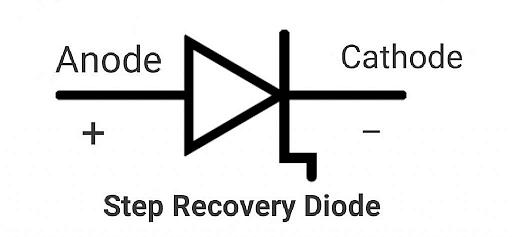
Step Recovery Diode
Laser Diode
- In laser diodes the active region is produced by a p-n junction also similar to that of an LED.
- In terms of electrical characteristics, a laser diode is a P-I-N diode with the active region in the intrinsic region.
- Fiber optic communications, barcode readers, laser pointers, CD/DVD/Blu-ray reading and recording, and laser printing are just a few of the applications.

Laser Diode
Diode Equations
[Click Here for Previous Year Questions]
Diode Equations are of two types: Forward Bias and Reverse Bias.
Forward Bias
- The state that allows current to flow through the pn junction is known as forward bias.
- VBIAS is the name for the external bias voltage.
- The resistor keeps the forward current low enough to avoid damaging the diode.
- The negative side of VBIAS is connected to the n area of the diode in the forward bias, while the positive side is connected to the p region.
- The bias voltage VBIAS must be more than the barrier potential. For germanium diodes the bias voltage must be greater than 0.3V and for silicon diodes it must be greater than 0.7V.

Diode: Forward Bias
Reverse Bias
- When the diode is reverse-biased a very little drift current flows across the junction due to thermal stimulation.
- Reverse bias is a condition that prevents current from flowing through the diode.

Diode: Reverse Bias
Also Read:
Things to Remember
- The greatest forward current is restricted by the diode's ability to dissipate heat.
- When a p-n junction diode is forward bias then it has a low resistance and when it is reverse bias then it has a high resistance.
- Light energy is converted into electrical energy by a solar cell. It is used in the production of energy.
- The first vacuum diode was created as the first semiconductor-based diode in the early 1900s.
- If the half-wave rectifier load resistor is replaced with a grounded capacitor then the peak value of the input signal can be detected.
- To generate fully differential output signals that are rectified by the diodes then we use a center-tapped transformer.
- The input voltage exceeds the voltage maintained by the capacitor until the diode remains turned off.
Sample Questions
Ques: What is the use of a p-n junction diode? (2 marks)
Ans: When the diode arrangement is reverse-biased then the p-n junction diode can be utilized as a photodiode and a light-sensitive diode.
Ques: Do diodes convert Alternating current (AC) to Direct current (DC)? (2 marks)
Ans: Yes, diode used as a rectifier to convert AC electricity to pulsing DC electricity.
Ques: What is the main significance of diodes? (3 marks)
Ans: The diode performs a number of valuable purposes in addition to its primary function of controlling the passage of electrical current. Diodes enable electricity to flow only in one direction through them.
Ques: Is it possible for a diode to work intermittently? (3 marks)
Ans: A zener diode may occasionally fail only in specific circumstances. Intermittent failure is the word for this type of failure. The zener diode must be examined while it is in operation to check for an intermittent.
Ques: What is the diode breakdown voltage? (3 marks)
Ans: The highest reverse voltage that may be provided without creating an exponential increase in the leakage current in a diode is defined by the breakdown voltage. To avoid overheating many small-signal transistors must have their breakdown currents regulated to significantly lower values.
For Latest Updates on Upcoming Board Exams, Click Here:https://t.me/class_10_12_board_updates
Do Check Out:



Comments