



Education Journalist | Study Abroad Lead
Vector Space, commonly known as linear space, is a cluster of objects referred to as vectors, added collectively and multiplied (scaled) by numbers, called scalars. Scalars are generally considered to be real numbers. However, there are certain possibilities of scalar multiplication by rational numbers, complex numbers, etc. with vector spaces. The methods of vector addition and scalar multiplication must fulfil specific requirements such as axioms. To define scalars as real or complex numbers, the terms real vector space and complex vector space are used. There are various types of vectors that exist. The addition and multiplication process must stick to the number of requirements called axioms for qualifying the vector space 'V'.
| Table of Content |
Key Terms: Vector Space, Vectors, Scalars, Vector Addition, Scalar Multiplication, Real Numbers, Rational Numbers, Associative Law, Commutative Law, Addition, Subtraction
Read More: Laws of Vector Addition
Definition of Vector Space
[Click Here for Sample Questions]
A space composed of vectors, collectively with the associative law and commutative law of addition of vectors and also the associative and distributive process of multiplication of vectors by scalars is referred to as vector space. It comprises a set of V (elements of V are called vectors), a field F (elements of F are scalars), and the two operations.
- Vector addition is a process that accepts two vectors u, v ∈ V, and produces a third vector u + v ∈ V.
- Scalar Multiplication is a process that accepts a scalar c ∈ F and a vector v ∈ V and further produces a new vector UV ∈ V.
Vectors can be of different types. In order to qualify the vector space V, the addition and multiplication operation must stick to axioms, i.e, the number of requirements. The axioms are used to generalise the properties of vectors introduced in the field F. It is called real vector space if it is over the real numbers R and over the complex numbers, C is called the complex vector space.

Vector Space Model
The video below explains this:
Types of Vectors Detailed Video Explanation:
Difference Between Vector and Vector Space
[Click Here for Sample Questions]
Vector space is a group of objects which is multiplied by scalars and combined by the vector space axioms whereas a vector is a part of a vector space.
What are Equal Vectors?
[Click Here for Sample Questions]
Equal Vectors are defined as vectors that have the same magnitude and the same direction. In the case when two vectors are equal, the addressed line segments are parallel and their vector columns are identical.
Read More: Types of Vectors
Vector Space Axioms
[Click Here for Sample Questions]
There are mainly ten axioms defined for a vector space which are broadly classified into vector addition and multiplication.
Let’s consider x, y, and z as the elements of a vector space ‘V’ and a, b as the elements of the field F.
- Conditions of Vector Addition
The ‘+’ addition as the operation vector must satisfy the following conditions:
Closure: In a vector space ‘V’, if ‘x’ and ‘y’ are some vectors, then ‘x+y’ belongs to the vector space ‘V’.
- Commutative Law: It states that for all vector elements x and y in V, x + y = y + x
- Associative Law: It states that for all vector elements x and y in V, x + (y + z) = (x + y) + z.
- Additive Identity: It states that for any vector elements x in V, the vector space contains the additive identity element and is denoted by ‘0’ such that 0 + x = x and x + 0 = x.
- Additive Inverse: It states that for any vector element x in V, there’s an additive inverse –x to obtain the solution in V.
Read More: Additive Identity Vs Multiplicative Identity
- Condition of Scalar Multiplication
The process of scalar multiplication is illustrated between a scalar and a vector element and should meet the following requirements listed below:
Closure: In a vector space ‘V’, if ‘x’ is any vector and ‘c’ is any real number, then ‘x.c’ belongs to the vector space V.
- Associative Law: It states that for all real numbers c and d, and the vector element x in V, x.c belongs to V.
- Distributive Law: It states that for all real numbers c and d, and the vector element x in V, (c + d).v = c.v + c.d.
- Distributive Law: It states that for all real numbers c and the vector elements x and y in V, c.(x + y) = c.x + c.y.
- Unitary Law: It states that for all the vectors x in V, 1.v = v.1 = v.
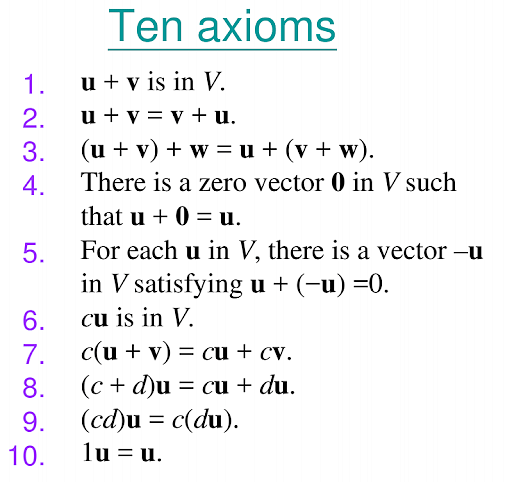
The Ten Vector Space Axioms
Read More: Properties Of Scalar Product Of Two Vectors
Properties of Vector Space
[Click Here for Sample Questions]
The fundamental properties of vector space derived from the axioms are as follows:
- The addition process of a finite list of vectors v1, v2, . . , vk can be evaluated in any order. The answer to this process will be the same.
- If x + y = 0, then the value of y = −x.
- The negation of 0 will be 0. This conveys that the value of −0 = 0.
- The outcome of negation of negation of any vector is the vector itself. This implies −(−v) = v.
- If x + y = x, if and only if y = 0. Thus, 0 is the only vector behaving like 0.
- The product of any vector with 0 times gives the 0 vector. This implies that for each vector in y, 0 * y = 0.
- For some real number c, any scalar times of the 0 vector is the 0 vector itself. c0 = 0
- If the value of cx = 0, then either c = 0 or x = 0. The product of a scalar and a vector is equivalent to 0 only when either of them is 0.
- The scalar value −1 times a vector is considered to be the negation of the vector. This implies that (−1)x = −x. We represent subtraction in terms of addition by defining x − y as an abbreviation for x + (−y).
x − y = x + (−y)
All the normal properties of subtraction are as follows:
- x + y = z then the value x = z − y.
- c(x − y) = cx − cy.
- (c − d)x = cx − dx
Read More: Unit Vector
Things to Remember
- The vector space is a set of multidimensional quantities referred to as vectors parallel with a set of one-dimensional quantities called scalars.
- The vectors can be added and multiplied by scalars while conserving the standard arithmetic properties.
- Each element of a vector space is a list of objects having a specific length, referred to as vectors.
- Vector addition is defined as the way of combining two vectors into a single vector.
- Scalar multiplication is the way of combining a scalar k with a vector v, to get the vector kv.
Sample Questions
Ques. Below mentioned are a few conditions. Prove that each of the conditions provided is in vector space:
Condition 1: The set of liner polynomials p1 = {a0 + a1x|a0, a1 € R} under addition and scalar multiplication operations.
Condition 2: Under usual matrix operation, the set of 2x2 matrixes with real entries.
Condition 3: Three-component row vectors with usual operations
Condition 4: The set A =  under the operations from R4 (5 Marks)
Ans. On comparing the given conditions in the question above with the axioms and properties:
- The zero element is 0 + 0x = 0
- The zero elements of the vector space under 2x2 matrix = zero
- The zero elements of 3 components row vectors are 0.
- The closure property of addition involves
![The closure property of addition]() is in A because (x1+x2) + (y1+y2) – (z1+z2) + (w1+w2) = ( x1+y1-z1+w1) + (x2+y2-z2+w2) = 0 + 0
is in A because (x1+x2) + (y1+y2) – (z1+z2) + (w1+w2) = ( x1+y1-z1+w1) + (x2+y2-z2+w2) = 0 + 0
 is in A because (x1+x2) + (y1+y2) – (z1+z2) + (w1+w2) = ( x1+y1-z1+w1) + (x2+y2-z2+w2) = 0 + 0
Similarly, one can obtain the closure of scalar multiplication.
Ques. The vector equation given is
\(2 \hat{i} - 3 \hat{j} + 6 \hat{k}\) .Find the vector in the direction of the given vector having a magnitude of 21 units. (3 Marks)Ans. 
=> 7 units
The unit vector in the direction of the given vector a is represented as:

Thus, the vector having a magnitude equal to 21 units in the direction of vector a will be:

Ques. You are given below a few measures for which you have to classify them as scalars and vectors. (5 Marks)
(1) 15 Kg
(2) 20 Kg weight
(3) 45o
(4) 10 meters south-east
(5) 50 m/s2
Ans. The scalar quantities only have magnitude whereas the vector quantities involve both magnitude and direction. The classification of the given measures into vectors and scalars are as follows:
- 15 Kg: It is scalar as it only involves the mass of a quantity.
- 20 Kg weight: It involves both magnitude and direction hence it is a vector quantity.
- 45?: A degree represents magnitude hence this is a scalar quantity.
- 10 meters southeast: This involves both directions, as well as magnitude hence, is a vector quantity.
- 50 m/s2: It involves no direction but only has magnitude hence it is a scalar quantity.
Ques. You are given with 3 collinear points P, Q and R such that
\(\overrightarrow{PQ} = \overrightarrow{a}\) and \(\overrightarrow{QR} = \overrightarrow{b}\). What will be the value of \(\overrightarrow{PR}\)? (3 Marks)
 Ans. According to the question, P, Q, and R are three collinear points.

Ques. There are three vectors a, b, and c which forms the three sides of a triangle. You have to calculate the other possibilities. (5 Marks)
Ans. According to the question, vectors a, b, and c form the three sides of a triangle.

According to the triangle law, if the vectors are represented in magnitude and direction by the two sides of a triangle taken in the same order, then the total sum is represented by the third side in reverse order.
Therefore, \(\overrightarrow{a} + \overrightarrow{b} = \overrightarrow{c}\)
Or
\(\overrightarrow{a} + \overrightarrow{c} = \overrightarrow{b}\)
\(\overrightarrow{b} + \overrightarrow{c} = \overrightarrow{a}\)
Ques. You are given below a few quantities. Classify these quantities into scalars and vectors: (5 Marks)
(1) Time period
(2) Distance
(3) Displacement
(4) Force
(5) Work
(6) Velocity
(7) Acceleration
Ans. The classification of given quantities as scalar and vector are as follows
- Time period: Since time doesn’t have any direction but only magnitude therefore it is a scalar quantity.
- Distance: Distance doesn’t have any direction hence it is a scalar quantity.
- Displacement: A displacement has both magnitudes as well as direction thus, it is a vector quantity.
- Force: It is a vector quantity since it involves both the magnitude and direction.
- Work: Since the work done has no directions as it only involves magnitude hence it is a scalar quantity.
- Velocity: Since speed or velocity have a magnitude and is said to be applied in a direction. Thus, velocity is a vector quantity.
- Acceleration: It is also a vector quantity as it has both magnitude and direction.
Ques. Consider that there are two non-collinear vectors a and b are having the same initial point. Determine what are the vectors represented by \(\overrightarrow{a} + \overrightarrow{b} and \overrightarrow{a} - \overrightarrow{b}\)?  (3 Marks)
Ans. According to the question, a and b are two non-collinear vectors that have the same initial point.

From the equation (i) and (ii), we will obtain \(\overrightarrow{a} + \overrightarrow{b} and \overrightarrow{a} - \overrightarrow{b}\) as the diagonals of the parallelogram having adjacent sides vector a and vector b.
Ques. You are given a quadrilateral ABCD. Calculate the sum of vectors
\(\overrightarrow{BA}, \overrightarrow{BC}, \overrightarrow{CD}\) and \(\overrightarrow{DA}\). (3 Marks)
 Ans. As per the question given, ABCD is a quadrilateral.
In triangle ADC,
Applying triangle law we will obtain,
\(\overrightarrow{CD} + \overrightarrow{DA} = \overrightarrow{CA}\)…. (i)Similarly, in triangle ABC,

Ques. Find the vector having magnitude 9 units in the direction of the given vector
\(\hat {i} - 2 \hat{j} + 2 \hat{k}\). (3 Marks)Ans. We are given in the question that

Ques. Find a unit vector in the direction of a given vector \(\overrightarrow{PQ}\), where the points p and Q are given by (1, 3,0) and (4,5,6) respectively. (3 Marks)
Ans.

Also Read:



Comments