



Content Curator
Volume of a cone is the amount of space taken by a cone in a three-dimensional plane. A cone has a circular base, which means the base is made of radius and width. Then from the center of the base, you can go to the highest part of the cone which is measured as the cone’s height. In this article, we will learn about the formula, derivation, and examples of a circular cone.
Key Terms: Volume, Right Circular Cone, Height, Radius, Width, Three dimensional Plane
Volume of a Right Circular Cone
[Click Here for Sample Questions]
Volume of a right circular cone defines the area or capacity of a cone. A cone is a three-dimensional geometric shape with a rounded base that extends from a flat base to an apex or vertex. The cone is made up of a set of line segments, half-lines, or lines that connect a common point, apex, to all points on a plane base that does not contain an apex.

Right Circular Cone
The cone can be seen as a set of inconsistent circular discs piled up on top of each other so that the radius of the nearest disk remains unchanged. Therefore, in the right circular cone, the vertex is above the center of the base vertically, while in the oblique cone, the vertex of the cone is not vertical above the base center.
Also Read:
| Related Topics | |||
|---|---|---|---|
| Circles | Triangles | Similarities of Triangle | Surface areas |
Formula of a Right Circular Cone
[Click Here for Sample Questions]
Generally, a cone is a pyramid with a circular cross. The right corner is a cone with its vertex above the base center. It is also called the right circular cone. You can easily find the volume of a cone if you have measurements of its height and radius.
Thus, the formula of the volume of a right circular cone is given below:
Volume of a cone =\(\frac{1}{3}\) \(\pi\)r²h
Where,
r = Base radius of a cone
h = Height of a cone
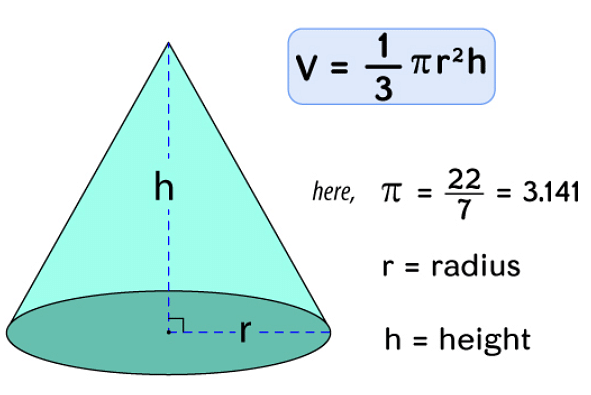
Volume of a cone formula
Also Read:
| Related Topics | ||
|---|---|---|
| Quadrilateral | Parallelogram | Vertex |
Derivation of Volume of a Cone
[Click Here for Sample Questions]
You can think of a cone as a circular triangle about one of its vertices. Now, think of a situation in which we need to calculate the amount of water that can be stored in a round flask. In other words, calculate the volume of this flask. The capacity of the conical flask is basically equal to the capacity of the cone involved. Therefore, the volume of a three-dimensional shape is equal to the amount of space occupied by that shape.
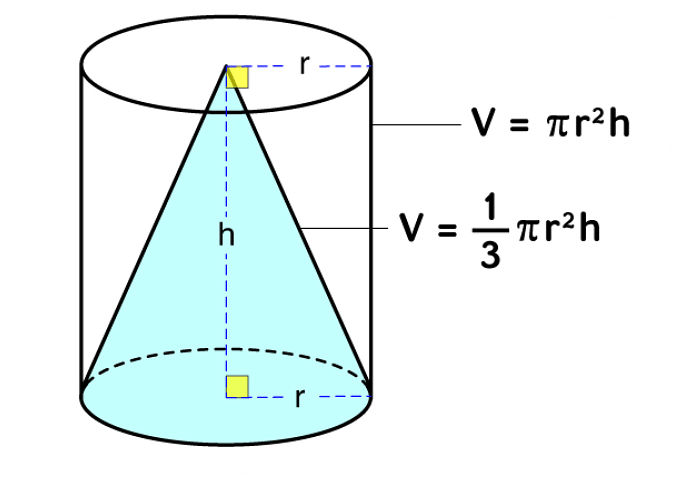
Volume of a Cone Derivation
Now, let’s suppose a cone has a circular base with radius ‘r’ and height ‘h’. Now, the volume of a cone will be equal to the \(\frac{1}{3}\)th of the product of the area of the base and height.
Thus, the volume of a cone V = \(\frac{1}{3}\) x Area of Circular Base x Height of the Cone
But, we know the formula of the area of a circle, the base of the cone has an area, which is equal to
B = \(\pi\)r²
Thus, by substituting this value, we get,
V = \(\frac{1}{3}\) \(\pi\) r² h
Read More:
Things to Remember
[Click Here for Sample Questions]
- Volume of a cone is the amount of space taken by a cone in a three-dimensional plane.
- A cone has a circular base, which means the base is made of radius and width.
- A cone is a solid 3-D shape with a rounded base. It has a curved surface.
- The volume of a cone = ? ????r²h
- The volume of the cone and the cylinder are related in the same way as the volume of the pyramid and the prism is related. When the cone and cylinder height are equal, the cylinder capacity is three times the cone capacity.
Read More:
Sample Questions
Ques: Find the volume of a cone from the figure given below. (3 marks)
Ans. Given, r = 8 cm
h = 18 cm
Volume of a cone = \(\frac{1}{3}\)x πr2 x h
=\(\frac{1}{3}\)* \(\frac{22}{7}\) * (8)² * 18
= \(\frac{1}{3}\) *\(\frac{22}{7}\) * 64 * 18
= 1206.4 cm³
Ques: Find the capacity of the conical vessel whose radius is 7 cm and height is 9 cm. (2 marks)
Ans. Given, r = 7 cm
h = 9 cm
The capacity of the conic vessel = volume of the cone
Therefore, the volume of a cone =\(\frac{1}{3}\) x πr2 x h
= \(\frac{1}{3}\) * \(\frac{22}{7}\)* (7)² * 9
= \(\frac{1}{3}\) * \(\frac{22}{7}\) * 49 * 9
= 462 cm³
Ques: If the height of a circular cone is 7 cm and its diameter is given as 8 cm. Then, find the volume of the circular cone. (2 marks)
Ans. Given, h = 7 cm
Diameter of the circular cone = 8 cm
Therefore, radius = 8/2 = 4 cm
Now, volume of the cone = \(\frac{1}{3}\) x πr2 x h
= \(\frac{1}{3}\)* \(\frac{22}{7}\) * (4)² * 7
= 117.33 cm³
Ques: If the volume of a cone is given as 32 π cm³ and its height is given 6 cm. Find the radius of the cone. (3 marks)
Ans. Given, Volume of the cone = 32π cm³
h = 6 cm
Now, Volume of the cone = \(\frac{1}{3}\) x πr2 x h
\(\frac{1}{3}\) x πr2 x h = 32 π
\(\frac{1}{3}\) x π (r²) * 6 = 32 π
r² = 16
r = 4 cm
Ques: A conical silo has a radius of 9 feet and a height of 14 feet. Find the volume of the conical silo. (3 marks)
Ans. Given, r = 9 feet
h = 14 feet
The volume of the conical silo =\(\frac{1}{3}\) x πr2 x h
= \(\frac{1}{3}\) * 3.14 * (9)² * 14
= 1186.92 cubic feet
Ques: A conical shape storage tank has a diameter of 5 m and a height of 10 m. Find the volume of the tank in liters. (4 marks)
Ans. Given, Diameter = 5 m
Radius = 2.5 m
Height = 10 m
Now, the volume of the tank = \(\frac{1}{3}\) x πr2 x h
= \(\frac{1}{3}\)* 3.14 * 2.5 * 2.5 * 10
= 65.4 m³
Since, 1 m³ = 1000 liters
Then, 65.4 m³ = 65.4 * 1000
= 65400 liters.
Ques: Find the volume of the cone whose radius is 6 feet and height is 12 feet. (2 marks)
Ans. Given, r = 6 feet
h = 15 feet
Therefore, the volume of a cone =\(\frac{1}{3}\) x πr2 x h
= \(\frac{1}{3}\) * 3.14 * 6 * 6 * 12
= 452.16 ft³
Ques: Find the volume of a cone whose radius is 2 cm and height is 6 cm. (2 marks)
Ans: Given, r = 2 cm
h = 6 cm
Thus, volume of a cone = \(\frac{1}{3}\) x πr2 x h
= \(\frac{1}{3}\) * \(\frac{22}{7}\) * (2)² * 6
= \(\frac{1}{3}\) * \(\frac{22}{7}\) * 24
= \(\frac{22}{7}\) * 8
= 25.14 cm
Ques: Find the volume of a cone whose radius is 7 cm and height is 12 cm. (2 marks)
Ans: Given, r = 7 cm
h = 12 cm
Thus, volume of a cone = \(\frac{1}{3}\) x πr2 x h
= \(\frac{1}{3}\) * \(\frac{22}{7}\) * (7)² * 12
= \(\frac{1}{3}\) * 22 * 84
= 616 cm
Ques: A conical flask has a radius of 17 feet and a height of 20 feet. Find the volume of the conical flask. (3 marks)
Ans. Given, r = 17 feet
h = 20 feet
The volume of the conical flask = \(\frac{1}{3}\) x πr2 x h
= \(\frac{1}{3}\) * 3.14 * (17)² * 20
= 6049.73 cubic feet
For Latest Updates on Upcoming Board Exams, Click Here: https://t.me/class_10_12_board_updates
Check More:



Comments