



Content Curator
Cyclone, in meteorology, is a system of winds that rotate inwards to an area of low barometric pressure, with anticlockwise circulation in the northern hemisphere and clockwise circulation in the Southern Hemisphere. Cyclones result from a massive quantity of energy transferred from the ocean to the atmosphere. The Coriolis force spirals the surface winds towards the low-pressure system.
Read Also: Effects of Air Pollution on Environment
| Table of Content |
Key Terms: Cyclone, Meteorology, Coriolis Force, Polar Lows, Ocean, Northern Hemisphere, Southern Hemisphere, Barometric Pressure
What is Cyclone?
Cyclones are very simply, ocean storms. These are storms that occur over a big body of water, such as the ocean. The water spins around a low-pressure spot known as the “eye”. The eye of these storms is found in the middle, while the outside regions of the spinning storm produce massive wind and rainfall. A cyclone is caused by a continuous rising of hot air and the filling of gap by cool air from the surrounding area.
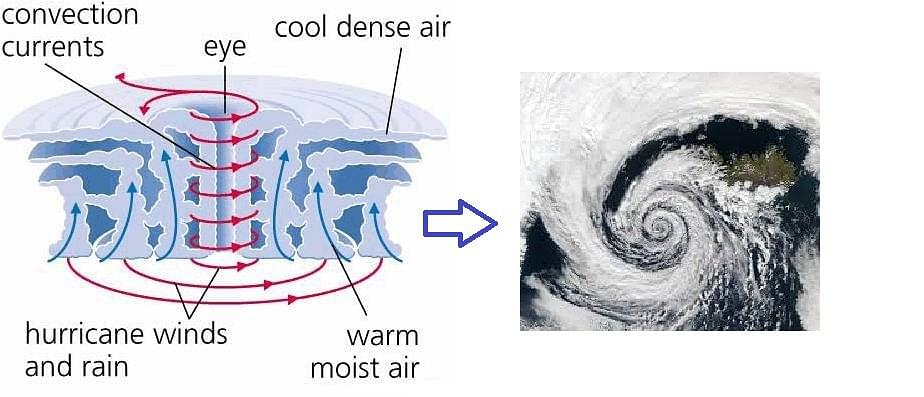
Cyclone
Cyclone is a term used in meteorology to describe a storm. Winds rotate inwards to a low-pressure area, with anticlockwise circulation in the northern hemisphere and clockwise in the southern hemisphere.
From the water to the atmosphere, cyclones are generated using a tremendous amount of energy. Because of the Coriolis force, the surface winds spiral toward the low-pressure system. Because the Coriolis force is insignificant between 5 degrees north and 5 degrees south, cyclonic systems do not form in the equatorial regions.
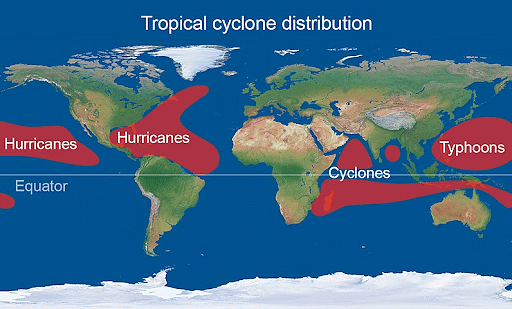
Cyclone Occurrence
Read More: Storage of Grains
Common Names for Cyclones
In different parts of the world, cyclone is known by several names, such as:
| Region | Names for Cyclones |
|---|---|
| China sea | Typhoons |
| Caribbean Sea | Hurricanes |
| Japan | Taifu |
| Philippines | Baguio |
| Indian Ocean | Tropical cyclones |
| USA | Tornadoes |
| Northern Australia | Willy willies |
Check Important Notes: The Role of Atmosphere in Climate Control
Different Types of Cyclones
Cyclone represents a meteorological pattern that is distinguished by swirling winds. Various types of cyclones occur around a low-pressure centre. Cyclones vary depending on the sizes and environment in which they exist. There are four forms of cyclones and they are :
- Tropical cyclone
- Polar cyclone
- Mesocyclone
- Extratropical cyclone
Tropical Cyclone
Tropical cyclone is similar to a revolving system that contains clouds and thunderstorms. They are native to tropical and subtropical regions. The North Atlantic (including the Caribbean), Southwest Indian Ocean, Eastern Pacific, North Indian Ocean, Western Pacific, Southern Pacific, and Australia regions are the most vulnerable to tropical cyclones.
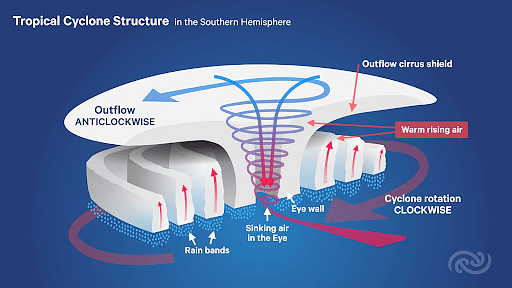
Tropical Cyclone Formation
Tropical cyclones normally form between 5 and 30 degrees latitude. The production of these cyclones are at least 80 degrees Fahrenheit. When the wind channels into a low-pressure disturbance, this happens. When the rising air condenses into clouds, the warm surface water begins to evaporate, releasing energy.
This is because people in various parts of the world have given these catastrophic storms various names. In the North Atlantic and the Caribbean, as well as the Northeastern Pacific, they are known as hurricanes. In the Indian Ocean and the South Pacific, however, they are known as tropical cyclones or cyclones.
Polar Cyclone
Over the Arctic and Antarctic oceans, hurricane-like cyclones known as “Polar lows” can form. They are sparked by the passage of cold air over somewhat warmer ocean waters. Polar lows are sometimes referred to as "Arctic Hurricanes" by meteorologists in the Northern Hemisphere. The heat is transmitted from water to air, while the latent heat is released in the form of cloud condensation. Polar lows occur quickly, sometimes in less than 24 hours and are difficult to predict. They form across the waters of the Arctic and Antarctic.
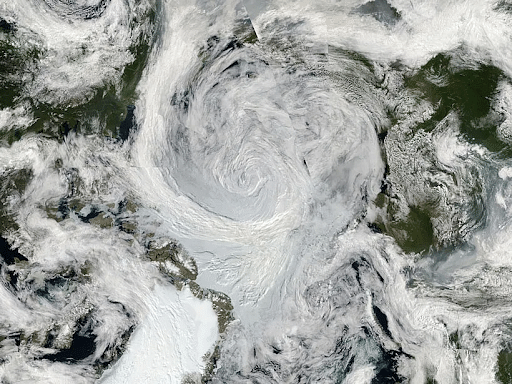
Arctic or Polar Cyclone
Mesocyclone
Mesocyclone is a vortex of air that exists within a convective storm. Along the vertical axis, the air rises and rotates. In the given hemisphere, the direction of this air and the low-pressure system are equal. The whirling air within the thunderstorms is accompanied by the mesocyclone. The formation of wall clouds from these mesocyclones eventually leads to the formation of a funnel cloud. When it makes contact with the earth, it transforms into a tornado.

Mesocyclone
Extratropical Cyclone
Extratropical cyclones or midlatitude cyclones are cyclonic storms that occur along frontal boundaries in the middle latitudes. Unlike their tropical counterparts, these cyclones form where there are sharp temperature differences between connected air masses. Even though their winds are normally weaker than Hurricanes, they can grow to be extremely massive. The extratropical cyclone's winds are less, but the temperature gradients are strong.

Extratropical Cyclones
Also Read:
How are Cyclones Formed?
Cyclones form in locations where there is a low level of pressure. The geography, severity, and frequency of the cyclone determine the susceptibility of the area where it strikes. Cyclones are usually formed by:
- A large amount of warm temperature is near the sea's surface.
- The atmosphere is unstable.
- How the Coriolis force affects the area to create low- pressure.
- When the humidity levels in the lower to middle troposphere are high.
- Disturbance in the low-level area that already existed.
- When there is less vertical wind shear.

Cyclone Formation
- When warm, moist air moves upward over the ocean, a cyclone forms. As the air rises, a low-pressure area forms beneath it.
- The low-pressure area has now been filled with high-pressure air from the surrounding area. As the next wave of cool air moves higher, it becomes warm and moist as it passes over the ocean. This results in the creation of a low-pressure area once more, and the cyclone goes on.
- Clouds form in the air as a result of this ongoing cycle. As the water from the ocean evaporates, more clouds form.
- The storm system forms as a result of this. An eye forms in the centre of the storm system as it rotates faster. The quiet and clear region of the storm is known as the eye. The air pressure in the storm's eye is extremely low.
- Cyclones are classified into distinct classes based on the strength of the winds they produce.

Cyclone Formation
Read More:
Things to Remember
- A cyclone is a large-scale air mass that rotates counterclockwise in the northern hemisphere and clockwise in the southern hemisphere.
- Cyclones are defined by inward-spiralling winds that revolve around a low-pressure zone. Polar vortex and extratropical cyclones of the biggest scale are the largest low-pressure systems. Tropical and subtropical cyclones, as well as warm core cyclones, are included on the synoptic scale.
- Cyclogenesis is the formation and intensification of cyclones.
- Four types of cyclones are Tropical cyclones, Polar cyclone, Mesocyclone, Extratropical Cyclone.
Sample Questions
Ques: Name the Indian States that are affected by tropical cyclones? (2 marks)
Ans: Every year, 2-4 tropical cyclones strike India's various states. The east coast of India, which comprises Tamil Nadu, Andhra Pradesh, Odisha, and West Bengal is the hardest hit.
Ques: What is the eye of a cyclone? (2 marks)
Ans: The geometric cyclone of any cyclone is the eye of the storm. There are two types of it. In the midst of a cyclone, a clear eye is a clear eye in which a dark ball is readily visible. The term second-filled eye refers to the fact that it has eyes, but light or medium-level storm clouds are imprisoned inside.
Ques: What effects do tropical cyclones have? (2 marks)
Ans: Heavy rain, high winds, massive storm surges near landfall, and tornadoes are all impacts of tropical cyclones. The extent of damage caused by a cyclone such as a hurricane or tropical storm is mostly determined by its severity, size and location.
Ques: What measure should we keep in mind during cyclones? (4 marks)
Ans: During a Cyclone, we should take the following safety measures.
- We should ignore the rumours. We should not freak out.
- Keep your cell phones charged for emergency communication.
- Regularly check weather updates, listen to the radio, watch TV for weather news.
- To safeguard the safety of your livestock or animals, leave them untied
Ques: What is a cyclone? (1 mark)
Ans: A cyclone can be defined as a large-scale air mass that spins counter-clockwise in the northern hemisphere and clockwise in the southern hemisphere.
Ques: What are the various types of cyclones? (1 mark)
Ans: There are 4 types of cyclones,
- Tropical cyclone
- Polar cyclone
- Mesocyclone
- Extratropical cyclone
Ques. Which divide helps to measure wind speed? (1 mark)
Ans. Anemometer is the device that helps to measure wind speed.
Related Links:



Comments