



Education Journalist | Study Abroad Lead
Zinc Acetate is an ionic salt chemically expressed as Zn(CH3CO2)2. Zinc Acetate can be found in two forms namely anhydrous and dihydrate. It is found in our environment in a dihydrate form expressed as Zn(CH3COO)2(H2O)2. Either of the two forms (dihydrate and anhydrous) are colourless crystalline solid. On the action of acetic acid on zinc oxide, zinc acetate is formed. The molecular weight of Zinc acetate (dihydrate) is 219.50 g/mol. It is used in the treatment of Wilson’s disease.
| Table of Content |
Key Terms: Zinc Acetate, Valency, Salt, Ointments, Solubility, Molecular Weight, Chemical Formula, Chemical Reaction
Zinc Acetate: Structure and Formula
[Click Here for Sample Questions]
The chemical formula for zinc acetate is Zn(CH3COO)2. It consists of ions of zinc and acetate. Zinc having valency 2 and acetate having valency 1 criss-cross each other to make the chemical formula of zinc acetate as Zn(CH3COO)2. Thus, zinc acetate is an ionic compound. It forms a coordination bond with four atoms of oxygen which results in a tetrahedral structure which further combines with itself to form a polymer of zinc acetate.
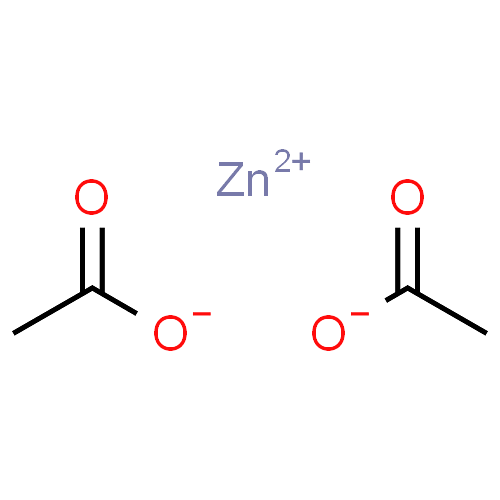
Structure of Zinc Acetate
Preparation of Zinc Acetate
[Click Here for Previous Year's Questions]
Zinc acetate has a cation Zn2+ and an anion (CH3COO)1- and is produced by the chemical reaction of zinc oxide with acetic acid in the la laboratory. This is the most common method of preparation. Apart from this, let us consider a few more methods of preparing zinc acetate.
- A salt is formed when a metal reacts with an acid. Hydrogen gas is released during this reaction. Zinc metal is made to react with acetic acid to produce zinc acetate salt and give out hydrogen gas. This chemical reaction can be expressed through a chemical reaction as follows:
Zn + 2CH3COOH → Zn(CH3COO)2 + H2
- Moreover, there is one more way to obtain zinc acetate. When acetic acid reacts with zinc oxide it produces zinc acetate and water. This reaction can be described as follows:
ZnO + 2CH3COOH → Zn(CH3COO)2 + H2O
- An alternate method for preparing zinc acetate is to heat zinc acetate dihydrate to obtain the zinc acetate salt.
- One more way to form zinc acetate is to take zinc acetate dihydrate and let it undergo refluxing with toluene.
Also Read:
| Related Links | ||
|---|---|---|
| Ionic Bond (Electrovalent Bond) | Zinc Chloride Formula | |
Properties of Zinc Acetate
[Click Here for Sample Questions]
Zinc acetate is an ionic compound which has a tetrahedral structure having a coordination bond. The type of bond and the structure of the compound largely determine the physical as well as chemical properties of that compound.
Physical Properties
- Zinc acetate looks like a white solid.
- It can dissolve in water. It is also soluble in methanol.
- If it is kept in the open air it can quickly turn into its dihydrate form because of its gyroscopic nature.

Zinc Acetate
Chemical Properties
- It has a melting point of 510K.
- Its density is 1.735g/cm3
- Its solubility in water is 43g/100mL (20°C).
- Its solubility in methanol is 1.5g/100mL.
Uses of Zinc Acetate
[Click Here for Previous Year's Questions]
Zinc acetate is an acetate salt which serves as an astringent. It is used to make several other compounds of zinc. It finds its use in diverse areas from chemicals to drugs and from preservatives to disinfectants. It is commonly used in medicine as emetic and styptic. Following are a few common uses in our day-to-life:
- It finds its use in supplements in diets.
- Common cold can also be treated with zinc acetate.
- Few anti-itch ointments also contain zinc acetate.
- To preserve wood in industries, zinc acetate is used.
- The most famous use of zinc acetate is in the treatment of Wilson’s disease. It is taken orally.
- The deficiency of zinc in the body can also be treated with zinc acetate.
- Power plants use zinc acetate as a planting inhibitor.
Also Read:
Things to Remember
- Zinc Acetate is an ionic salt with the chemical formula Zn(CH3CO2)2
- It can be obtained in both anhydrous as well as dihydrate forms. It looks like a crystalline solid.
- The molecular weight of zinc acetate is found to be 219.50g per mole.
- Zinc acetate is sparingly soluble in organic solvents other than water. It is soluble in methanol for instance.
- If zinc acetate is heated beyond 237 degrees Celcius, a decomposition reaction takes place which is why it does not have any certain boiling point.
- The ointments in which it is used are widely used in the treatment of acne. It also helps in the treatment of itches.
- It is a non-flammable substance. But it may cause irritation in the throat if swallowed which might cause cough and sneezing.
PYQs
- p-orbitals in a given shell can accommodate upto…
- The element with the atomic number 118, will be… [NEET 1996]
- The IUPAC symbol for the element with atomic number 119… [JEE MAIN 2019]
- Which will reduce zinc oxide to zinc… [BCECE 2006]
- When same amount of zinc is treated separately with excess of sulphuric acid… [BITSAT 2013]
- Which is the most important in making fluorine the strongest oxidising agent... [JCECE 2008]
- Which of the following has the highest first ionization potential… [AP EAPCET 1998]
- Which of the following eletronic configuration is not possible… [WBJEE 2018]
- Which arrangements represents the correct order of electron gain enthalpy… [NEET 2005]
- Which of the following oxides would be reduced by C… [UPSEE 2019]
Sample Questions
Ques. What is the chemical formula for zinc acetate? (1 Mark)
Ans. The chemical formula for Zinc Acetate is Zn(CH3COO)2.
Ques. How is zinc acetate formed in the laboratory? (3 Marks)
Ans. It is prepared by adding zinc oxide to acetic acid in the laboratory. The solution is kept to cool for a while when it is concentrated. After some time a solid zinc acetate dihydrate is obtained. It is slightly irritant. Thus, needs to be kept in good ventilation in air-tight containers.
Ques. What are other names for zinc acetate? (3 Marks)
Ans. The other names for Zinc Acetate are
- Zinc acetate
- Zinc acetate anhydrous
- Zinc (II) acetate
- Dicarbomethoxyzinc
Ques. Is zinc acetate harmful to the body on swallowing? (2 Marks)
Ans. Yes, it is irritation to your mouth and ailment canal. It can cause sour throat and sneezing. We should avoid touching it with our bare hands. It must be kept or stored in air-tight containers.
Ques. How much soluble is zinc acetate in water? (3 Marks)
Ans. It is highly soluble in water but sparingly soluble in other organic solvents. Its solubility in water is 43g and is completely soluble in 100mL of water at 20 degrees centigrade temperature. This is true of the dihydrate zinc acetate only.
Ques. Where can we purchase zinc acetate? (3 Marks)
Ans. It can be purchased online and offline from the shops where it is available as food supplements. A pure substance can be obtained by dissolving that food supplement in water and crystallising it from the solution. If you have a lab setup, then anhydrous zinc acetate can be heated or refluxed with toluene and collected in water.
Ques. Where can we dispose zinc acetate? (2 Marks)
Ans. Zinc acetate should nicely be diluted with water and then poured into the drain. Or you can precipitate zinc oxide by adding any strong alkali to the solution of zinc acetate.
Ques. How can we recognize salt as zinc acetate? (3 Marks)
Ans. The best way to do that is to add a drop of hydrochloric acid and no bubble formation will take place (as in the case of zinc carbonate). It will rather start smelling like acetic acid. This would confirm the salt to be zinc acetate.
Ques. What is the molecular structure of zinc acetate? (3 Marks)
Ans. There is a coordination bond between zinc and four other oxygen atoms forming a tetrahedral structure. These structures are interconnected to form a polymeric structure of acetate ligands. Zinc is octahedral. The two acetate groups are bidentate.
Ques. What is Wilson’s disease? (3 Marks)
Ans. It is a kind of genetic disorder in which excess copper accumulates in the body. A person has trouble speaking due to muscle stiffness. A brown ring on the edge of the iris is the observable symptom. It is treated by using zinc acetate.
Also Read:



Comments