



Education Content Expert
Reactivity series is a series of metals that are arranged in decreasing order of their reactivity. Most reactive metals lie at the top of the series while the least reactive metals are at the bottom. Metals tend to lose electrons due to incomplete outer orbitals and form positively charged ions (or cations). Therefore, metals having higher atomic numbers tend to be more reactive owing to the distance between the nucleus and the outer orbital electrons, which facilitates the easy removal of electrons.
Read More: Periodic Classification of Elements
Key Terms: Reactivity Series, Atomic Number, Metals, Single Displacement Reaction, Reactive Metals, Electrons
What is Reactivity Series?
[Click Here for Sample Questions]
Reactivity series of metals, also referred to as the activity series, is the arrangement of metals in the descending order of their activities.
- Reactivity series can be used to predict if a metal can displace another in a single displacement reaction.
- The higher the metal placed in the series, the more reactive it is and the more strongly it reacts with water, oxygen, and acid.
- Higher ranking metals generally show a more metallic nature than that placed lower in the series.
- Most of the metals react with oxygen to form metal oxides. But, different metals have different reactivities toward oxygen such as gold, which is an unreactive metal and doesn’t readily form oxides when exposed to air.
- Due to their high reactivity, Potassium, Sodium, Lithium, and, Calcium reacts with cold water to form hydroxides and hydrogen gas. On the other hand elements such as magnesium, iron, and aluminium react with steam to form oxides and hydrogen gas.
- Electrolysis is used to extract metals that are placed higher in the reactivity series. However, metals from Zinc to Mercury can be easily extracted by reducing their oxides, which is comparatively cheaper.
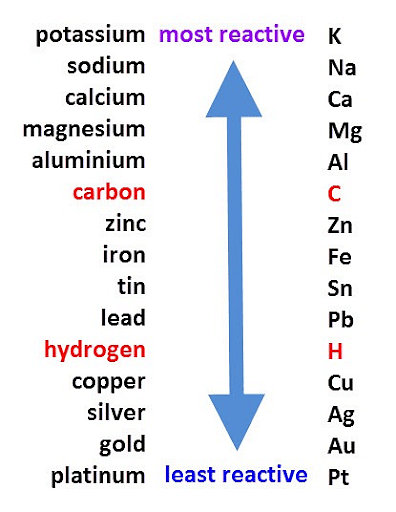
Reactivity Series
Read More:
| Chapter-Related Topics | ||
|---|---|---|
| Metallurgy | Refining of Metals | Non-Metals |
| Minerals | Crystalline Solids | Noble Gases |
| Balanced Chemical Equation | Chemical Reaction | Redox Reaction |
Salient Features of the Reactivity Series
[Click Here for Previous Year Questions]
Here are the salient features of the reactivity series:
- The top of the reactivity series comprises the most reactive elements, which are not available in nature in the free state and the bottom of the series includes the least reactive elements.
- The reducing power of the metals decreases as we move from the top of the table to its bottom. Hence, the upper part of the series contains powerful reducing agents as they are easily oxidized, and corrode easily.
- A metal situated above in the reactivity series (more reactive) can displace the metal placed below it (less reactive) from its compound. For example, Zinc can displace copper from the copper sulfate solution as it is placed above copper and therefore, is more reactive.
The reactivity of Metals chart gives a detailed understanding of the reactivity of different metals with different elements.
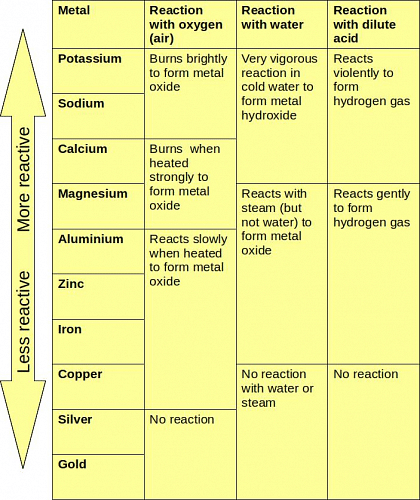
Reactivity of Metals Chart
- The electropositive nature of metals decreases as we move down the series. Hence, sodium is more electropositive than lithium but less electropositive than potassium.
- In addition to electro positivity, the electron-donating ability of the metal also reduces while travelling down the series.
- To isolate the metals from their ores and other compounds, a large amount of energy is consumed for metals at the top of the series.
- The metals situated above hydrogen are more reactive than hydrogen and have the potential to displace hydrogen from water or acids to liberate H2 gas.
Also Read: Difference Between Rust and Corrosion
Long Tabular Form of Reactivity Series
[Click Here for Sample Questions]
The reactivities of metals in the descending order is given below along with their corresponding ions. It must be noted that the metals in Red react with cold water, those in Orange cannot react with cold water but can react with acids, and those in Blue can only react with some strong oxidizing acids.
| Reactivity Series of Metals | Ions Formed |
|---|---|
| Caesium | Cs+ |
| Francium | Fr+ |
| Rubidium | Rb+ |
| Potassium | K+ |
| Sodium | Na+ |
| Lithium | Li+ |
| Barium | Ba2+ |
| Radium | Ra2+ |
| Strontium | Sr2+ |
| Calcium | Ca2+ |
| Magnesium | Mg2+ |
| Beryllium | Be2+ |
| Aluminium | Al3+ |
| Titanium | Ti4+ |
| Manganese | Mn2+ |
| Zinc | Zn2+ |
| Chromium | Cr3+ |
| Iron | Fe3+ |
| Nikel | Ni2+ |
| Tin | Sn2+ |
| Lead | Pb2+ |
| Hydrogen | H+ (Non-Metal, Reference for Comparison) |
| Antimony | Sb3+ |
| Bismuth | Bi3+ |
| Copper | Cu2+ |
| Tungsten | W3+ |
| Mercury | Hg2+ |
| Silver | Ag+ |
| Platinum | Pt4+ |
| Gold | Au3+ |
Uses of the Reactivity Series
[Click Here for Previous Year Questions]
The reactivity series is useful in several ways:
- It allows us to ascertain how the metal will react.
- It is used to predict whether a metal can displace another metal in a single displacement reaction (a reaction in which one element is displaced by another element in a compound).
- It is used to acquire information on the reactivity of the metals toward water and acids.
- It is instrumental in anticipating the outcome of the reactions between metals and certain acids.
Read More: CBSE Class 10 Metals and Non-Metals Important Question
Reaction between Metals and Water
[Click Here for Sample Questions]
The reactivity series is used to anticipate the results of the reaction between metals and water. Metals from potassium to calcium react with cold water to form their respective hydroxides and liberate hydrogen gas.
- Reaction of Potassium with Cold Water: Potassium reacts with cold water to produce potassium hydroxide and hydrogen gas.
K(s) + 2H2O (l) → KOH(aq) + H2 (g)
- Reaction of Calcium with Cold Water: Calcium readily reacts with cold water to form calcium hydroxide and hydrogen gas.
Ca(s) + 2H2O(l) → Ca(OH)2 (aq) + H2(g)
NCERT Solutions For: Class 10 Science Chapter 3 Metals and Non-metals
Reaction between Metals and Acids
[Click Here for Previous Year Questions]
Reactivity Series can help to predict the outcome of the reaction between some metals and certain acids. When acids react with some metals, salt is produced with the liberation of hydrogen gas. This is applicable for the metals from potassium to lead when reacted with sulfuric acid or hydrochloric acid.
Reaction of Magnesium and Sulfuric Acid: When magnesium reacts with sulfuric acid, magnesium sulfate and hydrogen gas are formed as products. The chemical equation is mentioned below.
Mg + H2SO4 → MgSO4 + H2
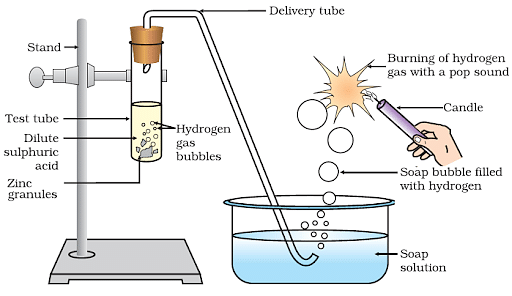
Reaction Between Metals and Acids
Single Displacement Reaction between Metals
[Click Here for Sample Questions]
When a more reactive metal reacts with the solution of a less reactive metal, the less reactive metal is displaced from its salt by the more reactive metal. This type of reaction is called displacement reaction or single displacement reaction.
A1 +B2X → A1X + B2
Where A1 is more reactive, B2 is less reactive and B2X is the salt of B2.
- Reaction of Iron with Copper Sulfate Solution: In this reaction, when an iron nail reacts with copper sulfate solution, it displaces copper and forms iron sulfate.
CuSO4 + Fe → FeSO4 + Cu
- Reaction of Zinc with Copper Sulfate Solution: In this reaction, zinc is more reactive than copper, so it displaces copper from its solution and forms zinc sulfate and copper.
CuSO4 + Zn → ZnSO4 + Cu
Thus, the reactivity series also helps in determining the outcome of the reaction of metals with the solution of other metals or in a single displacement reaction.
Also Read:
Things to Remember
- Reactivity series is an arrangement of metals based on their reactivity with other elements such as water, air, acids, alcohols, etc.
- The reactivity metal chart can be used to determine the reactivity of any metal.
- The reactivity series helps us to predict the rate of reaction.
- When a higher reactive metal reacts with the salt of a lower reactive metal, the higher reactive metal tends to replace the position of the lower reactive metal in the salt solution. This is called a single displacement reaction.
- Potassium and Sodium are considered to be the most reactive metals as per the reactivity series.
- Platinum is considered to be the least reactive metal which has remarkable resistance to corrosion, even at high temperatures, and is therefore considered a noble metal.
Previous Years’ Questions (PYQs)
- The correct order of reactivity of halogens with alkalies is…
- The order of reactivity of phenyl magnesium bromide…
- _______ being highly reactive is used in the extraction of chromium…
- The correct order of reactivity… (MET 2004)
- The correct order of reactivity towards the electrophilic… (NEET 2003)
- The correct increasing order of reactivity for the following…
- The decreasing order of reactivity towards electrophilic…
- Reactivity order of following towards NaOE… (DUET 2006)
- The correct order of reactivity for the addition reaction…
- Which of the following reactions is the metal displacement… (NEET 2021)
Sample Questions
Ques: Give Reason: Reverse of the following chemical reaction is not possible
Zn(s) + CuSO4 (aq) → ZnSO4 (aq) + Cu (s). (3 Marks)
Ans: ZnSO4 (aq) + Cu (s) → × (no reaction)
In the above chemical reaction, no products are formed because Cu is less reactive than Zn in the reactivity series. Therefore, less reactive metal (Cu) does not have the ability to displace more reactive metal (Zn) from its salt solution. Thus, this reaction is not possible.
Ques: You are given samples of three metals. Sodium, magnesium, and copper. Suggest any two activities to arrange them in order of decreasing activity. (3 Marks)
Ans: Activity 1: Reaction with oxygen- Sodium reacts vigorously with oxygen to form sodium oxide, which catches fire when kept open in the air.
Magnesium reacts with oxygen only on heating to form magnesium oxide, while copper does not react even on strong heating. It reacts only if prolonged heat is supplied to it. Hence, the decreasing order of the reactivity series is,
Sodium> Magnesium> Copper
Activity 2: Reaction with water – Sodium reacts vigorously with cold water and results in the formation of sodium hydroxide (NaOH) and hydrogen.
Ques: Magnesium does not react with cold water. However, it reacts rapidly with hot water to form Magnesium hydroxide (Mg(OH)2) and hydrogen. Whereas copper does not react even with steam, which clearly shows that,
Sodium> Magnesium> Copper
Suggest a method of reduction for the following metals during their metallurgical processes:
(i) metal ‘A’ which is one of the last, second, or third positions in the reactivity.
(ii) metal ‘B’ which gives a vigorous reaction even with water and air.
(iii) metal ‘C’ which is kept in the middle of the activity series. (3 Marks)
Ans: (i) ‘A’ can be obtained by chemical reduction using carbon or carbon monoxide as a reducing agent.
(ii) ‘B’ can be obtained by electrolytic reduction.
(iii) ‘C’ can be reduced by reducing agents like ‘Al’.
Ques: (a) Define the activity series of metals. Arrange the metals gold, copper, iron, and magnesium in order of their increase in reactivity.
(b) What will you observe when:
(i) Some zinc pieces are put in a copper sulfate solution.
(ii) Some silver pieces are put into a green-colored ferrous sulfate solution. (2 Marks)
Ans: (a) The series of metals in which metals are arranged in decreasing order of their reactivity.
Au < Cu < Fe < Mg is increasing order of reactivity.
(b) The blue solution will become colorless and reddish-brown copper metal will be deposited.
The reaction will not take place because Ag is less reactive than iron.
Ques: Carbon cannot be used as a reducing agent to obtain Mg from MgO. Why? (1 Mark)
Ans: Because Carbon lies below magnesium in the reactivity series and hence, it is less reactive than Magnesium.
Ques: The way metals like sodium, magnesium, and iron react with air and water is an indication of their relative positions in the ‘reactivity series’. Is this statement true? Justify your answer with examples. (2 Marks)
Answer: Yes, sodium reacts vigorously even with cold water, it is most reactive. Magnesium reacts with hot water, it is less reactive than Na. Iron reacts only with steam which shows it is the least reactive among the three.
Ques: Metal A is added to the salt solution of Metal B. No reaction takes place. What is your observation? (2 Marks)
Ans: No reaction takes place indicating that metal A lies below metal B in the reactivity series. Therefore, it cannot displace metal B from its salt solution.
Ques: X + YSO4 → XSO4+ Y
Y + XSO4 → No reaction
Out of the two elements, ‘X’ and ‘Y’, which is more reactive and why? (2 Marks)
Ans: ‘X’ is more reactive than ‘Y’ because it displaces ‘Y’ from its salt solution
Ques: Arrange the following metals in the decreasing order of reactivity: Na, K, Cu, Ag. (1Mark)
Ques: Which of the following -Zinc, Sliver, and Mercury will liberate Hydrogen gas from dil. HCl? And why? (2 Marks)
Ans: Zinc would be able to liberate hydrogen gas from dil.HCl as it lies above hydrogen and can displace it from its acid. Silver and mercury lie below hydrogen (being less reactive) and do not have the ability to liberate hydrogen from its acid.
Ques: Name the metal which is least reactive. (2 Marks)
Ans: Platinum is the least reactive metal which has remarkable resistance to corrosion, even at high temperatures, and which is why considered a noble metal. Consequently, platinum is often found chemically uncombined as native platinum.
Ques: What is metal reactivity? (2 Marks)
Ans: The reactivity series is a list of metals that is arranged in decreasing order of their reactivity. Most reactive metals lie at the top while the least reactive metals are at the bottom. For any two metals in the series, the metal placed higher in the series can displace lower metals from their salt solution.
Ques: What do you think non-metals are Reactive or non-reactive? (3 Marks)
Ans: Non-metal properties have a comparatively low boiling point, and other non-metals are gases. Similarly, non-metals are poor heat conductors, and solid non-metals are dull and brittle. Many non-metals are strongly reactive. On the other hand, others are in no way reactive which depends on the number of electrons in the outer amount of energy.
Read More:



Comments