



Education Journalist | Study Abroad Lead
Zinc Phosphate is an inorganic chemical compound with the chemical formula Zn3(PO4)2. Zinc Phosphate is also known as Zinc Orthophosphate, Trizinc Phosphate, and Trizinc Diphosphate. This white powder compound is commonly used as a corrosion-resistant coating applied to metal surfaces as part of electroplating or as a primer pigment. One of the oldest and most widely used cements, zinc phosphate dental cement is commonly used for luting permanent metal restorations and as a base for dental restorations. It is made by combining zinc oxide and magnesium oxide powders with a liquid that primarily consists of phosphoric acid, water, and buffers.
| Table of Contents |
Key Terms: Zinc Phosphate, Zinc Oxide, Magnesium Oxide, Zinc Orthophosphate, Crystals, Electroplating, Corrosion, Primer Pigment
What is Zinc Phosphate?
[Click Here for Sample Questions]
Zinc Phosphate, also known as Zinc orthophosphate, Trizinc phosphate, and Trizinc diphosphate, is an inorganic chemical compound. The chemical formula for zinc phosphate is Zn3(PO4)2 and it appears to be a white powder in appearance.

Zinc Phosphate
Do Check Out:
| Important Concepts | ||
|---|---|---|
| Difference between Rust and Corrosion | Atoms & Molecules | Sodium Dichromate |
| Phosphorus Trichloride | Gallium | Chromate |
| Chemical Kinetics | Phosphorous Acid | Sulfuric Acid |
Structure of Zinc Phosphate
[Click Here for Previous Year Questions]
The structure of Zinc Phosphate is as follows:
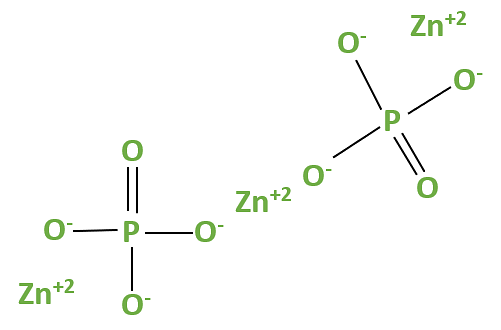
Structure of Zinc Phosphate
Chemical and Physical Properties of Zinc Phosphate
[Click Here for Sample Questions]
The properties of Zinc Phosphate are as follows:
| IUPAC/Chemical Name | Zinc Phosphate |
| Chemical Formula | Zn3(PO4)2 |
| Appearance | Appears like White Crystals/Dry Powder |
| Crystal Structure of Zinc Phosphate | Monoclinic |
| Density | 3.998 g/cm3 |
| Melting Point | 900 °C |
| Molar Mass | 386.11 g/mol |
| Solubility | Insoluble |
| Molecular Formula of Zn3(PO4)2 | O8P2Zn3 |
| Flashpoint of Zinc Phosphate | Non-flammable |
How is Zinc Phosphate Made?
Zinc phosphate is made by combining magnesium oxide and zinc oxide powders in a liquid composed primarily of water, phosphoric acid, and buffers. It is one of the standard types of cement against which to measure. It has the longest track record in dentistry. It is still widely used, but resin-modified glass ionomer cement is more durable and convenient when used in dental settings.
Occurrence of Zinc Phosphate
[Click Here for Sample Questions]
Minerals such as parahopeite and hopeite are examples of different forms of zinc phosphate. Tarbuttite, Zn2(PO4), is a similar mineral (OH).
This mineral is made up of zinc phosphate cement. This cement is commonly used as a foundation for dental restorations. Inlays, crowns, bridges, temporary restorations, and orthodontic devices are all cemented with it. It is created by combining zinc oxide and magnesium oxide powders with a liquid composed of phosphoric acid, water, and buffers.
Read More: Zinc Acetate
Uses of Zinc Phosphate
[Click Here for Previous Year Questions]
Some major uses of Zinc Phosphate are as follows:
- The chemical compound serves as a corrosion inhibitor as well as an anti-scaling agent.
- It is also used in dyes and as a paint additive.
- This compound is also used in primer pigment.
- The compound is also used in agricultural products that are not pesticides.
- It is one of the most well-known and widely used dental cement.
- It is used to cement inlays, crowns, bridges, and orthodontic appliances, as well as as a temporary restoration on occasion.
Read More: Cadmium
Zinc Phosphate Coating
[Click Here for Sample Questions]
We know that Zinc Phosphate is used as a corrosion-resistant coating. It is applied on the metal surfaces for the same. The process of Zinc Phosphate Coating is explained below.

Zinc Phosphate Coating
Thermostatic Cell Coating Process
The phosphating process forms a relatively inert film (Passivation) on the surface of a material, which prevents the external agent from interacting with the metal. By increasing the adhesion of the paint to the metal surface, the chemical reaction is either reduced or completely halted. This will help to prevent corrosion and increase lubrication during the creation or drawing process. It can also serve as a foundation for subsequent coatings or paints.
The thermostatic immersion cell (2) used a phosphating solution to deposit the primary coating on the surface of carbon steel (1). (3). This method produces a primary coating with improved paint adhesion. The phosphating solution flows through a latex tube (4) that is connected to a water bath (5) that is set at various temperatures ranging from 20 to 80 °C by using a regulator (6) to keep the temperature at the required value.
Working of Zinc Phosphate
[Click Here for Sample Questions]
When a person or an animal consumes zinc phosphide, the acid in the stomach causes the toxic gas phosphine to be released. Zinc phosphide baits are particularly dangerous to animals that cannot vomit, such as rabbits, rats, and mice.
The phosphine in the stomach then enters the body cells and prevents them from producing energy, causing the cells to die. Zinc phosphide affects all cells, but it specifically targets cells in the lungs, liver, and even the heart.
Symptoms of Zinc Phosphide Exposure
[Click Here for Previous Year Questions]
Dizziness, headache, breathing difficulties, and vomiting are some of the symptoms of phosphine gas and zinc phosphide exposure. If a person is exposed to too much phosphine, they may experience convulsions, liver and kidney failure, coma, and delirium.
Zinc phosphide has the same effect on animals as it does on humans. Anxiety, retching, and vomiting are all symptoms of poisoning in animals. Additionally, the animals may begin to stagger or lose coordination. Such symptoms could appear as soon as an hour after exposure if the animal's stomach is full, or as late as 12 hours if the stomach is empty. Poisoned dogs' vomit may also contain phosphine.
Read More: Oxoacids of Phosphorus
Things to Remember
[Click Here for Sample Questions]
- Zinc Phosphate (Zn3(PO4)2) is an inorganic chemical compound and is also known as Zinc Orthophosphate, Trizinc Phosphate, and Trizinc Diphosphate.
- It appears to be a white powder and is majorly used as a corrosion-resistant coating applied to metal surfaces as part of electroplating.
- Mixing magnesium oxide and zinc oxide powders yields zinc phosphate. This preparation process also includes a liquid composed primarily of water, phosphoric acid, and buffers.
- Zinc phosphate coatings are mandated in many industries including heavy mining equipment, pipeline and construction, oilfield drilling, exploration and production, refineries and petrochemical, slurry and hydro transport.
- Zinc phosphate is also an important component of zinc orthophosphate hydrate, a water-soluble protective compound. Because of its low solubility, it is highly compatible with both solvent- and water-based resins.
Do Check Out:
Previous Year's Questions
- Which one of the following arrangements represents the correct order of electron gain enthalpy (with negative sign) of the given atomic species?…(NEET 2005)
- Which one of the following ions will be smallest in size?...(NEET 1996)
- Among the following which one has the highest cation to anion size ratio?...(NEET 2010)
- Which one of the following orders is not in accordance with the property stated against it?...(NEET 2006)
- Identify the wrong statement in the following...(NEET 2012)
- If the atomic number of an element is 33, it will be placed in the periodic table in the...(NEET 1993)
- The first ionisation potential (in eV) of Be and B, respectively are...(NEET 1998)
- In the periodic table from left to right in a period, the atomic volume….(NEET 1993)
- One of the characteristic properties of non-metals is that they….(NEET 1993)
- Which electronic configuration of an element has abnormally high difference between second and third ionisation energy?...(NEET 1993)
- With which of the following electronic configuration of an atom has the lowest ionisation enthalpy?...(NEET 2007)
- Identify the correct order of the size of the following….(NEET 2007)
- Correct order of 1st ionisation potential (IP) among following elements Be, B, C, N, O is...(NEET 2001)
Sample Questions
Ques. What is the purpose of zinc phosphate? How is zinc phosphate made for use in dentistry? (3 Marks)
Ans. The substance is primarily used in dental cement, but it is also used to luting permanent metal and zirconium dioxide restorations.
For dentistry, zinc oxide and magnesium oxide powders are combined with a liquid composed of phosphoric acid, water, and buffers.
Ques. (a) How to prepare Zinc Phosphate?
(b) Is Zn3(PO4)2 a permanent cement? (3 Marks)
Ans. (a) Zn3(PO4)2 is prepared by mixing powders of Magnesium oxide (MgO) and Zinc oxide (ZnO) consisting of a liquid principally of water, phosphoric acid, and buffers.
(b)Yes, it is a permanent cement and is considered the standard cement to measure against
Ques. Explain the Physical properties of Zinc Phosphate. (3 Marks)
Ans. The physical properties of Zinc Phosphate are:
- This compound appears in the form of white crystals.
- The molecular weight of Zn3(PO4)2 is 386.11 g/mol.
- The density of Zinc Phosphate is 3.998 g/cm3.
- The melting point of Zinc Phosphate is 900°C.
- It is a non-flammable compound.
Ques. Explain the chemical properties of Zinc Phosphate. (3 Marks)
Ans. The chemical properties of Zinc Phosphate are:
- Zinc Phosphate is insoluble in water.
- It is known to be corrosion resistant. Therefore, the coating is applied on metal surfaces.
- The crystal structure of Zinc Phosphate is monoclinic.
Ques. What are the symptoms of Zinc Phosphate exposure? (3 Marks)
Ans. The most common symptoms are headaches, breathing difficulties, vomiting, and dizziness. Excessive exposure can result in problems such as
- Liver and Kidney Failure
- Coma
- Delirium
Ques. Determine the uses of Zinc Phosphate. (5 Marks)
Ans. The uses of Zinc Phosphate are listed below:
- Zinc phosphate is a chemical that is used in the production of dyes.
- It is used as both a plating agent and a surface treatment agent.
- Zinc phosphate is used to prevent corrosion.
- It is used as a paint additive.
- Water treatment products contain zinc phosphate.
- It works as an anti-scaling agent.
- It is also utilized in the production of rubber products.
Ques. How does Zinc Phosphate protect against corrosion? (3 Marks)
Ans. Zinc phosphate is used as a corrosion-resistant coating because it inhibits the anode process of metal corrosion, improves coating wet adhesion, prevents horizontal diffusion of the corrosive medium into the metal interface, and slows the disbonding of Zinc phosphate coating.
Also check:



Comments