



Education Journalist | Study Abroad Lead
Zinc bromide is an inorganic chemical compound with the formula ZnBr2. It is a white crystalline solid compound. Zinc bromide does not possess any specific odor, it is an odorless compound. Zinc bromide is hygroscopic. It also exists in dihydrate with the chemical formula ZnBr2.2H2O. The other names for zinc bromide are zinc dibromide, dibromozinc, and zinc (II) bromide.
- Zinch bromide formula is ZnBr2.
- The molar mass of zinc bromide is 225.188 g/mol.
- The melting point of zinc bromide is 394℃.
- The boiling point of zinc bromide is 697℃.
Read More: Diatomic Bromine
| Table of Content |
Key Terms: Zinc Bromide, Zinc Bromide Formula, Lewis Acid, Water-Soluble, Electrolyte, Non-flammable.
Zinc Bromide Formula
[Click Here for Sample Questions]
The molecular formula for zinc bromide is ZnBr2. Zinc bromide is prepared by the reaction of zinc oxide with hydrobromic acid. This yields dihydrate zinc bromide. The reaction equation is shown below-
ZnO + 2HBr +H2O → ZnBr2.2H2O
Another method for preparing anhydrous zinc bromide is by the reaction of zinc metal with hydrobromic acid. In this reaction, zinc bromide is prepared along with the release of hydrogen gas. The reaction equation for this reaction is-
ZnO + 2HBr → ZnBr2 + H2
Structure of Zinc Bromide
[Click Here for Previous Year Questions]
Zinc bromide is formed when two ions of bromine atom form bonds with zinc metal ions. Zinc bromide upon crystallization forms four tetrahedral zinc centers and shares three vertices to form a super-tetrahedra form, which are linked by their vertices to form a three-dimensional structure.
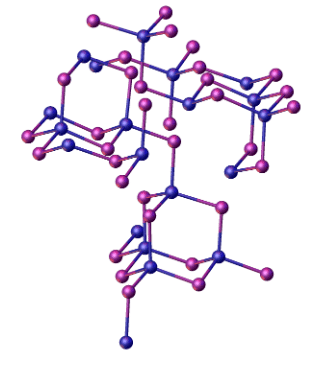
Structure of Zinc Bromide
In gaseous state, according to VSEPR theory zinc bromide has a linear shape.
The bond length between Zn-Br is 221 pm.
Properties of Zinc Bromide
[Click Here for Sample Questions]
The characteristic Properties of Zinc Bromide are-
- It is a white crystalline solid.
- Zinc bromide is a Lewis acid.
- It is non-flammable in nature.
- The compound has a tendency to form acidic solutions.
- The compound has good solubility in organic compounds such as acetone, tetrahydrofuran, and ethanol.
- It is non-combustible.
- It is highly soluble in water.
- The density of zinc bromide is 4.20 g/cm3.
Uses of Zinc Bromide
[Click Here for Previous Year Questions]
The uses of zinc bromide are as follows-
- Zinc bromide is mainly used in the oil industry.
- Zinc bromide batteries use zinc bromide as an electrolyte.
- It is used in chemical reactions as a catalyst to speed up and enhance the reaction.
- It is used in deep-sea drilling to seal the well and to keep the well open over its entire length.
- It is employed in the electrical industry and metalworking companies.
- Zinc bromide in aqueous form is used as a transparent shield against sun radiations. This is usually observed in window panes, hot cells and wherever there are high changes in exposure to radiation.
Things to Remember
- The formula for zinc bromide is ZnBr2.
- The formula for zinc bromide dihydrate is ZnBr2.2H2O.
- Zinc bromide is a lewis acid.
- The compound has a linear shape in its gaseous state.
- The chemical properties of zinc bromide are similar to that of zinc chloride.
- The structural properties of zinc bromide are similar to that of zinc iodide.
- It is highly corrosive.
Read More:
| Relevant Topics | ||
|---|---|---|
| Extraction of Zinc | Zinc Oxide | Zinc Sulfate |
| Bromine | Potassium Bromide | Barium Bromide |
Previous Year Questions
- In the electrolytic refining of Zinc - (KCET-2010)
- Extraction of zinc from zinc blende is achieved by- (JEE Advanced- 2007)
- When the same amount of zinc is treated separately with an excess of sulphuric acid and excess of sodium hydroxide, the ratio of volumes of hydrogen evolved is- (JEE Advanced-1979)
- Which will reduce zinc oxide to zinc?- (BCECE-2006)
- Important ore of zinc is - (AFMC - 2007)
- Reaction of methyl bromide with aqueous sodium hydroxide involves- (KCET - 2010)
- Solubility product of silver bromide is- (AIEEE-2010)
- Bromine can be liberated from potassium bromide solution by the action of– (JEE Advanced - 1987)
Sample Questions
Ques. What is the molecular formula for zinc bromide? (1 mark)
Ans. The molecular formula for zinc bromide is ZnBr2. zinc bromide is an odorless white crystalline solid compound.
Ques. Is zinc bromide water soluble? (1 mark)
Ans. Zinc Bromine is a hygroscopic compound which means it has high water solubility. Zinc bromide is also soluble in organic solvents such as acetone, ether, and alcohol.
Ques. Is zinc bromide hazardous? (3 marks)
Ans. Zinc bromide is a hazardous compound. Exposure to zinc bromide can cause headaches, and personality changes like depression, poor appetite, lethargy, and confusion. Repeated exposure, it can cause skin damage. Extreme exposure can irritate the lungs and repeated exposure can lead to bronchitis along with cough, phlegm, and shortness of breath.
Ques. Is zinc bromide a Lewis acid? (3 marks)
Ans. Zinc bromide, in an aqueous solution, is an electron-deficient species and thus is a Lewis acid. This means that zinc bromide has empty orbitals and readily accepts lone pair of electrons from Lewis bases. Zinc bromide is also highly corrosive.
Ques. What is the structure of zinc bromide? (3 marks)
Ans. Zinc bromide upon crystallization, attains a super-tetrahedra form. Four zinc centers bond to form a tetrahedral structure and share three vertices. These are interlinked structures and make a 3-D structure. In a gaseous state, zinc bromide follows VSEPR theory and has a linear shape like Br-Zn-Br. The bond length between these bonds is 221pm.
Ques. Suppose 18.2G of zinc bromide is dissolved in 150. mL of a 0.80 M aqueous solution of potassium carbonate. Assume the volume of the solution doesn't change when the zinc bromide is dissolved in it. What's the final molarity of zinc cation in the solution? (5 marks)
Ans. Zinc bromide will react with the potassium carbonate solution to produce a zinc carbonate precipitate and aqueous potassium bromide.
ZnBr2(aq) + K2CO3(aq) → ZnCO3(s) + 2KBr(aq)
The net ionic equation is-
Zn+2(aq) + CO32-(aq) → ZnCO3(s)
ZnCO3 is a precipitate, it has low solubility Ksp= 1.46*10-10
Ksp=[Zn2+][(CO3)2-]
Now, determine if excess zinc or carbonate ions are left after the reaction is complete because excess ions will decrease the solubility of zinc carbonate.
n(ZnBr2)=m/M=18.2g/225.198gmol-1 = 0.081 moles
Adding 0.081moles of Zn2+, we get,
n(K2CO3) = CV = (0.80M)(0.150L) = 0.12moles
We have O.12 moles of (CO3)2-
The two ions react in a 1:1 ratio, there are excess carbonate ions left after all ions zinc ions have reacted.
Excess (CO3)2-= 0.12moles - 0.081moles = O.040moles
So, the[(CO3)2-]= n/V = 0.040moles/0.150L = 0.27M
Now,
Ksp = [Zn2+][(CO3)2-]
1.46 x 10-10 = [Zn2+](0.27)
[Zn2+] = 5.4 x 10⁻¹⁰ M
For Latest Updates on Upcoming Board Exams, Click Here: https://t.me/class_10_12_board_updates
Check-Out:



Comments