



Education Content Expert
Acetone is a colorless liquid solvent that can dissolve or break down materials such as paint or grease.
- Acetone is the simplest and most important aliphatic ketone.
- The chemical formula of Acetone is C3H6O.
- It is also known as dimethyl ketone, 2-propanone, propanone, and beta-ketopropane.
- Pure acetone is an aromatic and flammable organic compound that evaporates quickly into the air.
- It is naturally present in trees, tobacco smoke, vehicle exhaust, and landfills.
- Acetone is used in the manufacturing of artificial fibers and explosives.
| Table of Content |
Key Terms: Acetone, Ketone, Solvent, Propanone, Dimethyl Ketone, Human Body, Keto-enol Tautomerism, Benzene, Cumene Process, Fats, resins, cellulose ethers, cellulose acetate, nitrocellulose
What is Acetone?
[Click Here for Sample Questions]
Acetone is the simplest and smallest of the ketone family with the chemical formula C3H6O.
- It is a colorless, highly combustible liquid with an unpleasant odor.
- Acetone can dissolve fats, resins, cellulose ethers, cellulose acetate, nitrocellulose, and other cellulose esters.
- Acetone is produced and eliminated by the natural metabolic processes of the human body.
- It is commonly found in the blood and urine.
- Acetone is a widely used solvent in the manufacture of plastics and other industrial goods.
- It is also found in a few domestic products, such as cosmetics and personal care items, with nail paint removers being the most common use.
Read More:
Structure of Acetone
[Click Here for Previous Year Questions]
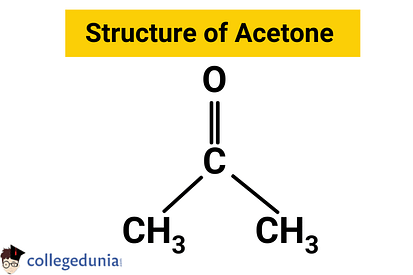
Acetone chemical formula is given as C3H6O. It can also be written as (CH3)2CO.
- One molecule of Acetone consists of three carbon atoms, six hydrogen atoms, and one oxygen atom.
- In acetone, the structural arrangement of these atoms consists of two methyl groups (CH3) attached on either side of a central carbon atom.
- The carbon atom in the middle is also double-bonded with an oxygen atom forming a carbonyl or ketone functional group.
The structure of Acetone is given as follows:
Properties of Acetone
[Click Here for Sample Questions]
The important properties of Acetone are specified below:
| Properties of Acetone | |
|---|---|
| Chemical Formula | C3H6O |
| Molecular Weight/ Molar Mass | 58.08 g/mol |
| Boiling Point | 56℃ |
| Melting Point | -94.7 ℃ |
| Density | 0.7845 g/cm3 |
| Appearance | Colorless Liquid |
Preparation of Acetone
[Click Here for Previous Year Questions]
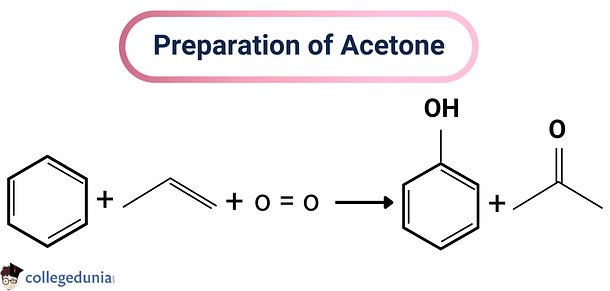
Acetone is an organic compound produced from the raw material of propylene and benzene.
- Around 83% of acetone in the industry is produced by the Cumene Process.
- During the cumene process, benzene is alkylated with propylene in order to produce cumene.
- It is then oxidized by air to produce phenol and acetone.
- At last, acetone and phenol are separated using distillation.
Chemical Properties of Acetone
[Click Here for Sample Questions]
Acetone is a member of the family of organic compounds called Ketones. It undergoes several chemical reactions due to its structural properties. Here are a few important chemical properties of Acetone:
Keto-enol Tautomerism
- Acetone, like most ketones, has keto-enol tautomerism, which means that the enol isomer (CH3)C(OH)=(CH2) is in equilibrium with the nominal keto structure (CH3)2C=O).
- At ambient temperature, just 2.4107% of the molecules in acetone vapor are in the enol form.
- The enol form is critical in several chemical reactions.

Haloform Reaction
Acetone undergoes a haloform reaction in the presence of the CH3-C=O group. It reacts with halogen in presence of alkali in order to form haloform and acid salt.

Uses of Acetone
[Click Here for Previous Year Questions]
Acetone is used in numerous industrial processes as a solvent and acetylene carrier, used for cleaning, chemical research, etc. Acetone is used in small amounts to create products that break down or dissolve substances such as
- Nail Polish
- Paint
- Varnish
Acetone is also used for a variety of purposes in the industrial setup such as
- It is used for removing grease or gum from textiles such as wool and silk.
- Used for making lacquers for cars or furniture.
- It is also utilized in making plastics.
A few other important uses of Acetone are as follows:
- Acetone is used as a precursor for methyl methacrylate.
- It is used in some drugs in the pharmaceutical industry.
- It is also used to rinse lab glassware in laboratories.
Health Hazards of Acetone
[Click Here for Sample Questions]
Though Acetone is not that toxic for humans in small amounts, however, there are several risk factors associated with this compound:
- Acetone is a highly flammable compound that has low acute and chronic toxicity.
- It can cause a sore throat or cough on inhalation of small amounts.
- Inhaling moderate to high amounts of acetone can irritate our nose, throat, lungs, and eyes.
- It can also lead to headaches, dizziness, confusion, nausea, vomiting, effects on the blood, passing out, shorter menstrual cycle in women, and possible coma.
Things to Remember
- Acetone is a colorless volatile liquid with the chemical formula C3H6O.
- It is the simplest ketone also known as propanone and dimethyl ketone.
- Acetone is miscible in water, ethanol, and ether and has a pungent, floral, or irritating smell.
- It is an organic compound that contains hydrogen, oxygen, and carbon atoms.
- Acetone is produced from the raw material of propylene and benzene.
- It is used in various applications in the pharmaceutical industry, cosmetics, laboratory, and domestic purposes.
Check More:
Previous Year Questions
- Give IUPAC name of Acetone…
- Acetone and Propanal are… (KCET 2013)
- A mixture of acetone (b.p. 56∘) and methanol…
- When acetone reacts with bleaching powder, the compound… (JIPMER 2001)
- Which of the following is the process used for the… (BITSAT 2012)
- MgBr2 and Mgl2 are soluble in acetone because of…
- Aldehydes can be distinguished from ketones…
- Aldehydes or ketones when treated with… (MHT CET 2017)
- Which of the following ketones will not respond to iodoform… (BITSAT 2007)
- The number of isomers ketones with formula…
Sample Questions
Ques 1. What are the other names of Acetone? (2 Marks)
Ans. The various other popular names of Acetone are:
- Dimethyl ketone
- 2-propanone
- Propanone
- Beta-ketopropane
Ques 2. Explain the production of Acetone. (2 Marks)
Ans. Acetone can be produced from propylene, directly or indirectly. Around 83% of the global acetone production is through the cumene cycle. Benzene is alkylated with propylene in the cumene cycle to produce cumene, which in turn is oxidized to create phenol and acetone. Lastly, phenol and acetone are separated using distillation.
Ques 3. Is Acetone toxic for humans? (2 Marks)
Ans. Acetone can irritate the skin if inhaled or in contact for a short period of time. It can irritate the eyes, nose, throat, or lungs causing
- Irritated Eyes
- Sore Throat
- Cough
- Headache
- Dizziness
Severe exposure to acetone can also cause damage to the nervous system or unconsciousness.
Ques 4. Where is Acetone found apart from the human body and laboratories? (2 Marks)
Ans. Acetone is a chemical compound that can be found in nature and many household items. Apart from the human body, it is found in the following places or items:
- Volcanoes
- Trees and Plants
- Forest Fires
- Landfills
- Tobacco
- Car Exhaust
Ques 5. Acetone is primarily used for
(a) Liquid nail polish constituent
(b) Extraction of essential oils
(c) Both a and b
(d) None of the above (1 Mark)
Ans. (c) Both a and b
Acetone is used for the extraction of essential oils and it is also a constituent of liquid nail polish.
Ques 6. What is the condensed structural formula of Acetone? (2 Marks)
Ans. Acetone has the chemical formula CH3COCH3. The condensed formula of Acetone is C3H6O. It is the simplest ketone, consisting of a three-carbon chain with two hydrogen atoms from the second carbon replaced by an oxygen double-bound by a carbon atom.
Ques 7. Give the chemical formula and organic formula for Acetone. (2 Marks)
Ans. The chemical and organic formula of Acetone is as follows:
- Chemical Formula of Acetone: C3H6O
- Organic Formula of Acetone: (CH3)2O
Ques 8. Where can we find Acetone in our daily lives? (2 Marks)
Ans. Acetone can be found in the following places and items in our daily lives:
- Nail Paint Remover
- Cosmetics
- Household Cleaner
- Medicines and Pharmaceuticals
- Furniture Shops
Ques 9. Name the state of Acetone. (2 Marks)
Ans. Acetone is Liquid. Acetone is a colorless liquid that evaporates easily. It is an organic compound because carbon atoms are present in acetone's chemical formula, which is (CH3)2O. It consists of three carbon atoms, six hydrogen atoms, and one oxygen atom.
Ques 10. Is acetone acidic or basic? Explain. (2 Marks)
Ans. Acetone is weakly acidic, with a pKa of about 19. The lower the pKa of an acid, the stronger the acid. Its alpha carbon can get deprotonated by a strong base such as NaOH to form an enolate. This enolate can be used to form new carbon-carbon bonds in the synthesis.
Ques 11. Describe the physical and chemical properties of acetone. (5 Marks)
Ans. The physical and chemical properties of acetone are specified below:
Physical Properties of Acetone
The physical properties of acetone are:
- Appearance of Acetone: Colorless Liquid
- Taste of Acetone: Sweet
- Odor of Acetone: Fruity, Irritating
- Solubility of Acetone: Benzene, Methanol, Ethanol, Diethyl ether, Miscible with Water and Chloroform
Chemical Properties of Acetone
The chemical properties of acetone are:
- Molecular Weight of Acetone: 58.08 g/mol
- Acidity of Acetone: 9.2 pKa
- Basicity of Acetone: -5.2 for Conjugate Base
- Refractive Index of Acetone: 1.35 nD
Ques 12. What happens if a human consumes acetone? (2 Marks)
Ans. A small amount of acetone can be digested and naturally excreted. However, drinking acetone causes toxicity levels in the body. This can cause a severe adverse reaction, called acetone poisoning, which will require medical treatment.
Ques 13. How many functional groups does acetone have? (2 Marks)
Ans. Acetone comes under the classification of ketones, which are organic compounds containing a carbonyl group bonded to two hydrocarbon groups. Acetone has a carbonyl group, where carbon and oxygen are bonded to each other with a double bond, and is known as the simplest ketone.
For Latest Updates on Upcoming Board Exams, Click Here:https://t.me/class_10_12_board_updates
Check-Out:



Comments