



Content Curator
Diatomic bromine(Br2) is a molecule formed by two bromine atoms combined. It is a reddish-brown-colored liquid at room temperature and is very volatile. It releases dense red colour vapours which are very toxic for the mucous membrane. Bromine belongs to the P block of the periodic table and is a part of a group of elements called halogens. The highly reactive element lacks only one electron to become a stable noble gas configuration. It is found rarely in certain parts of the world. It has many uses in chemical industries.
Read Also: Some Basic Concepts of Chemistry
| Table of Content |
Key Takeaways: Diatomic bromine, Halogens, Bromine, p-Block, group 17
Bromine (Br) in the periodic table
[Click Here for Sample Questions]
Bromine belongs to the p block of the periodic table, in group 17 called the halogens. Along with other elements like Fluorine, chlorine, iodine, and astatine, Bromine is a highly reactive nonmetal element. Bromine, like other elements in the group, is available in the form of salts and shows similarities to groups 1 and 2 of the periodic table.
Check Important Notes for Significant Figures
Diatomic Bromine (Br2)
[Click Here for Sample Questions]
When two atoms of bromine Br-Br combine and make covalent bonds to come in a stable form, they make Br2. Bromine has one less electron than a noble gas and hence to combine to get one electron for its stability it is so volatile. Two Bromine atoms share their electrons and make a stable compound of Br2. It is in a liquid state at room temperature, highly toxic and volatile. Bromine-79 and Bromine-81, 79 and 81 being the atomic mass, mixed to make natural bromine.
It was discovered by a French chemist, Antoine J. Ballard in 1826. It is sold in the form of salts because it is not only a challenging process to produce but also very expensive. Bromine is a rare element, found in nature only in the form of compounds such as soluble or insoluble bromides. Natural salt deposits and brines are the main sources, produced by the US, Israel, Jordan, and China. Other bromine-producing countries also include Japan, Ukraine, and India.
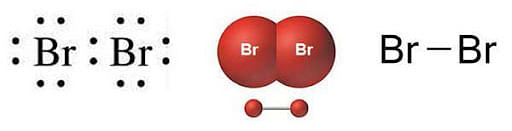
Diatomic Bromine (Br2)
Read More: Phosphorous Trichloride
Properties of Diatomic Bromine
[Click Here for Sample Questions]
Following are the Physical and Chemical Properties of Diatomic Bromine:
Physical Properties of Bromine:
Bromine has various physical properties which indicate its presence if there is no labelling on it. It has a red colour and is a dense liquid state. It is non-metallic and heavy. Bromine quickly evaporates at room temperature due to its liquid state into a very pungent-smelling gas which is three times denser than water.
Following are the physical properties of Bromine:
- Atomic number: 35
- Atomic mass/ g mol–1: 79.90
- Electronic configuration: [Ar]3d104s2 4p 5
- Covalent radius/pm: 114
- Ionic radius X – /pm: 196
- Ionisation enthalpy/kJ mol–1: 1142
- Electron gain enthalpy/kJ mol–1: –325
- Electronegativity: 3.0
- Melting point/ K: 265.8
- Boiling point/ K: 332.5
- Density/g cm–3 : 3.19(273)c
- Distance X – X/pm: 228
- Bond dissociation enthalpy /(kJ mol–1) : 192.8
- E V /Ve: 1.09
- Odour: Unpleasant
- Appearance: Reddish-brown liquid and gas at room temperature
- Covalently-Bonded Unit: 1
- Heavy atom Count: 2
- Solubility in water: 0.33 mg/ml
Also Read:
Chemical Properties of Bromine
As a halogen, bromine represents a less reactive halogen than its halogen cousins, but it is more reactive than iodine, another halogen belonging to the same group. It reacts with many metals, such as potassium. Human skin is highly sensitive to bromine, which causes severe burns when directly in contact with it. It creates a thick, brown smoke when exposed to air.
Some chemical reactions of Diatomic bromine are:
- Bromine is reacted with sodium carbonate to form sodium bromide, carbon dioxide, and sodium bromate.
3Br2 + 3Na2CO3 → 5NaBr + NaBrO3 + 3CO2
- Bromine reacts with water to form Hypobromous acid and hydrogen bromide.
Br2 + H2O → HBr + HBrO
- Bromine readily accepts an electron to achieve stability, which is why it is such a strong oxidizing agent. Halogens oxidise halide ions of higher atomic numbers.
F2 + 2X- → 2F– + X2 (X = Cl, Br or I)
Cl2 + 2X- → 2Cl– + X2 (X = Br or I)
Br2 + 2I- → 2Br– + I2
- Halogens react with Hydrogen to form hydrogen halides. These hydrogen halides can dissolve in water to form hydrohalic acids. These substances are acidic, HBr being more acidic than HCl and HF.
- The bromine oxides are the least stable halogen oxides. BrO2, Br2O, BrO2. They exist only at very low temperatures and are very powerful oxidizing agents.
- Bromine reacts with metals to form metal bromide. Bromine reacts with the alkali metals explosively along with phosphorus, arsenic, aluminium, and antimony.
Mg + Br2→ MgBr2
- Halogens react with other halogens to form compounds known as interhalogens of the types XX ′, XX3 ′, XX5 ′, and XX7 ′ where X is a larger size halogen and X′ is smaller size halogen.
For example, BrCl, IBr3, BrF5, IBr7
Check Also: Pinacol Pinacolone Rearrangement
Uses of Diatomic Bromine
[Click Here for Sample Questions]
Bromine is commercially used with 0.3 percent of chlorine component and is stored in glass bottles or barrels coated with lead or monel metal.
Br2 is used in various ways mentioned below:
- Silver bromide (AgBr) is an important component in photographic films as it is light-sensitive.
- KBr03 potassium bromate is used in wheat flour for a better baking process.
- Hydrogen Bromide makes for a great catalyst in organic reactions due to its reducing properties and colourless gas appearance.
- Compounds with 32% bromine components are used in spray bounded textile coatings, adhesives, fibres.
- Ethylene bromide is a vital compound in destroying nematodes and other pests. It is used in fire retardants.
- It is used in dyes, and compounds tetrabromoethane and bromoform are used as liquids in the gauges as they have a very high specific gravity.
- It is used for production and analysing Organic Compounds.
- It is used in water purifying compounds
Also Check:
Health effects of Diatomic Bromine
[Click Here for Sample Questions]
Bromine is highly toxic to human tissues in the liquid state and the harmful vapours irritate the eyes and throat. One must not inhale as it can be highly toxic to the human body. Organic bromine is absorbed by the skin during breathing and eating. They are poisonous to all animals as a result they are used in killing insects and pests. The more serious health problem caused by organic bromine or compounds containing organic bromine is related to the nervous system breaking down and genetic disorders which can continue for generations. It also damages our important organs such as the liver, kidneys and lungs causing some serious malfunctions in the body. It may even cause cancer.
Environmental effects of Diatomic Bromine
[Click Here for Sample Questions]
Organic bromines are highly toxic to the environment. It is believed it affects the ozone layer 40-100 times more than chlorine. It has had a significant role in the depletion of the ozone layer above Antarctica. It is used to kill microorganisms and as a result, used in disinfectants. Use in farmland affects fishes and other animals by mixing in the surface water. Like humans, Bromine and its compounds adversely affect mammals largely damaging the nervous systems and leaving genetic malfunctions causing cancer. Organic bromines are usually found with inorganic bromines which are non-biodegradable and have heavy health effects.
Also Read More:
Points to Remember
[Click Here for Sample Questions]
Following are some important points:
- Diatomic Bromine (Br2) is formed from two Bromine atoms combining to share one of their electrons to form a stable compound.
- Bromine belongs to group 17 of the periodic table and is a halogen along with fluorine, chlorine, iodine, and astatine.
- Bromine readily reacts with alkali metals and potassium, magnesium, etc in a very explosive manner.
- It is a reddish-brown liquid and room temperature and evaporates quickly into very dense brown vapours which are highly toxic for humans to inhale causing some bodily malfunctions and throat irritations.
- It is used in various industries like oil and gasoline, making pesticides, as a catalyst in organic reactions, etc.
Sample Questions
Ques: In the liquid state of bromine, it only exists as Br2 and not as a singular Br atom. Explain. (2 Marks)
Ans: Liquid state bromine is a diatomic molecule because the energy of the system is lower in a stable compound rather than two isolated bromine atoms. This causes greater stability for the compound. When halogens are in their diatomic form it indicates that they have formed a covalent bond sharing their one lost electron, filling their valence electrons shell to 8, which is much more stable. While in the gaseous state bromine atoms can remain as autonomous bodies as they have enough energy to sustain. Hence in a liquid state, only Br2 exists and Br atoms cannot.
Ques: How can you prepare bromine water or bromine solution? (2 Marks)
Ans: Bromine water is a reddish-brown mixture prepared by mixing diatomic bromine(Br2)and water(H2O). It has a molecular weight of 159.81. It can be prepared in the lab by mixing bromine fumes with water, however, it is too toxic and can be dangerous if not done with precaution. So instead of this, you can break sodium bromide(NaBr) in the presence of bleach and hydrochloric acid.
Ques: Why is BrCI more reactive than Br2? (2 Marks)
Ans: In general, interhalogen compounds are more reactive than halogens due to weaker X-X’ bonding than X-X bonds. Thus, BrCI is more reactive than Br2. Halogens react with other halogens to form compounds known as interhalogens of the types XX ′, XX3 ′, XX5 ′, and XX7 ′ where X is a larger size halogen and X′ is smaller size halogen.
Ques: Why are halogens coloured? (2 Marks)
Ans: The halogens are coloured because their molecules absorb light in the visible region. Electrons in halogens get very excited with higher energy levels due to the remaining particles in it. This would give a transmitted remaining light. That’s why, the colour of halogens is the same as the colour of a transmitted light.
Ques: Arrange the following in increasing bond therapy F2 , Cl2 , Br2 , I2. (2 Marks)
Ans: Bond dissociation enthalpy decreases as the bond distance increases from F2 to I2 due to increasing in the size of the atom, on moving from F to I. F – F bond dissociation enthalpy is smaller than the Cl – Cl and even smaller than Br – Br. This is because the F atom is very small and has large electron-electron repulsion among the lone pairs of electrons in the F2 molecule where they are much closer to each other than in the case of Cl2. The increasing order of bond dissociation enthalpy is I, < F2 < Br2 < Cl2
Ques: Give the formula and describe the structure of a noble gas species which is isostructural with IBr2– and Br03–. (2 Marks)
Ans: IBr2–: In IBr2–, the central atom has eight electrons. Two of these are utilised in forming two single bonds with two Br atoms. Six remaining electrons constitute three lone pairs. It is arranged in a linear structure.

IBr2– has 22 valence electrons. A noble gas species having 22 valence electrons is XeF2 (8+2 x 7=22). XeF2 is also linear. In Br03– ion the central Br atom has 8 valence electrons (7 +1). Out of these, it shares 4 with two atoms of O forming Br = O bonds. The remaining 2 electrons constitute one lone pair. In order to minimise the force of repulsion, the structure of Br03– ions must be pyramidal. Br03– ion has (7 + 3 x 6 + 1) = 26 valence electrons and is isoelectronic as well as iso-structural with noble gas species Xe03 which has also 26(8 + 3 x 6) electrons.

Ques: How does Bromine affect cattle and cows? (2 Marks)
Ans: Cattle after ingesting such doped food can transfer diseases to humans and have to be killed if found with bromine in their bodies. You can deduce the presence of bromine from liver or nerve damage, less production of milk, and even malformed calves.



Comments