



| Updated On - Jul 30, 2026
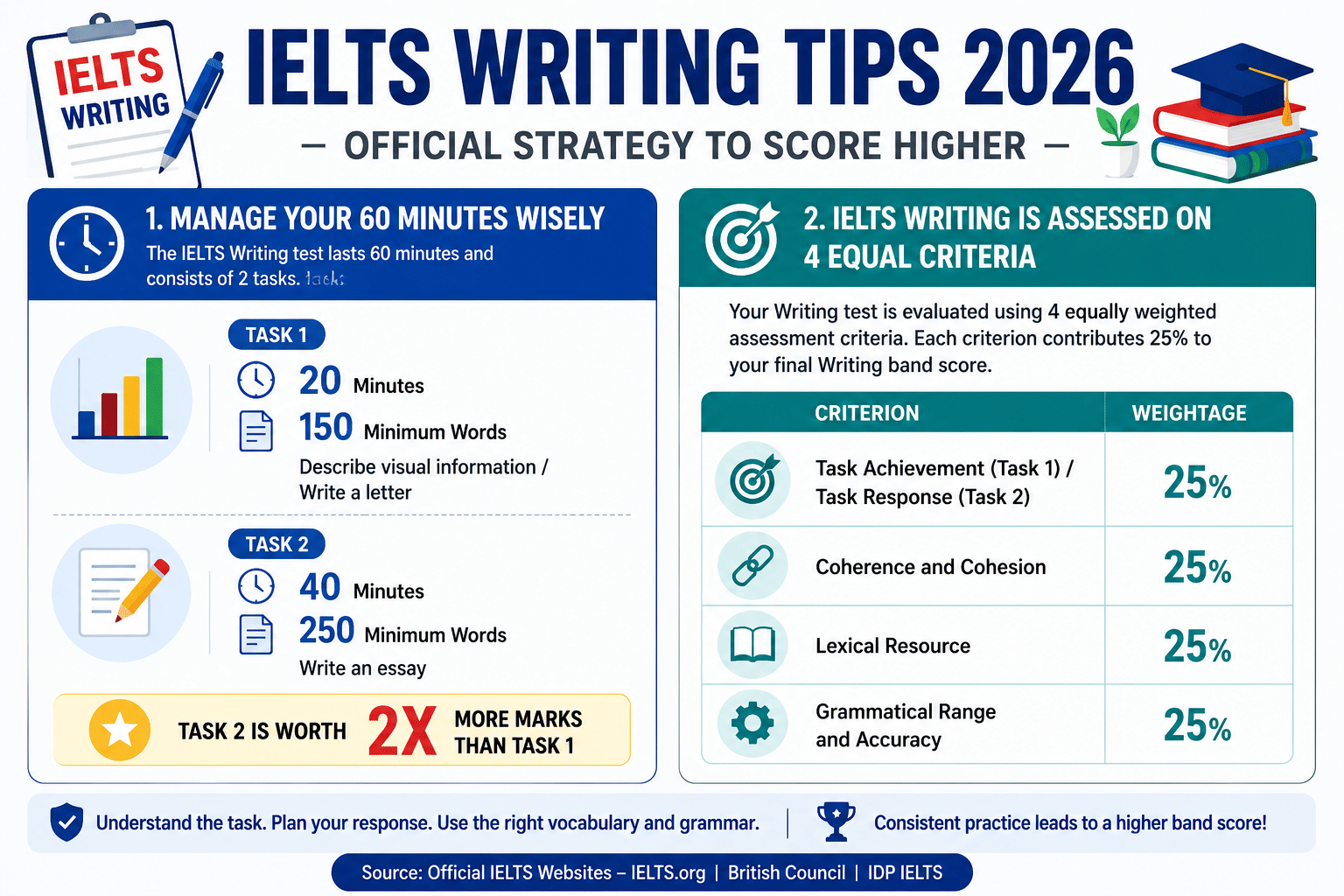
IELTS Writing task is divided into 2 parts, Task 1, which is 20 minutes long, and Task 2, which is 40 minutes long. In Task 1, applicants need to describe the given graph in 150 words, and in Task 2, applicants need to write an essay in 250 words.
Applicants need to break the given time for the 2 task effectively to strategise their content and use excellent vocabulary to get good IELTS scores. Applicants also need to maintain grammar, as it is the basic and core area of the IELTS exam.
Also read: What is a Good IELTS Score to Study Abroad in 2026
- What Makes IELTS Writing Difficult?
- IELTS Writing Test Pattern 2026
2.1 IELTS Academic Writing Pattern
2.2 IELTS General Training Writing Pattern
- IELTS Writing Task 1 Tips 2026
- IELTS Writing Task 2 Tips 2026
- IELTS Writing Band Descriptors Explained
- How is IELTS Writing Evaluated in 2026?
6.1 Weightage of Each Writing Assessment Criterion
- IELTS Writing Common Mistakes and Solutions 2026
- IELTS Writing Vocabulary and Grammar Tips 2026
- Time Management Tips for IELTS Writing 2026
9.1 IELTS Writing Quick Time Management Tips
- FAQs
What Makes IELTS Writing Difficult?
The IELTS Writing test is considered one of the most challenging sections because candidates are assessed on multiple language skills simultaneously. Unlike Listening and Reading, there are no objectively correct answers.
Trained IELTS examiners evaluate your responses against 4 assessment criteria. Candidates must understand the task, organize ideas logically, use a wide range of vocabulary accurately, and demonstrate grammatical control within a limited time.
Some factors that make the Writing test challenging include:
- Completing two writing tasks within 60 minutes
- Writing in a formal and coherent style
- Meeting the minimum word count for each task
- Addressing every part of the question
- Using appropriate vocabulary and grammar throughout the response
- Managing time effectively, as Task 2 carries more weight than Task 1
The IELTS partners also state that candidates should write connected sentences rather than notes or bullet points, and responses that do not address the task requirements may receive lower IELTS scores.
IELTS Writing Test Pattern 2026
The IELTS Writing test lasts 60 minutes and consists of two tasks. While the duration and word count remain the same for both IELTS Academic and IELTS General Training, the type of questions in Task 1 differs. In both test types, Task 2 contributes twice as much to the final Writing band score as Task 1.
IELTS Academic Writing Pattern
| Feature | Details |
|---|---|
| Total Duration | 60 minutes |
| Number of Tasks | 2 |
| Task 1 | Describe visual information such as a graph, chart, table, process, map, or diagram |
| Task 2 | Write an essay in response to a point of view, argument, or problem |
| Recommended Time | Task 1: 20 minutes; Task 2: 40 minutes |
| Minimum Word Count | Task 1: 150 words; Task 2: 250 words |
| Score Weightage | Task 2 is worth twice as much as Task 1 |
IELTS General Training Writing Pattern
| Feature | Details |
|---|---|
| Total Duration | 60 minutes |
| Number of Tasks | 2 |
| Task 1 | Write a formal, semi-formal, or informal letter based on the given situation |
| Task 2 | Write an essay expressing your opinion or discussing an issue |
| Recommended Time | Task 1: 20 minutes; Task 2: 40 minutes |
| Minimum Word Count | Task 1: 150 words; Task 2: 250 words |
| Score Weightage | Task 2 is worth twice as much as Task 1 |
IELTS Writing Task 1 Tips 2026
Task 1 requires candidates to write at least 150 words in about 20 minutes. In the Academic test, candidates summarize visual information, while in the General Training test, they write a letter. The following are IELTS Writing Task 1 tips:
- Understand the task before writing: Spend the first minute identifying exactly what the question asks. For Academic Writing, determine whether the visual is a graph, table, process, or map. For General Training, identify the purpose and tone of the letter.
- Write an effective introduction: Paraphrase the question instead of copying it word for word. A clear introduction immediately tells the examiner what the response will discuss.
- Highlight the main features: Focus on the most important trends, comparisons, or stages instead of describing every detail. Examiners reward candidates who summarize key information effectively.
- Use logical paragraphs: Organize your response into clear sections such as an introduction, overview, and supporting details. Well-structured paragraphs improve readability and coherence.
- Avoid personal opinions: Academic Task 1 is a factual report. Do not include opinions or assumptions that are not supported by the given visual information.
- Use an appropriate tone: Match the tone of the letter to the situation. Formal letters require professional language, while informal letters can be more conversational.
- Meet the minimum word count: Write at least 150 words. Responses that are too short may not fully address the task and can lose marks under Task Achievement.
- Leave time to proofread: Spend the final 2-3 minutes checking grammar, spelling, punctuation, and missing words. Small corrections can improve your Grammatical Range and Accuracy score.
IELTS Writing Task 2 Tips 2026
Task 2 requires candidates to write at least 250 words within approximately 40 minutes. Since this task carries twice the weight of Task 1, candidates should devote more time to planning and developing their ideas. Follow the tips below to score well in IELTS Writing Task 2
- Understand the essay question carefully: Read the prompt more than once and identify the essay type before you begin. Ensure you answer every part of the question throughout your response.
- Spend time planning your ideas: Use the first few minutes to organize your ideas and decide the structure of your essay. A clear plan helps you write more logically and avoid repetition.
- Present a clear position: State your opinion or main argument in the introduction and maintain it consistently throughout the essay. Avoid changing your viewpoint midway.
- Develop each idea fully: Support every main point with explanations, examples, or reasons. Well-developed ideas score higher than multiple undeveloped points.
- Write clear body paragraphs: Each paragraph should discuss one central idea. Use logical transitions to connect paragraphs and improve cohesion.
- Use formal academic language: Avoid contractions, slang, and informal expressions. Use vocabulary that is appropriate for an academic essay.
- Focus on accuracy rather than difficult words: Examiners reward vocabulary that is accurate and appropriate. Using complex words incorrectly may lower your Lexical Resource score.
- Review before submitting: Reserve a few minutes to check grammar, punctuation, spelling, and whether every part of the question has been answered.
Also read: Check IELTS Writing Practice Topics
IELTS Writing Band Descriptors Explained
The IELTS Writing Band Descriptors are the scoring criteria used by certified IELTS examiners to assess every Writing response. Rather than judging only grammar or vocabulary, examiners evaluate your performance across four equally weighted assessment criteria, each contributing 25% to your Writing band score.
| Assessment Criterion | What the Examiner Looks For |
|---|---|
| Task Achievement (Task 1) | Whether you have covered all parts of the task, presented the key features accurately, and supported your information appropriately. |
| Task Response (Task 2) | Whether you answer every part of the essay question, present a clear position, and develop your ideas with relevant explanations and examples. |
| Coherence and Cohesion | Logical organization of ideas, effective paragraphing, and appropriate use of linking words without overusing them. |
| Lexical Resource | A wide and accurate range of vocabulary with correct word choice, spelling, and natural collocations. |
| Grammatical Range and Accuracy | Variety of sentence structures, grammatical correctness, punctuation, and overall control of written English. |
How is IELTS Writing Evaluated in 2026?
Every IELTS Writing response is assessed by a certified IELTS examiner using the official Band Descriptors. Each task is marked independently, after which the scores are combined to produce your overall Writing band score. Since Task 2 is worth twice as much as Task 1, strong performance in the essay has a greater impact on your final score.
| Assessment Stage | How It Is Evaluated |
|---|---|
| Evaluate Task 1 | The examiner checks whether you have completed the task, summarized or responded appropriately, and met the minimum word count. |
| Evaluate Task 2 | Your essay is assessed for relevance, idea development, organization, vocabulary, and grammar. |
| Apply Four Assessment Criteria | Both tasks are marked using the official criteria: Task Achievement/Response, Coherence & Cohesion, Lexical Resource, and Grammatical Range & Accuracy. |
| Calculate Overall Writing Score | Task 2 contributes twice as much as Task 1 when calculating the final Writing band score. |
Weightage of Each Writing Assessment Criterion
| Criterion | Weightage |
|---|---|
| Task Achievement / Task Response | 25% |
| Coherence and Cohesion | 25% |
| Lexical Resource | 25% |
| Grammatical Range and Accuracy | 25% |
IELTS Writing Common Mistakes and Solutions 2026
Indian applicants often commit silly spelling or grammar mistakes in the Writing test. Common mistakes such as going off-topic or writing fewer words than required can be improved by regularly practicing IELTS Writing sample papers.
The table below lists such common mistakes and their solutions:
| Common Mistake | Solution |
|---|---|
| Writing fewer than the required words | Write at least 150 words (Task 1) and 250 words (Task 2). |
| Not answering all parts of the question | Read the prompt carefully and address every requirement. |
| Writing notes or bullet points | Write in complete sentences and connected paragraphs. |
| Going off-topic | Keep every paragraph relevant to the task. |
| Poor organization | Use logical paragraphing and cohesive devices appropriately. |
| Inappropriate writing style | Use the style required by the task (formal for Academic; appropriate tone for General Training letters). |
Also read: Check IELTS Exam Mock Test 2026.
IELTS Writing Vocabulary and Grammar Tips 2026
The IELTS Writing assessment rewards candidates who demonstrate accurate and flexible language use rather than unnecessarily complex vocabulary. Vocabulary and grammar account for 50% of your Writing score, with Lexical Resource and Grammatical Range & Accuracy each contributing 25%.
The goal is not to use difficult words or overly complex sentences, but to communicate ideas clearly, accurately, and naturally. Follow the tips below to enhance your IELTS vocabulary and grammar:
| Tip | Why It Matters |
|---|---|
| Use Topic-Specific Vocabulary | Select words that accurately fit the topic instead of relying on very general vocabulary. |
| Avoid Repeating the Same Words | Use appropriate synonyms where possible to demonstrate lexical range without changing the meaning. |
| Choose Accuracy Over Complexity | It is better to use familiar words correctly than advanced words incorrectly. |
| Use Natural Collocations | Words that naturally go together make your writing sound more fluent and precise. |
| Check Spelling Carefully | Frequent spelling mistakes can reduce your Lexical Resource score. |
IELTS Grammar Tips:
| Tip | Why It Matters |
|---|---|
| Use a Variety of Sentence Structures | Include both simple and complex sentences to demonstrate grammatical range. |
| Maintain Subject-Verb Agreement | Ensure verbs agree correctly with their subjects throughout the response. |
| Use Correct Tenses | Select tenses according to the context instead of switching unnecessarily. |
| Punctuate Correctly | Proper use of commas, full stops, and capital letters improves clarity. |
| Proofread for Grammar Errors | Reserve the last few minutes to identify and correct avoidable grammatical mistakes. |
Also read: How Grammar Helps in the Success of the IELTS Exam 2026
Time Management Tips for IELTS Writing 2026
Effective time management helps ensure that both writing tasks are completed within the 60-minute test duration. Since Task 2 carries twice the marks of Task 1, candidates should allocate more time to planning, writing, and reviewing the essay.
Follow the strategy below to complete your task in time and with accuracy:
| Time | Activity | Purpose |
|---|---|---|
| 0-2 Minutes | Read both tasks carefully | Understand the instructions and identify the question requirements before writing. |
| 2-5 Minutes | Plan Task 1 | Identify the key features (Academic) or purpose and tone of the letter (General Training). |
| 5-20 Minutes | Write Task 1 | Complete at least 150 words with a clear structure and accurate language. |
| 20-25 Minutes | Plan Task 2 | Brainstorm ideas, choose your main arguments, and create a simple essay outline. |
| 25-55 Minutes | Write Task 2 | Develop a well-organized essay of at least 250 words with clear arguments and supporting examples. |
| 55-60 Minutes | Review Both Tasks | Check grammar, spelling, punctuation, paragraphing, and ensure you have met the minimum word count for both tasks. |
IELTS Writing Quick Time Management Tips
- Prioritize Task 2, as it contributes twice as much to your Writing score.
- Do not spend more than 20 minutes on Task 1.
- Plan before writing to improve coherence and reduce repetition.
- Leave 5 minutes for proofreading instead of writing until the last second.
- Monitor the clock regularly, as no separate time limits are enforced during the Writing test.
Also read: Check IELTS Preparation Guide 2026 for Indian Applicants
Mastering the IELTS Writing section requires balancing two tasks in 60 minutes, meeting the minimum word limits of 150 words for Task 1 and 250 words for Task 2, and performing well across the four official assessment criteria-Task Achievement/Response, Coherence and Cohesion, Lexical Resource, and Grammatical Range and Accuracy. Since Task 2 contributes twice as much as Task 1 to the final Writing band score, following the right writing strategies, managing time effectively, and regularly reviewing your grammar and vocabulary can significantly improve your overall IELTS Writing performance.
FAQs
Ques. How long is the IELTS Writing test?
Ans. The IELTS Writing test lasts 60 minutes for both IELTS Academic and IELTS General Training. Candidates must complete two writing tasks within this time. The recommended time allocation is 20 minutes for Task 1 and 40 minutes for Task 2, as Task 2 carries more weight in the final Writing score.
Ques. What is the minimum word count for IELTS Writing tasks?
Ans. Candidates should write at least 150 words for Task 1 and at least 250 words for Task 2. Writing fewer than the required number of words may result in a lower score because the response may not fully address the task requirements.
Ques. Does Task 2 carry more marks than Task 1?
Ans. Yes. According to the official IELTS guidelines, Task 2 contributes twice as much as Task 1 to the overall IELTS Writing band score. Candidates are therefore advised to spend approximately 40 minutes on Task 2 and 20 minutes on Task 1.
Ques. Can I write more than the minimum word limit?
Ans. Yes. There is no maximum word limit for IELTS Writing. However, candidates should focus on answering the question effectively and organizing ideas clearly rather than writing unnecessarily long responses.
Ques. Can I use bullet points in the IELTS Writing test?
Ans. No. The official IELTS guidance instructs candidates to write their answers in full sentences. Bullet points or note-form answers are not appropriate for IELTS Writing tasks.
Ques. Should I write in formal or informal language?
Ans. For IELTS Academic Writing, candidates should use a formal writing style. In IELTS General Training Task 1, the tone depends on the purpose of the letter and may be formal, semi-formal, or informal.
Ques. Which IELTS Writing task is different in Academic and General Training?
Ans. The main difference is Task 1. In the Academic test, candidates describe visual information such as graphs, charts, tables, maps, or diagrams. In the General Training test, candidates write a letter based on a given situation. Task 2 is an essay in both test types.



Comments