



| Updated On - Jul 26, 2026
IELTS Listening is the first module of the test: 4 parts, 40 questions, about 30 minutes, and the audio plays only once. For Indian test takers, the module is moving fully on-screen.
Key Takeaways:
- The module runs 4 parts of 10 questions each, from everyday conversation to an academic lecture.
- Every recording plays once, across British, Australian, American and other accents.
- Band scores convert from raw marks: 30 correct answers equal Band 7.0.
- IELTS on Paper ends in India after August 22, 2026, so the answer-sheet transfer step is retiring.
Note- For Indian students, Listening is the most improvable module, because its marks come from method, not vocabulary size.
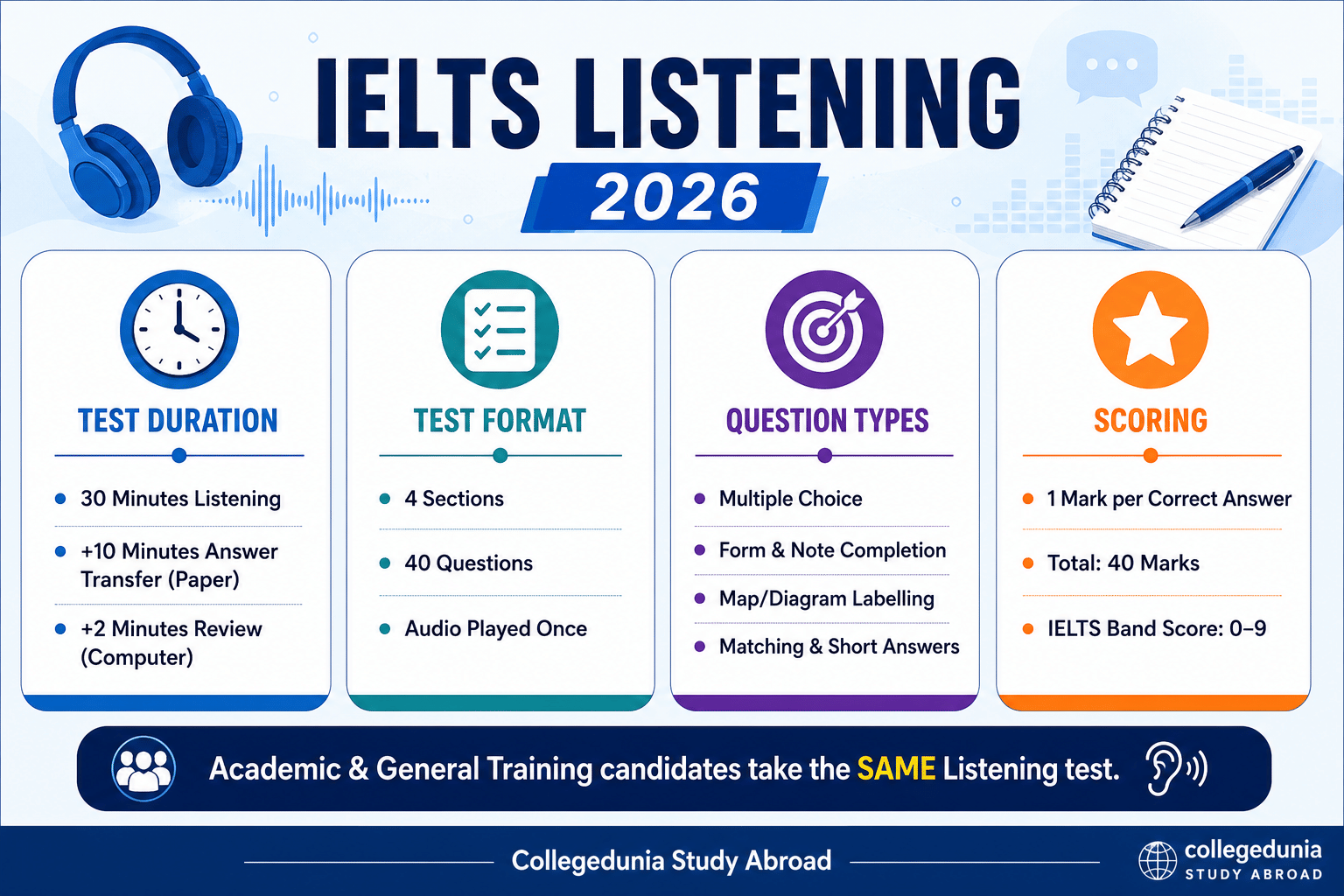
IELTS Listening Quick Facts 2026
| Parameter | Detail |
|---|---|
| Structure | 4 parts, 40 questions, 1 mark each, no negative marking |
| Duration | About 30 minutes, plus 10 minutes transfer on paper or 2 minutes review on computer |
| Audio | Played once only, mixed international accents |
| Same for both versions | Academic and General Training share the identical Listening test |
| Band anchor points | 30 correct = 7.0, 35 = 8.0, 39 = 9.0 |
| Test fee in India | INR 19,000 from April 1, 2026; One Skill Retake INR 12,650 |
| Mode in India | Computer-only after August 22, 2026 |
What is the IELTS Listening Test?
The Listening module measures how well you follow spoken English in everyday and academic settings, through 40 questions answered while the audio plays. It opens the test and sets its rhythm.
Your target band depends on where the score is going, from course pages at the institutions in this list of top universities abroad for Indian students to visa thresholds. The essentials:
- One test for everyone: Academic and General Training candidates sit the identical Listening module, unlike Reading and Writing.
- Skills measured: main ideas, specific facts, opinions, attitudes, purpose and the ability to follow how an argument develops.
- Accent range: British, Australian, New Zealand, American and Canadian voices appear, so single-accent preparation leaves gaps.
- The one-play rule: no recording repeats, which makes reading ahead and prediction part of the skill being tested.
What the module covers and what it does not:
- Covers: understanding spoken English and writing down exactly what you hear, spelled correctly.
- Does not: grammar theory, essay skills, or accent imitation, which belong to other modules.
IELTS Listening Format 2026
The four parts climb in difficulty: two everyday recordings first, two study-context recordings after, with 10 questions each and the whole module inside about 30 minutes. The climb is deliberate.
The structure:
| Part | What you hear | Typical setting |
|---|---|---|
| Part 1 | Conversation between two speakers | Everyday transaction: a booking, an enquiry, a registration form |
| Part 2 | Monologue | Everyday information: a talk about facilities, an event, directions |
| Part 3 | Conversation, up to four speakers | Education setting: students and a tutor discussing an assignment |
| Part 4 | Academic monologue | A university-style lecture, with no break in the middle |
Key Insight: Part 1 and Part 4 are mirror opposites in strategy. Part 1 gives easy content at conversational pace, where marks vanish through spelling and number slips, while Part 4 gives dense content in one unbroken stretch, where marks vanish through losing your place. Train Part 1 for accuracy and Part 4 for stamina, and your raw score climbs from both ends.
IELTS Listening Question Types
Applicants need to answer 6 types of questions in IELTS Listening in 4 parts of the test. The six types are:
- Multiple choice: pick one answer or several from a list, with distractors built from things the speakers mention and then reject.
- Matching: pair a list of items with options, common in Parts 2 and 3 for opinions and features.
- Plan, map and diagram labelling: follow spoken directions around a layout, where left, right and past are the marks.
- Form, note, table and flow-chart completion: fill gaps in structured notes, the backbone of Parts 1 and 4.
- Sentence completion: finish statements within the stated word limit.
- Short-answer questions: answer directly, again inside the word limit printed on the question.
IELTS Listening Tips and Tricks 2026
The Listening task becomes a bit difficult for Indian applicants due to the accent. To tackle this task, you may follow simple methods such as expecting the correction trap, etc. Here are more such methods which can help you in the Listening task:
- Use every silence: the recording gives time to look at questions, so read the next set during instructions and predict whether each gap wants a name, a number, a date, or a noun.
- Expect the correction trap: speakers change their minds, so the first plausible answer you hear is often cancelled two lines later. The final version is the mark.
- Keep moving after a miss: one lost answer costs one mark, but chasing it while the audio continues costs three more. Leave it, move, return at review time.
- Write what you hear, check what it means: answers come from the recording's own words, so resist paraphrasing into your own.
- Mind plurals and units: book and books are different answers, and 15 pounds is not 50 pounds, a pairing the accents deliberately test.
- Never leave a blank: with no negative marking, a guess in every unanswered slot is free probability.
Key Insight: Distractor-proofing is one habit: keep listening for two beats after you think you have the answer. The test's favourite trick is agreement followed by reversal, as in a speaker accepting Tuesday and then moving the meeting to Thursday, while the candidates who lose those marks are the ones who stopped listening at Tuesday.
IELTS Listening Band Score Calculation
Scoring in the Listening task becomes easy as each of the 40 questions carries one mark, nothing is deducted for errors, and your raw total converts to a band on a published scale. The anchor points matter more than the formula.
The conversion of the raw score to the IELTS score band is given in the table below:
| Raw score out of 40 | Listening band |
|---|---|
| 39 to 40 | 9.0 |
| 37 to 38 | 8.5 |
| 35 to 36 | 8.0 |
| 32 to 34 | 7.5 |
| 30 to 31 | 7.0 |
| 26 to 29 | 6.5 |
| 23 to 25 | 6.0 |
| 18 to 22 | 5.5 |
| 16 to 17 | 5.0 |
What the band table covers and what it does not:
- Covers: the standard conversion pattern, which shifts marginally between test versions to keep difficulty fair.
- Does not: your overall IELTS band, which averages Listening with the three other modules and rounds to the nearest half.
If your target is Band 7.0 in Listening, then the real goal is 30 correct answers. That means you can lose 10 marks, a budget worth spending consciously on the hardest matching set rather than on Part 1 spelling.
IELTS Listening Answer Sheet
The answering pattern for the Listening task is different for IELTS on paper and computer. For paper-based answers, move to a separate sheet in 10 dedicated minutes after the audio. In computer-based, answers go straight on screen with 2 minutes to review. The rules for both modes are as follows:
- Paper mode: write on the question booklet while listening, then transfer everything to the answer sheet in the 10-minute window, in pencil, with spelling and legibility counting in full.
- Computer mode: type answers as you listen, with no transfer stage and a 2-minute check at the end, which removes transfer errors and shortens the sitting.
- Rules in both modes: correct spelling required, both British and American spellings accepted, answers must respect word limits and capital letters are safe throughout.
- Results speed: computer results typically arrive in 1 to 5 days against about 13 for paper.
Common Mistakes in IELTS Listening
Indian candidates often lose marks due to simple mistakes such as not minding the format, or thinking about any other question while answering the other. Here are some common mistakes:
- Spelling casualties: a correctly heard accommodation misspelled scores zero, so the 40 highest-frequency Listening words deserve dictation practice.
- Word-limit breaches: three words where two were allowed, the most avoidable zero on the test.
- Frozen on a miss: losing three live questions while replaying one dead one in your head.
- First-answer traps: writing the option the speaker mentioned before correcting to another.
- Singular and plural slips: course against courses, judged exactly.
- Transfer misalignment on paper: one skipped line on the answer sheet shifting ten answers into the wrong boxes, a mistake the computer mode retires.
- Format mismatches: writing a word where the gap and the recording gave a number, or spelling out figures a form wanted as digits.
Also Check: Check September intake in the USA, UK, Canada and Germany in 2026
IELTS Listening rewards a candidate who treats it as a procedure: know the four parts and their difficulty climb, know which of the six question families is coming, predict each gap's answer type, survive the correction trap and protect the easy marks with clean spelling inside the word limit. Score against the band table consciously, spend your error budget where the test is hardest and, if you sit in India, prepare for the screen, because after August 22, 2026 the screen is the test. Thirty correct answers is Band 7.0, and every one of them is trainable.
FAQs
Ques. What is the IELTS Listening test?
Ans. The module measuring spoken English understanding through 4 recordings and 40 questions in about 30 minutes, identical for Academic and General Training candidates, with every recording played once across a mix of international accents.
Ques. How many parts does IELTS Listening have?
Ans. Four parts of 10 questions each: an everyday conversation, an everyday monologue, a study-context conversation with up to four speakers and an academic lecture delivered without a break.
Ques. Is the audio played twice?
Ans. No, once only. The one-play rule is why reading ahead, predicting answer types and continuing after a missed question are scored skills in practice, even though no mark is labelled for them.
Ques. How is the IELTS Listening band score calculated?
Ans. One mark per correct answer, no negative marking, converted on a published scale: 30 to 31 correct is Band 7.0, 35 to 36 is 8.0 and 39 to 40 is 9.0, with minor shifts between versions to balance difficulty.
Ques. What question types appear in IELTS Listening?
Ans. Six families: multiple choice, matching, plan or map or diagram labelling, completion tasks across forms, notes, tables and flow-charts, sentence completion and short-answer questions, each governed by its printed word limit.
Ques. Do spelling and word limits really matter?
Ans. Completely. A misspelled answer scores zero, an answer beyond the stated limit scores zero regardless of content, hyphenated words count as one word and both British and American spellings are accepted.
Ques. How does the answer sheet work?
Ans. On paper, you note answers in the booklet and transfer them in a 10-minute window in pencil. On computer, answers are typed directly with a 2-minute review and no transfer stage, which removes misalignment errors entirely.
Ques. What changes for Indian test takers in 2026?
Ans. IELTS on Paper ends in India after August 22, 2026, making the test computer-only from September, and the fee stands at INR 19,000 from April 1, 2026. Candidates should train on typed answers and the on-screen review.
Ques. Can I retake only the Listening module?
Ans. Yes, through the One Skill Retake at INR 12,650, available to computer-delivered candidates, booked within 60 days of the original test, once per full test, with a fresh Test Report Form carrying the updated score.
Ques. How can I improve my IELTS Listening score fast?
Ans. Fix handling before English: predict each gap's answer type, keep listening through corrections, never freeze on a miss, drill high-frequency spellings and respect word limits. Each fix is worth 1 to 3 raw marks, and 3 raw marks is a half-band.



Comments