



| Updated On - Aug 1, 2026
IELTS Listening topics usually revolve around everyday conversations, education, travel, accommodation, jobs, health, environment, and university life. While the exact questions change in every test, the topic categories remain similar. Understanding these recurring IELTS themes helps candidates predict vocabulary, identify keywords faster, and improve their listening band score.
- IELTS Listening Topics 2026 Overview
- Why Learning Topics Improves Your IELTS Band Score
- 10 Most Common IELTS Listening Topics 2026
- IELTS Listening Section-wise Topics (Part 1-4)
- IELTS Listening Topic-wise Vocabulary 2026
5.1 Accommodation
5.2 Education
5.3 Travel
5.4 Healthcare
5.5 Workplace
- IELTS Listening Topic-wise Sample Questions 2026
6.1 Accommodation
6.2 Travel
6.4 Museum Tour
- Recent IELTS Listening Themes 2026
- Most Frequently Repeated Topics
- Topic-Wise Preparation Strategy for IELTS Listening 2026
- Common Mistakes
- FAQs
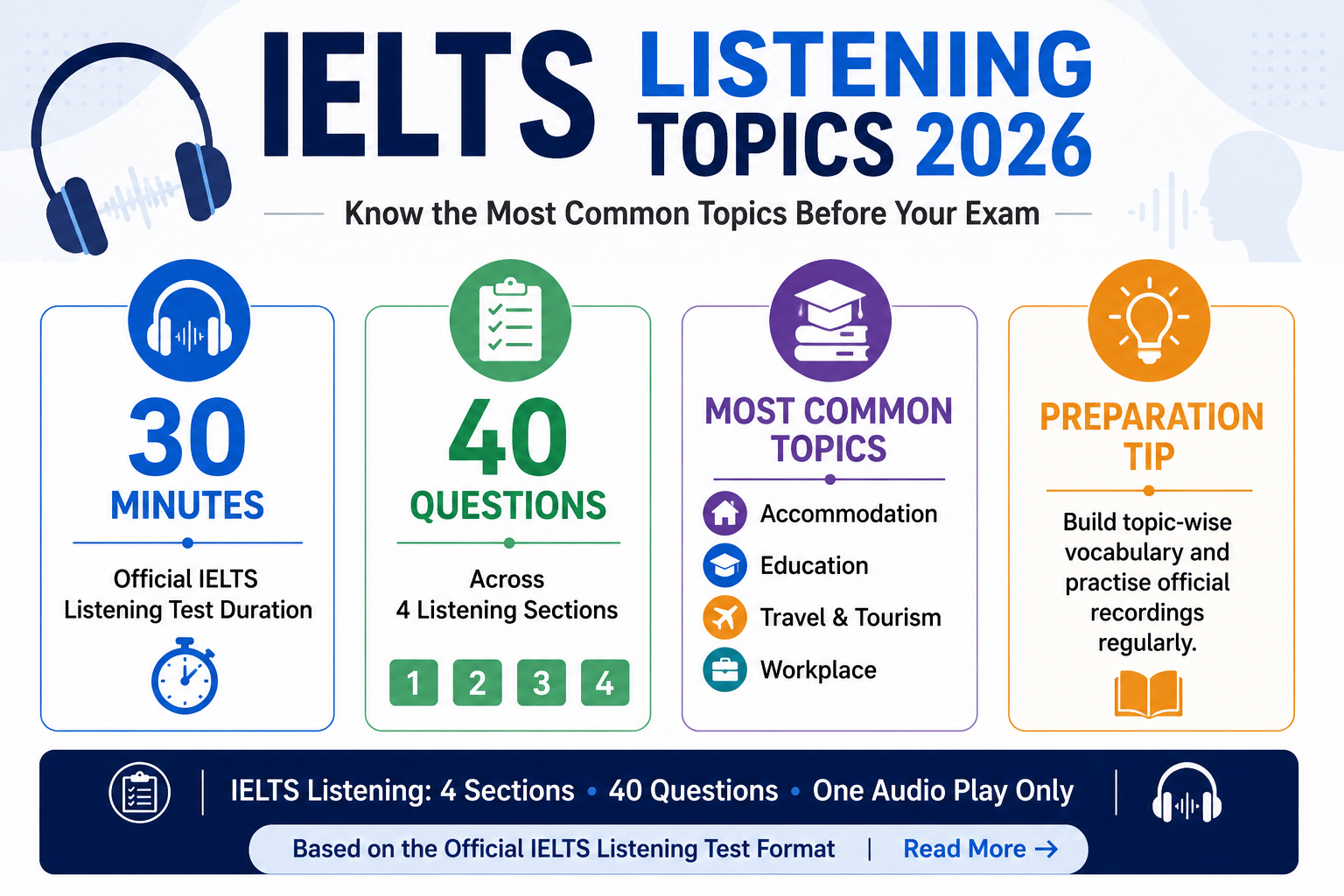
IELTS Listening Topics 2026 Overview
The IELTS Listening test assesses a candidate's ability to understand spoken English in both everyday and academic contexts. The test consists of 4 recorded sections, 40 questions, and lasts approximately 30 minutes, followed by 2 minutes to review answers in the computer-based test (or 10 minutes to transfer answers in the paper-based test).
Both IELTS Academic and IELTS General Training use the same Listening test format. The following are the details of the IELTS Listening test:
| Feature | Details |
|---|---|
| Duration | 30 minutes |
| Questions | 40 |
| Sections | 4 |
| Audio Played | Once only |
| Test Types | Academic & IELTS General Training (same Listening test) |
| Context | Everyday and Academic |
Why Learning Topics Improves Your IELTS Band Score
The IELTS Listening test assesses your ability to understand spoken English across a wide range of real-life situations rather than memorized content. Familiarity with common topics helps candidates predict context, recognize vocabulary faster, and accurately identify key details such as names, dates, prices, and locations.
- Improves vocabulary recognition: Most IELTS Listening recordings contain topic-specific vocabulary. Learning common words related to accommodation, travel, education, healthcare, and work helps candidates identify answers more quickly.
- Helps predict information: Knowing the topic enables candidates to anticipate the type of information that may follow, such as dates, names, prices, locations, measurements, or opinions.
- Reduces processing time: Instead of translating every word mentally, candidates recognize familiar phrases instantly and can focus on identifying correct answers.
- Improves spelling accuracy: Repeated exposure to topic-specific vocabulary reduces spelling mistakes, which are a common cause of losing Listening marks.
- Builds Confidence: Candidates who practise recordings across multiple themes become comfortable with different accents, speaking rates, and conversational styles.
Also read: IELTS Vocabulary and Grammar Tips 2026
10 Most Common IELTS Listening Topics 2026
IELTS does not publish a fixed syllabus of Listening topics. The recordings generally cover situations related to daily life, education, work, travel, public services, science, environment, and social issues. Becoming familiar with these recurring themes helps candidates recognize keywords quickly and understand context during the exam.
| Topic | Common Situations |
|---|---|
| Accommodation | Renting apartments, hostel enquiries, moving house |
| Education | University orientation, lectures, assignments |
| Travel & Tourism | Flight booking, hotels, guided tours |
| Transportation | Bus routes, train schedules, directions |
| Healthcare | Medical appointments, pharmacies, clinics |
| Workplace | Job interviews, office meetings, internships |
| Shopping | Product enquiries, refunds, customer service |
| Environment | Wildlife, climate change, conservation |
| Technology | Artificial intelligence, research, innovation |
| Public Services | Library membership, bank accounts, post office |
IELTS Listening Section-wise Topics (Part 1-4)
Each of the 4 IELTS Listening sections focuses on a different communication setting, ranging from everyday conversations to academic lectures. Knowing the type of topics generally covered in each section helps candidates anticipate vocabulary, follow the speaker's ideas, and answer questions more efficiently.
| Section | Context | Frequently Covered Topics |
|---|---|---|
| Part 1 | Conversation between two speakers | Accommodation, hotel booking, shopping, bank enquiry, transport, medical appointment |
| Part 2 | Monologue | Museum tour, city guide, campus orientation, park information, local facilities |
| Part 3 | Academic discussion | Group projects, research work, assignment discussions, university courses |
| Part 4 | Academic lecture | Environment, biology, history, psychology, architecture, business, technology |
IELTS Listening Topic-wise Vocabulary 2026
A strong vocabulary is essential for identifying keywords and understanding context in the IELTS Listening test. Learning topic-specific words related to accommodation, education, travel, healthcare, and workplaces can improve comprehension and reduce spelling errors during the exam.
Accommodation
| Word | Meaning |
|---|---|
| Tenant | Person renting property |
| Landlord | Property owner |
| Deposit | Advance payment |
| Lease | Rental agreement |
| Utilities | Electricity, water, gas |
| Furnished | House with furniture |
| Shared Accommodation | Room shared with others |
| Maintenance | Repairs |
Education
| Vocabulary | Meaning |
|---|---|
| Lecture | A formal class where a teacher presents information to students |
| Tutorial | A small-group teaching session for discussion and guidance |
| Semester | One of the two or three academic terms in a year |
| Assignment | A task or project given to students for assessment |
| Deadline | The final date by which work must be submitted |
| Scholarship | Financial support awarded to a student for education |
| Curriculum | The subjects and courses included in a study programme |
| Faculty | The teaching staff or an academic department of a university |
| Credits | Units used to measure completion of academic courses |
| Research Proposal | A document outlining the objectives and methodology of a research project |
Travel
| Vocabulary | Meaning |
|---|---|
| Boarding Pass | A document that allows a passenger to board a flight |
| Departure Gate | The designated area where passengers board an aircraft |
| Itinerary | A planned schedule of a journey or trip |
| Reservation | A booking for travel or accommodation |
| Luggage | Bags and suitcases carried while travelling |
| Customs | The authority that checks goods entering or leaving a country |
| Visa | An official document permitting entry into another country |
| Terminal | A building at an airport where passengers arrive and depart |
| Connecting Flight | A flight that requires passengers to change aircraft during the journey |
| Check-in | The process of confirming a booking before travelling |
Healthcare
| Vocabulary | Meaning |
|---|---|
| Appointment | A scheduled meeting with a doctor or healthcare professional |
| Prescription | A doctor's written instruction for medicines |
| Symptoms | Physical signs indicating an illness or medical condition |
| Clinic | A healthcare facility providing medical treatment |
| Diagnosis | Identification of a disease based on examination or tests |
| Vaccination | Administration of a vaccine to prevent disease |
| Treatment | Medical care given to cure or manage an illness |
| Emergency | A serious medical situation requiring immediate attention |
| Pharmacy | A place where medicines are dispensed |
| Consultation | A discussion between a patient and a healthcare professional |
Workplace
| Vocabulary | Meaning |
|---|---|
| Recruitment | The process of hiring new employees |
| Internship | Short-term practical work experience for students or graduates |
| Promotion | Advancement to a higher job position |
| Vacancy | An available job position |
| Supervisor | A person responsible for overseeing employees or work |
| Training | Instruction provided to improve job-related skills |
| Salary | Fixed regular payment made to an employee |
| Shift | A scheduled period during which an employee works |
| Meeting | A gathering of people to discuss work-related matters |
| Department | A division within an organisation responsible for specific functions |
IELTS Listening Topic-wise Sample Questions 2026
The IELTS Listening test includes question types such as form completion, multiple choice, note completion, map labelling, and matching across different real-life scenarios. Practising sample questions by topic helps candidates understand how information is presented and improves their ability to locate correct answers while listening.
Accommodation
Listening Scenario: A student is calling a landlord to enquire about renting a room.
Sample Questions
- What is the weekly rent for the room?
- Which utilities are included in the rent?
- On which date can the student move into the property?
- How much security deposit is required?
- Complete the form using ONE WORD AND/OR A NUMBER
Travel
Listening Scenario: A customer is booking a holiday package through a travel agency.
Sample Questions
- What is the destination of the tour?
- How many nights does the package include?
- Which airport does the flight depart from?
- What is the total cost of the package?
- Choose the correct departure date.
University Education
Listening Scenario: Two students are discussing a group research project with their professor.
Sample Questions
- What is the topic of the research project?
- Which student is responsible for data collection?
- When is the final report due?
- Complete the notes using NO MORE THAN TWO WORDS.
- Which resources does the professor recommend?
Museum Tour
Listening Scenario: A guide explains the layout and facilities of a museum.
Sample Questions
- Which gallery is located on the first floor?
- Where is the gift shop situated?
- Match the exhibition with its location.
- Label the museum map correctly.
- What time does the guided tour begin?
Environmental Science
Listening Scenario: A university lecturer explains the effects of climate change.
Sample Questions
- What is identified as the main cause of global warming?
- Which species is mentioned as being endangered?
- Complete the flow chart using ONE WORD ONLY.
- According to the speaker, what can reduce carbon emissions?
- Which research study is referred to in the lecture?
Recent IELTS Listening Themes 2026
IELTS does not officially publish the latest Listening topics or repeat exact recordings in future tests. However, recent official practice materials frequently feature contemporary themes such as sustainability, technology, higher education, public services, and scientific research, reflecting modern real-world contexts.
| Theme | Typical Context |
|---|---|
| Artificial Intelligence | University lectures |
| Climate Change | Environmental science |
| Renewable Energy | Academic presentations |
| Wildlife Conservation | Biology lectures |
| Sustainable Tourism | Travel discussions |
| Digital Libraries | University orientation |
| Mental Health | Student counselling |
| Urban Planning | City development lectures |
| Space Exploration | Science lectures |
| Recycling & Waste Management | Environmental awareness |
Most Frequently Repeated Topics
While IELTS changes its Listening recordings for every test, several broad topic categories recur consistently in official practice tests because they reflect common everyday and academic situations. Prioritising these high-frequency themes allows candidates to build relevant vocabulary and become familiar with the contexts most likely to appear in the exam.
| Topic | Typical Section(s) | Common Listening Context |
|---|---|---|
| Accommodation | Part 1 | Renting a room, hostel enquiries, moving house |
| Education | Parts 3 & 4 | University discussions, lectures, assignments |
| Travel & Tourism | Parts 1 & 2 | Flight bookings, hotels, guided tours |
| Transportation | Parts 1 & 2 | Bus routes, train schedules, directions |
| Shopping & Customer Service | Part 1 | Product enquiries, refunds, purchases |
| Public Services | Parts 1 & 2 | Libraries, banks, post offices, community centres |
| Workplace & Careers | Part 3 | Job interviews, internships, workplace training |
| Environment | Part 4 | Climate change, conservation, sustainability |
| Healthcare | Part 1 | Doctor appointments, clinics, pharmacies |
| Science & Technology | Part 4 | Artificial intelligence, engineering, innovation |
| History & Culture | Part 4 | Historical events, museums, archaeology |
| Agriculture & Wildlife | Part 4 | Farming, biodiversity, animal conservation |
Topic-Wise Preparation Strategy for IELTS Listening 2026
An effective IELTS Listening preparation strategy combines topic-wise vocabulary building, regular practice with recordings, and familiarity with different question types. Preparing one topic at a time enables candidates to recognise common expressions, improve prediction skills, and strengthen overall listening accuracy
| Topic | Best Preparation Method |
|---|---|
| Accommodation | Practise form completion exercises |
| Travel | Learn numbers, dates, prices, locations |
| Education | Listen to university lectures and discussions |
| Healthcare | Learn medical vocabulary |
| Environment | Build scientific vocabulary |
| Technology | Read technology-related articles and lectures |
| Workplace | Practise conversations with multiple speakers |
| Public Services | Focus on names, addresses, and spellings |
Topic-wise Preparation Tips
- Learn 20–30 vocabulary words for every major topic.
- Practise one listening recording daily from different themes.
- Focus on identifying keywords rather than individual words.
- Read questions before the recording starts to predict possible answers.
- Use official IELTS Listening practice materials to become familiar with authentic question types.
Common Mistakes
Many candidates lose Listening marks not because they fail to understand the recording, but due to avoidable mistakes such as incorrect spelling, ignoring word limits, or missing distractors. Recognising these common errors early can significantly improve answer accuracy and help maximise the score out of 40 Listening questions.
| Mistake | How to Avoid |
|---|---|
| Ignoring keywords | Underline important words before listening. |
| Poor spelling | Practise commonly used IELTS vocabulary. |
| Missing plural forms | Listen carefully for -s and -es endings. |
| Writing extra words | Follow instructions such as "ONE WORD ONLY". |
| Losing concentration | Move to the next question instead of dwelling on a missed answer. |
| Ignoring distractors | Speakers often correct or change information; wait for the final answer. |
| Not checking grammar | Ensure answers fit grammatically into the sentence. |
| Limited topic vocabulary | Study vocabulary by recurring themes like accommodation, education, travel, and healthcare. |
Also read: IELTS Listening Tips 2026
The IELTS Listening test includes 4 sections, 40 questions, and a wide range of everyday and academic topics, making topic-wise preparation essential for success. Building vocabulary, practising common Listening themes, and understanding different question types can significantly improve accuracy and confidence. Regular practice with official IELTS materials and familiarity with recurring topic categories will help candidates maximise their Listening band score.
FAQs
Ques. What topics are covered in the IELTS Listening test?
Ans. The IELTS Listening test does not have a fixed syllabus of topics. However, the recordings generally cover everyday social situations and academic contexts such as accommodation, travel, education, public services, work, healthcare, science, and the environment. These themes help assess a candidate's ability to understand spoken English in real-life situations.
Ques. Does IELTS repeat Listening topics or questions?
Ans. No. IELTS does not officially repeat the same Listening recordings or publish a list of repeated topics. Each test uses new recordings, although similar real-life themes such as accommodation, education, travel, and workplace situations may appear across different tests.
Ques. Can I listen to the IELTS Listening recording more than once?
Ans. No. Each recording in the IELTS Listening test is played only once. Therefore, candidates should read the questions carefully before the recording starts and stay focused throughout the test.
Ques. What types of accents are used in the IELTS Listening test?
Ans. IELTS Listening recordings may include a variety of native English accents, including British, Australian, American, Canadian, and New Zealand. This reflects real-world English communication and prepares candidates for international environments.
Ques. Is spelling important in the IELTS Listening test?
Ans. Yes. Correct spelling is essential because incorrectly spelled answers are marked as incorrect. Candidates should also follow the word limit given in each question, such as "ONE WORD ONLY" or "NO MORE THAN TWO WORDS AND/OR A NUMBER."
Ques. How is the IELTS Listening test scored?
Ans. Each correct answer receives one mark, giving a maximum raw score of 40. The raw score is then converted to the official IELTS band scale from Band 0 to Band 9.
Ques. Do I get extra time to check my answers in the IELTS Listening test?
Ans. For the computer-delivered IELTS, candidates receive 2 minutes at the end of the Listening test to review their answers. In the paper-based IELTS, candidates are given 10 minutes to transfer their answers from the question booklet to the answer sheet.



Comments