



Study Abroad Expert | Updated On - Aug 1, 2026
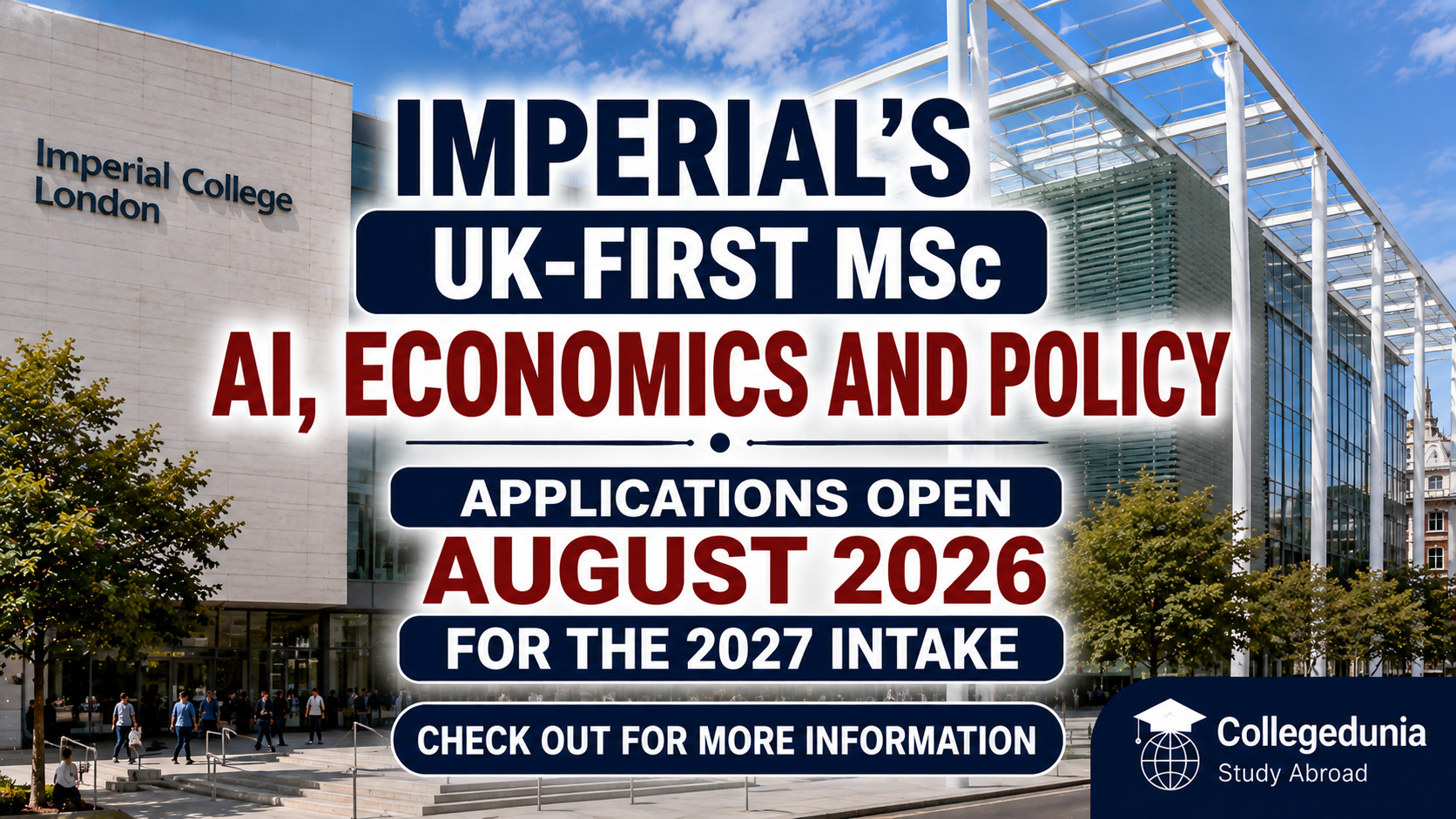
Imperial College London on July 28, 2026 launched the UK’s first master’s degree focused on AI’s economic and policy impact. The MSc AI, Economics and Policy targets Indian graduates aiming for AI governance and regulation careers. Applications open in August 2026, with the first cohort starting September 2027. The programme replaces a fragmented mix of separate AI, economics and public policy master’s routes.
- Imperial Business School and the Department of Computing will jointly deliver the degree, according to the July 28, 2026 Imperial announcement.
- The curriculum blends AI systems training with competition economics, digital markets and legal frameworks for AI governance.
- Professor Tommaso Valletti, Academic Director, said AI "shapes markets, challenges existing regulation, and raises fundamental policy questions".
The launch sits alongside Imperial’s push to link its Business School and Computing department more tightly. It positions the university as the first UK institution to treat AI regulation, competition policy and technical AI training as one degree, not three.
Must Check, Imperial College London Launches 300 Scholarships Worth £15,000 Pounds a Year for 2027 Entry
Also Check,
- Imperial College London: Courses, Intakes, Scholarships & Rankings
- Imperial College London Scholarships 2026-27
- UK Fully Funded Scholarships for Indian Students 2026
- GREAT Scholarship for Indian Students 2027: Full Guide
What the New Imperial MSc AI Economics and Policy Covers
The programme builds three linked skill layers into one year. Students first learn how AI systems and data-driven technologies actually work. They then study the economics of AI, competition and digital markets. The final layer covers the legal and regulatory approaches to AI governance.
Each student will also complete an individual research project or an internship. Imperial has not yet published the module list, credit split or assessment weightings. Those details are expected when applications open in August 2026.
Key Insight: This is not another technical AI master’s. It is a policy and economics degree with a compulsory AI-systems spine, aimed at students who want to sit inside regulators and competition authorities, not inside model-training teams.
When Do Applications Open for Indian Students?
Imperial has confirmed two firm dates so far. Everything else, including the specific application deadline, has still to be released.
| Milestone | Date | Source |
|---|---|---|
| Programme announcement | July 28, 2026 | Imperial College London news release |
| Applications open | August 2026 | Imperial College London news release |
| Deposit and offer stages | To be confirmed | Awaiting course page |
| First cohort starts | September 2027 | Imperial College London news release |
Imperial Business School typically works in rolling rounds for its MSc courses. Indian applicants should treat the August 2026 window as the earliest round, not the only one. Round-one applicants historically get first pick of scholarships and offers.
Who Should Apply and What Careers It Unlocks
Imperial describes the target cohort as recent graduates and early-career professionals. That reads narrower than a standard MSc: the programme wants applicants who can sit in a policy room and a coding room. Strong quantitative backgrounds in economics, computer science, engineering, mathematics, law or public policy should map well.
The listed career destinations, taken from the Imperial announcement, are:
- AI governance analyst, regulation specialist and responsible AI specialist roles.
- Technology policy, digital regulation and legal-technology teams inside law firms.
- Competition economics and AI strategy roles at consulting firms.
- Risk consulting, plus positions inside governments, regulators and international organisations.
What it means for Indian Students: India is drafting its own AI regulation and Digital India Act. A one-year UK master’s in AI policy plus the two-year Graduate Route work visa gives Indian applicants two live paths: a London-based AI regulation role, or a policy-shop return to Delhi or Bengaluru with a rare credential.
Also Check,
- How to Apply to UK Universities?
- UK Higher Education System: A Complete Guide for 2026
- UK Student Visa Application Guide
- Is Imperial College London Expensive for Indian Students?
How It Compares to Imperial’s Existing AI Master’s Routes
Imperial already runs several AI-adjacent master’s. The new degree fills the gap between the technical AI courses and the pure business analytics track.
| Programme | Primary focus | Best for |
|---|---|---|
| MSc Artificial Intelligence | Deep technical AI, model building | STEM graduates targeting engineering roles |
| MSc Computing | Advanced computing foundations | CS graduates broadening technical depth |
| MSc Business Analytics | Applied analytics for business | Non-technical grads entering data roles |
| MSc AI, Economics and Policy (NEW) | AI governance, regulation, competition economics | Grads targeting regulators, policy, legal tech |
The choice is not about prestige. It is about which door the degree opens. Applicants who want to build models should stick with the technical tracks. Applicants who want to write the rules for those models are the audience for this new programme.
Fees, Funding and Cost of Living
Imperial has not yet published tuition for the new MSc. As a benchmark, existing one-year MSc programmes at Imperial Business School charge overseas students in the £40,000 to £62,000 range for 2026 entry. At today’s rate of roughly ₹130 per GBP (August 2026), that translates to about ₹52 lakh to ₹80 lakh in tuition alone.
Living costs in London add a further requirement. The UK Home Office currently expects £1,483 per month for Student visa applicants living in London, for up to nine months. That is roughly ₹1.93 lakh per month, or about ₹17.35 lakh that must be shown in a bank account before the visa is granted.
Important Distinction: The final fee for this programme has not been confirmed. Treat the £40,000 to £62,000 range as a planning band, not the quoted fee. The actual number will appear on the Imperial course page when applications open in August 2026.
Must check,
How Do Indian Applicants Prepare Before August 2026?
- Bookmark the Imperial Business School and Department of Computing course pages for the fee and deadline release.
- Register for the MSc AI, Economics & Policy information session listed on the Imperial Business School events page.
- Line up IELTS or TOEFL scores at Imperial’s standard postgraduate band. The scorecard must be valid at the intake date.
- Prepare two academic references and a statement of purpose linking economics, policy and AI systems interest.
- Begin the funding conversation with a lender now. Loan sanction letters strengthen a visa file.
Indian applicants should treat the August 2026 opening as their earliest, not latest, action point. Round-one candidates get access to the widest scholarship shortlist and to earlier CAS letters, which in turn eases the September 2027 visa timeline. The next round in this cycle will only follow once Imperial publishes its full application calendar.
Keep an Eye On: The Imperial Business School course page in August 2026, when the full fee, deadline calendar and module list for the September 2027 intake are due to go live.


1720766750.png?tr=w-305,h-145,c-force?h=175&w=350&mode=stretch)



Comments